20 Japandi Kitchen Ideas That Are Quietly Stunning
Most kitchens demand attention. The best Japandi kitchens command it, in total silence.
There’s a reason Japandi kitchen ideas dominate the interior design conversation right now. They’ve cracked the code that eluded the all-white kitchen for decades: how to be both minimal and warm, both visually arresting and calming to actually cook in. The Japandi aesthetic borrows the restrained precision of Japanese design and the organic warmth of Scandinavian interiors, and the result in a kitchen context is something that feels almost impossibly composed. Here are 20 ideas that show you exactly how it’s done. A Japandi kitchen is one of the quietest home decorating ideas you can pursue, and one of the most stunning, because restraint applied with complete confidence produces interiors that are more visually arresting than any amount of decoration.
This post contains affiliate links. As an Amazon Associate, I earn from qualifying purchases. If you buy through these links, I may earn a small commission at no extra cost to you.
What Makes Japandi Kitchen Ideas Actually Work
The Japandi kitchen operates on a principle of “only what earns its place.” Every cabinet, fixture, material, and object is chosen with deliberate restraint, not because less is more as a blanket rule, but because the space between objects is itself a design element. When you look at a great Japandi kitchen, your eye doesn’t know where to land because nothing is competing for attention. That stillness is the design. The Japandi kitchen belongs to a wider philosophy of intentional simplicity. These minimalist interior design ideas show how the same principles of restraint, natural materials, and functional beauty that define a Japandi kitchen apply to every room in the home.
This post contains affiliate links. As an Amazon Associate, I earn from qualifying purchases. If you buy through these links, I may earn a small commission at no extra cost to you.
The Hidden Value
Kitchen design has spent the last decade oscillating between maximalist farmhouse and sterile all-white modern, and neither extreme is particularly liveable. Japandi kitchen ideas offer a third path: deeply liveable spaces that also happen to be achingly beautiful. Research on biophilic design shows that incorporating natural materials and uncluttered surfaces into kitchens reduces stress during food preparation and increases time spent cooking at home. Japandi isn’t just aesthetically right; it’s practically right. The Japandi kitchen palette, warm off-white, pale ash, and matte stone, sits at the most refined end of the warm neutral kitchen spectrum. These warm neutral kitchen palette ideas show how the same tones work across a range of kitchen styles from Japandi to farmhouse to classic shaker.
1. Go Handleless on Every Cabinet
Nothing signals Japandi kitchen ideas faster than handleless flat-front cabinetry. The unbroken surface plane creates visual silence that simply can’t be achieved with hardware. Use push-to-open mechanisms or subtle recessed channels. Paint the cabinets in warm white, greige, or sage for the full effect. Matte black cabinet pulls and minimalist bar handles, if you prefer hardware, search “minimalist cabinet hardware matte black” on Amazon or Rejuvenation
2. Mix Warm Wood With Cool Matte Surfaces
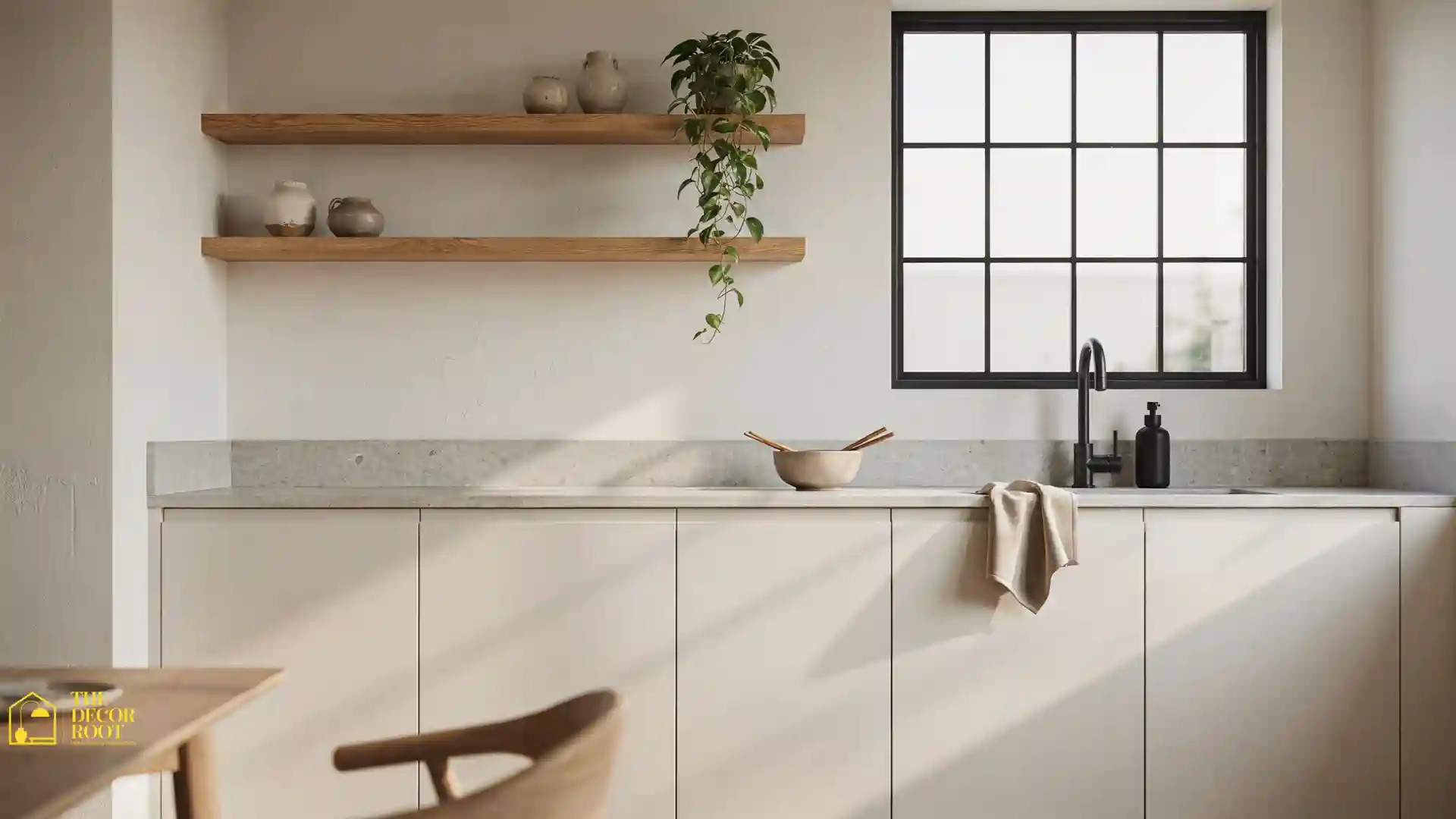
The essential Japandi tension is between warm and cool. Natural oak or walnut open shelving against matte white or concrete-toned lower cabinets creates that push-pull that makes Japandi kitchens visually interesting without introducing any busyness. The wood reads warm; the cabinets read cool; the combination reads perfect.
3. Choose Matte Black Fixtures, Always
Polished chrome and stainless steel belong in a different design language. In a Japandi kitchen, every fixture, faucet, soap dispenser, and pendant light housing is matte black. The flatness of the finish integrates rather than reflects, keeping the visual calm intact.
4. Add One Section of Open Japandi Kitchen Shelving
A single run of open oak or walnut shelves above the counter, holding only a few ceramic vessels, a plant, and the dishes you actually use daily, creates a display space that’s also a philosophy statement. The key is brutal editing: if it doesn’t belong, it doesn’t stay. Six objects maximum per shelf.
5. Use a Stone or Concrete Countertop
Honed white marble, brushed concrete, or warm quartzite in stone-grey tones gives Japandi kitchens their grounded, material quality. Avoid polished surfaces; the matte finish is essential. These materials age beautifully, which aligns perfectly with the Japanese concept of wabi-sabi, finding beauty in imperfection and age.
6. Keep the Color Palette to Four Tones Maximum
The Japandi kitchen palette is not negotiable: warm white or cream, natural wood tone, matte black or charcoal, and one organic accent (sage, clay, or dusty olive). That’s it. Four tones. Every material and finish in the kitchen maps back to one of these four. This constraint is what gives the space its extraordinary sense of calm. Japanese ceramic bowls, concrete-style serving trays, and wooden cutting board sets. Search “Japanese ceramic dinnerware set” or “walnut cutting board” on Amazon
7. Install a Window Above the Sink (Or Maximize the Existing One)
The Japandi kitchen treats natural light as a material. A window above the sink kept bare or dressed only with a minimal flat Roman shade in natural linen floods the countertop with the kind of morning light that makes even a simple cup of coffee feel ceremonial. If you’re renovating, this is the single highest-value addition.
8. Choose a Farmhouse or Apron-Front Sink in a Muted Tone
A farmhouse sink in matte white, concrete grey, or a warm neutral ceramic anchors the Japandi kitchen with both function and form. The deep basin and clean lines read as Scandinavian; the material texture reads as Japanese. Combined with a matte black faucet, it’s the most compositionally beautiful element in the room.
9. Use Japandi Kitchen Lighting That Disappears
Lighting in a Japandi kitchen should illuminate, not decorate. A slim matte black pendant or two over an island (or a linear suspension over a dining table adjacent to the kitchen) with a clean geometric shade is sufficient. Avoid anything fussy, ornate, or obviously trendy. Japandi lighting looks timeless because it’s unassuming.
10. Add a Single Trailing Plant
One plant. One. In a Japandi kitchen, a single lush trailing pothos on the open shelf, or a small bonsai on the windowsill, carries more visual weight than a dozen plants would in a more maximalist aesthetic. The restraint amplifies the impact. Choose a specimen with an interesting leaf shape, such as a monstera or a sculptural succulent, which works especially well.
11. Integrate Appliances Behind Cabinet Panels
The refrigerator, dishwasher, and even the microwave ideally hide behind the same cabinet doors as everything else. Panel-ready appliances aren’t always accessible at every budget, but even partial integration, pulling the refrigerator into a built-in surround, dramatically increases the sense of unified calm that defines Japandi kitchen ideas.
12. Leave Counter Space Deliberately Empty
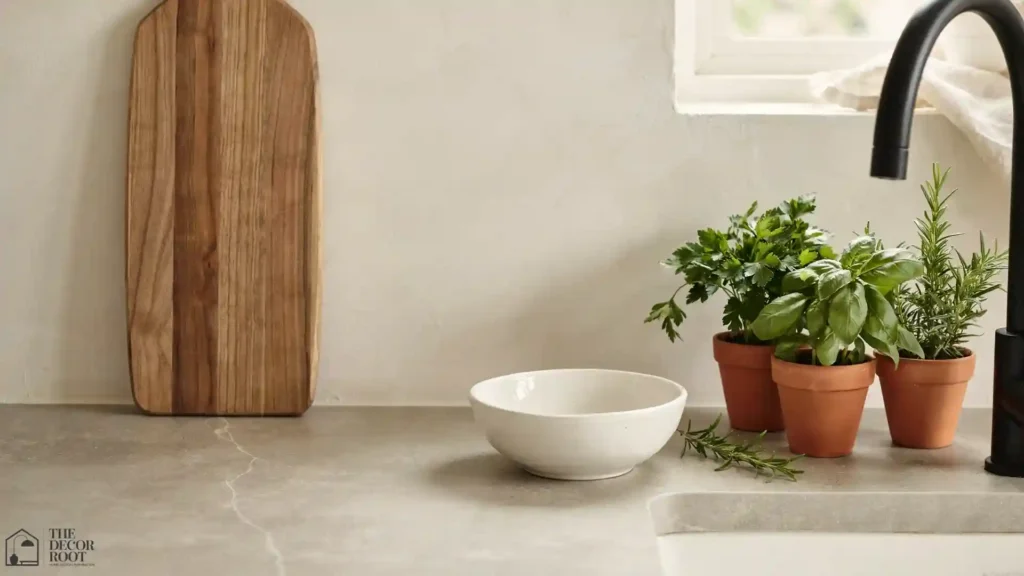
This one requires nerve, but it’s the most important Japandi principle of all. Leave at least 40% of your counter surface empty. Not because you’ll keep it tidy (nobody does), but because the negative space is where the eye rests. The less on the counter, the more intentional everything on it becomes.
13. Use Japandi Kitchen Open Shelves for Your Best Ceramics
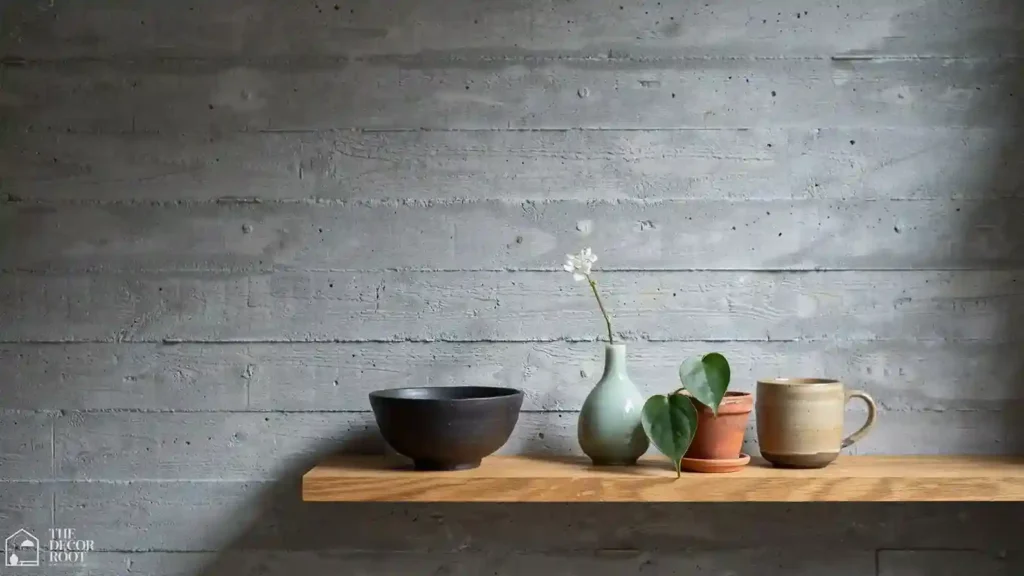
The objects you display on open shelves in a Japandi kitchen should be beautiful enough to be art: a matte black cast iron pot, a pale celadon ceramic bowl, a hand-thrown mug from a local potter. These daily-use objects are the decor. This is what the Japanese concept of mingei folk craft as art looks like in a modern kitchen.
14. Introduce Texture Through Natural Fiber Details
A woven linen tea towel draped over the oven handle. A small jute placement under the ceramics on the open shelf. Texture in a Japandi kitchen comes in whispers, not shouts, but its absence would be felt immediately. These natural fiber details add warmth and tactility that prevent the minimal palette from feeling clinical.
15. Go for Flat Flush Cabinet Doors With Grain
If you’re choosing wood-front cabinets rather than painted, opt for a species with visible, beautiful grain, such as quarter-sawn oak, white ash, or pale walnut, and leave the surface with a natural matte oil finish rather than lacquer. The grain is the decoration. This is the Japandi sweet spot: natural beauty without embellishment.
16. Use Under-Cabinet Lighting as the Primary Kitchen Light
Overhead lighting in a Japandi kitchen should be minimal to none. Under-cabinet LED strips in a warm 2700K tone turned low cast light directly onto the work surface while leaving the rest of the kitchen in atmospheric shadow. The effect is meditative rather than utilitarian.
17. Add a Japandi Kitchen Island in Contrasting Wood
If the perimeter cabinets are painted white or greige, an island in warm walnut or oak creates a natural focal point without needing a single decorative accessory. The material contrast does all the work. Keep the island surface bare except for a wooden bowl of fruit or a single bud vase.
18. Display Just Three Herbs in Terra Cotta Pots
Three small terracotta pots in a tight cluster on the windowsill basil, rosemary, thyme give a Japandi kitchen something alive, useful, and quietly beautiful all at once. The unglazed terracotta reads as wabi-sabi without trying. This is the cheapest, most effective detail in the entire list.
19. Choose a Backsplash That Recedes
Subway tile, zellige, and decorative backsplash patterns are not for this kitchen. A Japandi kitchen backsplash should blend seamlessly with the wall or counter: a large-format slab in the same material as the countertop, or a painted plaster finish in the wall color. Invisible is the goal.
20. Finish With a Minimalist Dish-Drying Rack in Wood or Black Steel
The dish rack is one of the most visible everyday objects in any kitchen. In a Japandi kitchen, it earns its counter space: a slatted wooden dish rack or a matte steel wall-mounted version transforms a functional object into a compositional element. These are available from Japanese housewares brands and are worth every penny. Minimalist pendant kitchen lighting and Japanese ceramic dish sets search “japandi pendant light kitchen” or “Japanese ceramic dinnerware matte” on Amazon or CB2
Fast-Track Guide
This Weekend:
- Saturday morning: Clear your counters completely, put everything in a box, and only return items you actively use daily
- Saturday afternoon: Swap any colorful or shiny accessories for one or two neutral ceramics; add a small plant to the windowsill
- Sunday: Replace any visible hardware with matte black bar pulls if budget allows; change lightbulbs to 2700K warm white
- Next month: Research handleless flat-front cabinet doors for one section of the kitchen if renovation is on the horizon
Frequently Asked Questions
Conclusion
Japandi kitchen ideas aren’t about stripping your kitchen of personality; they’re about distilling it. These 20 ideas give you the framework to create a kitchen that’s functional, beautiful, and genuinely calming to spend time in. Start with restraint. Choose materials with integrity. Leave space, and watch how everything gets better.
This post contains affiliate links. If you purchase through them, I may earn a small commission at no extra cost to you.
📌 Save these Japandi kitchen ideas to Pinterest so your dream kitchen is always one tap away!