Boutique Style Bedroom Aesthetic Ideas: Hotel Calm, Made to Live In
boutique style bedroom aesthetic ideas fail one way: they are styled for a photo, not for arrival. A room can look good at noon and feel ordinary at night, because the bed is flat, the light is harsh, and nothing greets the senses when the door opens. The photo promises calm, but the lived room delivers none of it, and more shopping rarely fixes that gap.
The promise here is simpler. Five layers resolved in order give hotel calm without a renovation: bedding, light, scent, texture, and edited surfaces. The audit finds which layer is actually broken, so you fix that layer first instead of buying decor at random. When each layer does one clear job, the room stops looking assembled and starts feeling considered.
The order of work matters more than the budget. Audit first, bed second, light third, scent and texture fourth, and surfaces last. Buy only for the layer the audit names, and stop when the room passes the arrival test. If a purchase does not fit the step you are on, it waits, no matter how good it looks in a photo.
Methodology
This article is research based curation, not hands on testing. Picks are researched from listing and source pages and checked at the publish date. No star rating is claimed for any pick. Before ordering, check size, color, and contents on the listing, because listings and variants change. Where a detail cannot be verified, it is left out rather than guessed.
Affiliate Disclosure: This article contains affiliate links to products on Amazon. As an Amazon Associate I earn from qualifying purchases. The price you pay stays the same, and the commission helps keep The Decor Root running.
The Boutique Bedroom Audit for Boutique Style Bedroom Aesthetic Ideas
Start with a mood line, written down in one sentence. It might name restful warmth, quiet luxury, or soft morning light, but it must be one line only. Test every later purchase against that line. A purchase that serves no mood line waits, even if it is beautiful on its own.
Next, judge the bed from the doorway. Stand in the doorway in evening light and name the first three things the eye lands on. If none is the bed, the room has a focal problem, not a shopping problem.
Then count the light layers. A boutique room has three: a soft overall glow, one directed light per sleeper, and one low glow after dark. One overhead fixture counts as one layer, and it is the wrong layer for evening.
Then count the textures. Run a hand across the bed, the throw, the rug, and the curtains. If every surface feels smooth and similar, the room will read flat.
Then count the visible objects per surface. Look at the nightstand, the dresser, and any chair or bench. If the count keeps growing, the problem is storage, not styling.
Then run the scent check. Walk in from another room and notice what you smell in the first few seconds. No scent means no arrival signal. Three competing scents mean confusion.
Finish with the arrival test. Walk in as a guest would, and note what the hand touches first, whether bedding, switch, or scent. Fix the first touch before the decor. This 60 second arrival test is the standard for the whole article.
Two rules preview the work ahead. The nightstand rule is three things only: lamp, one small dish, one charming item. The dresser rule is three to five pieces, arranged with intent, with negative space protected.
Write the audit results down before shopping. Note the mood line, the first three doorway sights, the light count, the texture count, the surface counts, the scent result, and the first touch. A written audit stops impulse buys, because a later purchase must answer a line on that page. Keep the page on the phone while shopping, and check each candidate against it before checkout. Hold those numbers in mind, because they return in Problem 3.
Quick Decision Table
Use the table to find your starting point, then follow the first move only.
| Starting point | First move | Skip for now |
|---|---|---|
| Bare room with no focal point | anchor the bed first, then the headboard or art | skip scent and small objects |
| Room full of matching sets that feels like a showroom | break the set with one texture hero and one warm light layer | skip more matching sets |
| Small bedroom | low profile bed, one hero, vertical storage, no extra furniture | skip the accent chair until the room grows |
| Rental with no paint and no drilling | carry the palette in bedding, curtains, throws, and one large artwork | skip wall treatments and drilled hardware |
| Dark room | warm light first, then warm textiles | skip more dark accents until the light layer is fixed |
| Shared bedroom with two sleepers and two styles | agree one mood line and one palette together | skip two competing styles in one room |
Problem 1: The Bed Looks Flat, Not Plush
A flat bed usually has one smooth surface, no layer edges, pillows all one height, and no texture hero. Plush is not about thickness alone. It is about edges, heights, and one material that breaks the smoothness.
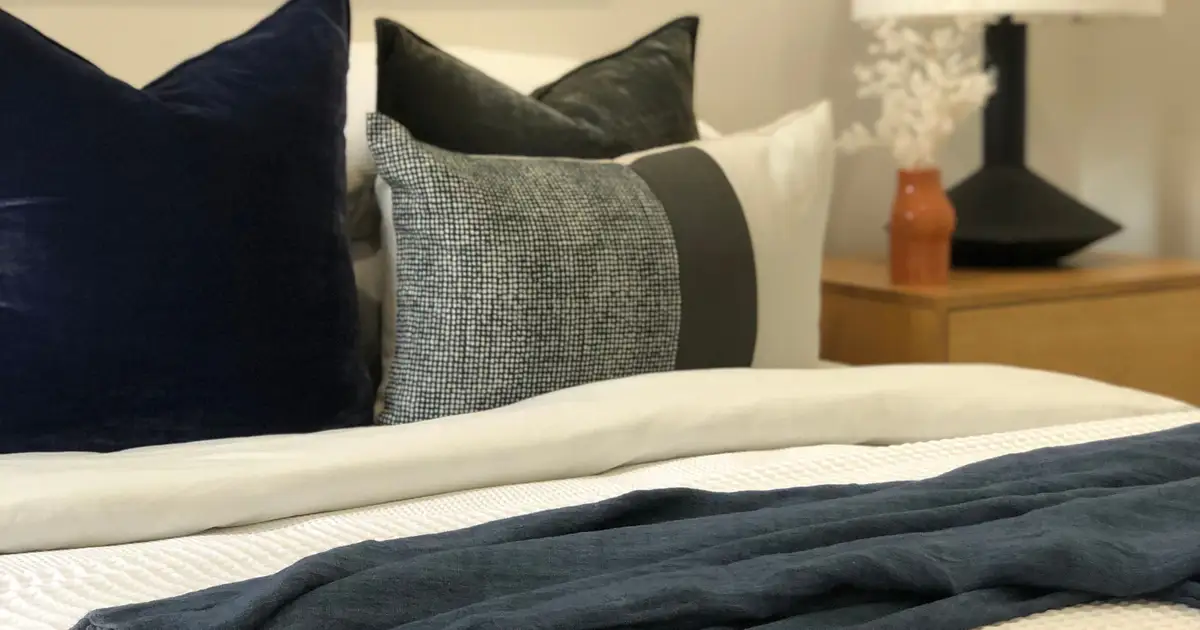
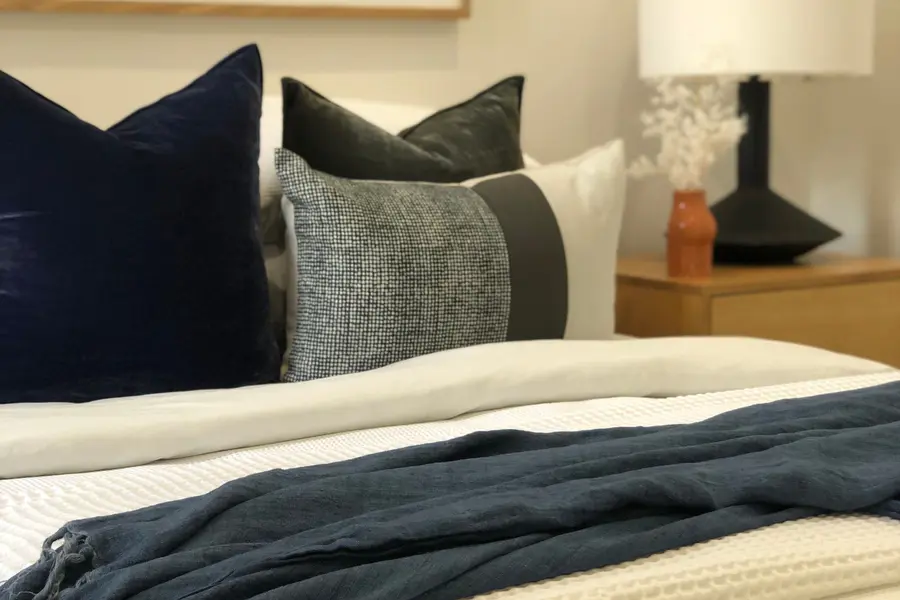
Use the bedding formula in order: fitted sheet, flat sheet folded back, duvet, one texture hero folded at the foot, sleeping pillows plus two euro shams plus one lumbar. Each layer shows its edge.
Fold with intent. Fold the flat sheet back over the duvet edge so a crisp band shows. Fold the throw across the lower third, never bunched at the foot. Place euro shams upright behind sleeping pillows, with the lumbar centered in front.
Keep one texture hero per bed. One hero gives the eye a place to rest. Two heroes compete, and three turn the bed into a display. Choose the hero by touch first.

Confirm the Sage colourway on the listing before ordering, and note that no thread count is claimed for this pick. Colour names and contents can vary by variant, so the listing check is part of the purchase, not an afterthought.
The oversized duvet trick helps many beds: choose one size up for overhang and drape. The honesty limit is plain. It needs a matching cover, or the overhang looks unfinished instead of plush.
White versus tone is a mood decision. Crisp white reads hotel clean, while warm ivory or oat reads boutique soft. Pick one family and keep every layer inside it. For the white route, see white linen bedroom ideas at the point where you choose the sheet family.
Test the finished bed for hospitality, not just for looks. A guest should be able to find the sleeping pillows and fold back the top layers without a puzzle. For that guest test, see guest bedroom ideas.
Also solves this: the bed with no texture hero
Amélie Home Premium Chenille Throw Blanket, Soft Cozy Luxury Two-Tone Knit Blanket for Couch, Sofa, Chair, Home Decor, Grey and Ivory 50×60
50 by 60 inches; 100 percent polyester chenille knit; Two tone Grey and Ivory colourway as listed; Moss stitch inspired pattern as described in the source. Not for: a reader who wants a single solid colour throw, because this pick is two tone by design.
Check Price on Amazon → (paid link)
Problem 2: One Harsh Light Kills the Mood
Harsh light usually comes from one overhead fixture, a cool temperature, no dimming, and no evening layer. The room may be bright enough to clean, but it is too bright to rest in.
Build three light layers. Ambient gives a soft overall glow and must be dimmable. Task gives one directed light per sleeper. Accent gives one low glow after dark. Each layer has a job, and no layer should try to do all three.
Follow the warm light rule throughout: warm bulbs throughout the room. Cool light turns warm bedding blue and cold. Once task and accent layers exist, use no overhead light at night.
Sconce versus lamp is a space decision. Sconces free the nightstand and suit small rooms. Sculptural lamps suit rooms where the nightstand is part of the look. Choose one per side, matched in height.
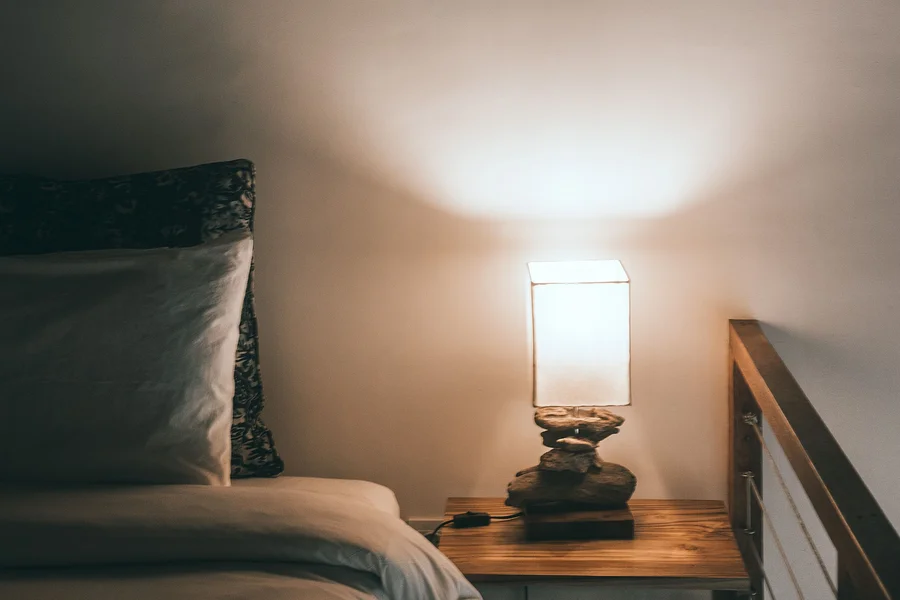
Every layer dims separately. Separate dimming is what lets one partner read while the other sleeps. A layer that cannot dim forces a choice between too bright and fully dark.
Try the halo trick in the evening only. A low glow behind the headboard or under a floating shelf adds depth without adding clutter. Keep it low and warm, and switch it off in daylight.
Also solves this: the one overhead light problem
29 Tall Table Lamps for Living Room Set of 2 with USB C+A Charging Ports, Gold Farmhouse 3-Way Dimmable Bedside Lamps, Modern Industrial Nightstand Lamps for Bedroom End Table (2 LED Bulbs Included)
Set of 2 lamps, 29 inches tall; Gold metal base with fabric shade; Touch control with 3 brightness levels: low, medium, and high; USB plus Type-C charging ports; 2 LED bulbs included, E26 base. Not for: a small nightstand that cannot hold a 29 inch lamp pair, because height and footprint must be checked against the nightstand first.
Check Price on Amazon → (paid link)
No colour temperature figure is claimed for this lamp variant, so check the listing before ordering if warmth matters for your palette. Height matters just as much: a tall lamp pair needs a nightstand that can hold it without crowding the three item rule.
Two sleepers often mean two light conflicts, especially when one reads and one sleeps early. The fix is task light per side with separate dimming, plus overhead light off at night. For that balance, see master bedroom ideas.
Problem 3: Surfaces Collect Clutter
Clutter happens because every flat surface becomes a drop zone when nothing has a closed home. Styling cannot fix a room that has nowhere to put daily life, so storage comes before decor here.
Use the nightstand rule without exception: three things only, lamp, one small dish, one charming item. Everything else goes in a drawer. The dish corrals small things, and the charming item gives personality.
Use the dresser console formula: mirror or art above, three to five pieces arranged with intent, negative space protected. If adding one more piece means losing the gaps, the surface is full.

Also solves this: the nightstand with no corral
BABONIE Bamboo Serving Tray with Handles Set of 2, Decorative Wooden Trays for Eating, Working, and Storing, Suitable for Use in Bedroom, Living Room, Kitchen, Bathroom, Outdoor Scenarios and More
Set of 2 trays; Bamboo material with handles; Non slip feature as printed for this listing; Size as printed: 17 inches long by 12.8 inches wide by 1.5 inches high. Not for: a nightstand smaller than the tray, because the tray size must be measured against the surface first.
Check Price on Amazon → (paid link)
Follow the closed home rule: every category gets one closed home, whether drawer, door, or lidded basket, or it leaves the room. Open storage is for display, never overflow.
Also solves this: the category with no closed home
OEHID Wicker Storage Baskets, Hand-Woven Rectangular Wicker Basket with Lid for Bedroom and Living Room, Nesting Rattan Basket for Shelves (Water Hyacinth, 3-Pack)
Set of 3 baskets, nesting; Water hyacinth woven around a strong metal frame; Lid included on each basket as listed. Not for: a reader who needs exact internal measurements before ordering, because the source printed conflicting size lines for this set and no single size is claimed here. Check size on the listing before ordering.
Check Price on Amazon → (paid link)
Run a weekly return pass. Once a week, return every stray object to its closed home. The pass also reveals which categories still lack a home, so the system improves instead of just resetting.
Count furniture before buying more, and remove one piece before adding one. For the closed home system, see small bedroom closet ideas. For the calm zone rule, see earthy boho bedroom ideas.
Problem 4: Texture Feels Random, Not Rich
Random texture happens when every beautiful material is bought once. Richness comes from repetition with restraint, not from variety alone.
Use the three family rule: one woven material, one soft material, one fibre textile, each with a job. The woven material might ground the room, the soft material might carry comfort, and the fibre textile might carry light and drape.
Follow the repeat twice rule: the star material appears in exactly two places. A third tips curated into themed. Two appearances feel intentional. One feels accidental.

Size the rug by the bed, not by the price tag. The rug goes under the bed with a generous border to step onto on every used side, never a small island. Measure before ordering.
No pile height and no fibre percentage are claimed for this rug, so check the listing if either detail matters for your floor or cleaning routine. Size and washability are the verified anchors here, and they are enough to judge whether the rug fits the rug rule.
Hang curtains high and wide. Rods go close to the ceiling and extended past the frame on both sides, so curtains stack on the wall. Heavy fabric pooling slightly reads boutique.
Also solves this: the window that reads short
Joydeco Linen Curtains 96 inch Length 2 Panel Set, Light Filtering Curtain for Living Room Bedroom, 52 inch Wide Drapes with Rod Pocket Back Tab (96 Lx52 W, Ivory on Linen)
Set of 2 panels, each 52 inches wide by 96 inches long; 30 percent linen and 70 percent polyester as printed; Light filtering; Rod pocket and back tab hanging; Ivory on Linen colourway as listed. Not for: a reader who needs full blackout, because this pick is light filtering only and blackout is not claimed.
Check Price on Amazon → (paid link)
Finish with one metal finish, repeated through hardware, lamp bases, and frames. One repeated finish reads calmer in a bedroom, and it lets textures carry the variety.
One bold choice still has a place inside restraint. A single strong headboard, art piece, or colour moment can carry a quiet room, provided everything else stays simple. For that one bold choice rule, see minimalist bedroom ideas with personality.
Problem 5: The Room Smells Like Nothing, or Like Everything
Scent fails in two opposite ways. No scent gives no arrival signal. Three competing scents give confusion. Both failures share one cause: scent was never chosen, it simply accumulated.
Follow the one signature scent rule: one scent, used consistently, in one or two places. Consistency is what turns scent into memory, while a new scent every week reads as random.
Place scent on the nightstand and dresser, never on the pillow itself. The pillow is for sleep, not for direct fragrance, and scent placed too close to the face overwhelms quickly.

Choose the form by habit. A candle suits evenings when someone is home to tend it. A diffuser suits steady background scent. A room spray suits arrival only, because it refreshes the air before guests enter and then fades.
Also solves this: the room with no arrival scent
Chesapeake Bay Candle Mind and Body Serenity Scented Candle, Pause with Pure Essential Oils (Lavender and Sage), Large
Large size as listed; Lavender and sage essential oils as listed; Scent notes as printed: top notes lavender, thyme, and white sage; middle notes jasmine, ylang ylang, and orange flower; base notes musk, vanilla, honey, and patchouli. Not for: a scent sensitive household or a home with pets, because scent safety must be checked first and the article requires a scent free option for sensitive guests.
Check Price on Amazon → (paid link)
No burn time and no weight in ounces are claimed for this candle, so check the listing if either detail matters before ordering. The scent notes above are the verified guide, not a promise of strength or duration in your room.
State the honesty limits plainly. Scent sensitivity is real, so a guest room needs a scent free option and the scent removed before a sensitive guest arrives. Pets and scented products need a check first. A scent that gives the reader a headache is the wrong scent whatever the price.
Never stack candle plus diffuser plus spray in one evening. One source at a time keeps the room pleasant and keeps the cause clear if something goes wrong. For a spa scent routine that follows the same one scent discipline, see boho bathroom ideas.
Problem 6: The Room Looks Boutique by Day, Ordinary by Night
Night fails because rooms are styled in daylight and never tested after dark. Evening light is honest: it shows what glows, what disappears, and what glares.
Run the evening audit. Run the audit again after dark with only task and accent layers on. Name what disappears and what glares, and fix those first.
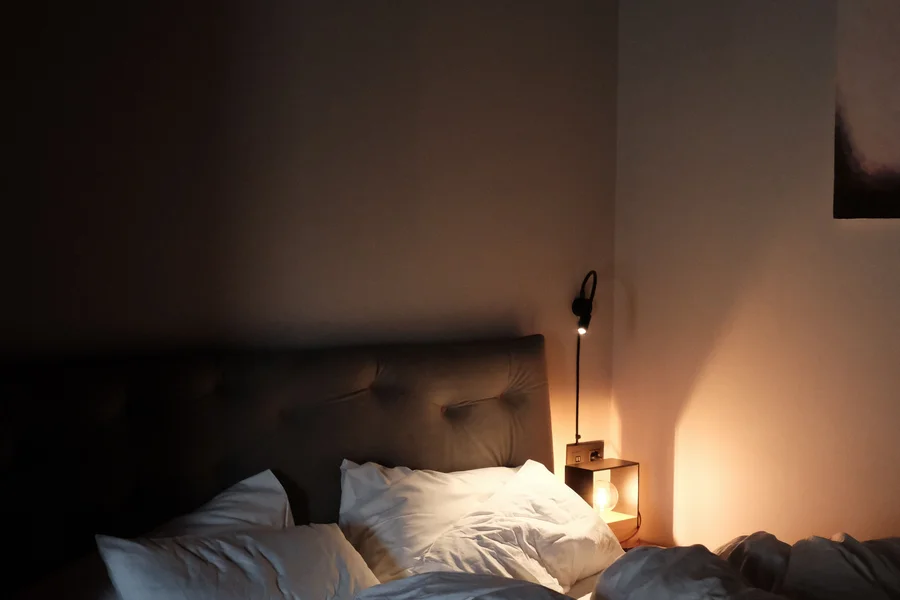
Follow the nightly reset ritual. Make the bed fully in the morning, place the throw, clear the nightstand to three things, and set the scent for the evening. Five minutes, guest ready every night.
No weight capacity is claimed for this bench, so check the listing if seating load matters before ordering. Footprint and storage are the verified points, and they decide whether the bench helps the reset or blocks the walkway.
Also solves this: the nightstand that drifts back to clutter
Night Caddy Deluxe, Bedside Caddy Organizer with USB Charger, Adjustable, Cup Holder, Space Saving Storage for Bedrooms College Dorms Bunk Beds Sofas to Hold Remotes Tablets Laptops Phones, Grey
Bedside caddy organizer that sits beside the bed, not a nightstand itself; Dual USB charger with a 6 foot power cord, both included as listed; 32 oz bed cup holder as listed; Space for a book, tablet, laptop, remote, or phone as listed. Not for: a reader who wants a piece of furniture, because this is a hanging style caddy for beside the bed, and it must be checked against the bed frame before ordering.
Check Price on Amazon → (paid link)
Also solves this: the nightstand with no evening ritual piece
Bedside Water Carafe and Glass Set, 25 oz Lead-Free Glass Pitcher with Tumbler Lid, Nightstand Water Bottle for Bedroom, Guest Room and Bathroom, Mouthwash Dispenser, Juice or Cold Drink Carafe
25 fluid ounce carafe; Lead free glass as listed; Tumbler lid included, carafe plus tumbler as listed. Not for: a household that needs unbreakable nightstand ware, because glass is breakable and shatterproof is not claimed.
Check Price on Amazon → (paid link)
Remember the made bed rule. A fully made bed with all layers and pillows in place is the difference between a beautiful room and a boutique room. An unmade bed hides bedding, texture, and palette work in one glance.
Add the temperature note before calling the night routine done. A room that sleeps hot fails at night whatever it looks like, so breathable layers come first. For the hot sleeper system, see cooling bedroom ideas.
Steal This Look: Two Boutique Palettes, Named
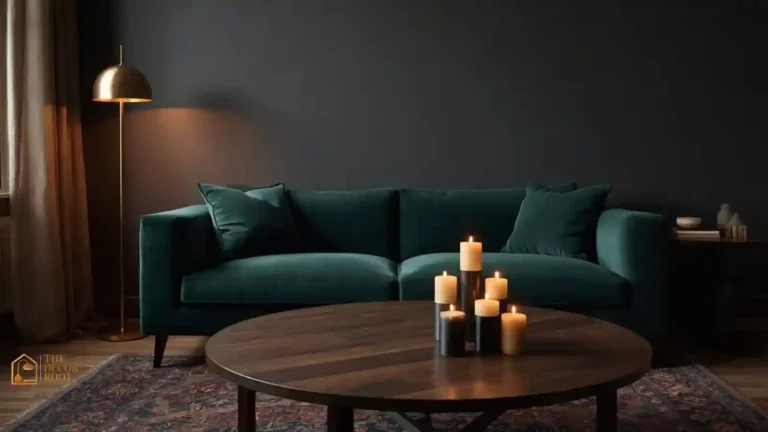
Palette one is Midnight Velvet. The hero is deep teal or midnight, the supports are warm ivory, the metal finish is brass, the hero texture is velvet, and the support texture is linen. This palette suits dark rooms. The bed carries the hero, curtains carry the support, and lamp bases carry the brass.
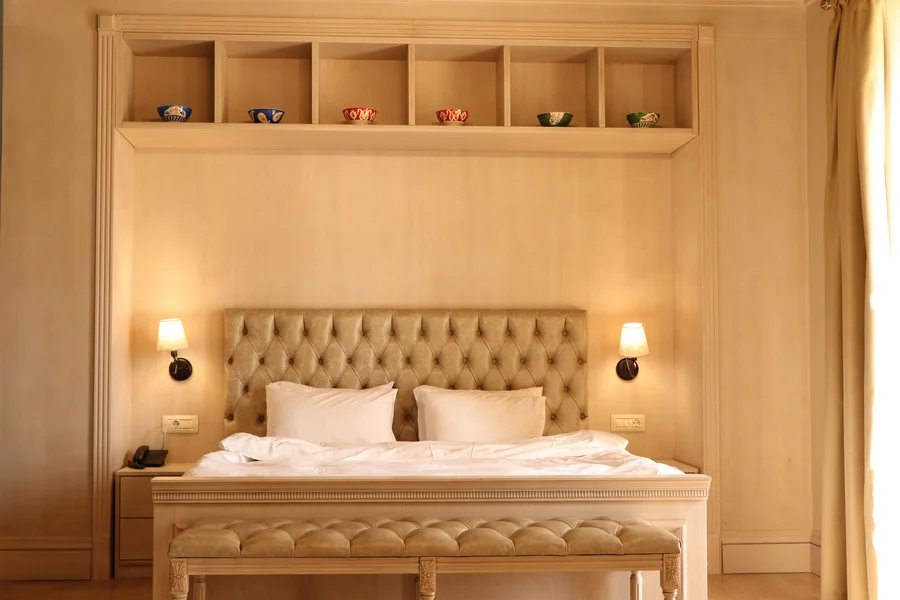
Palette two is Warm Ivory. The hero is warm ivory, the supports are oat and sand, the metal finish is aged wood or matte gold, the hero texture is linen, and the accent texture is boucle. This palette suits airy rooms. Bedding carries the hero, the rug carries the support, and art carries the accent.

Choose by givens, not by trend. A dark room with small windows will fight a pale palette, and a bright room will wash out a palette that needs shadow. Start from window size, floor tone, and existing furniture.
Inside each palette, follow the three color rule: one hero, two supports, repeated at least three times each through bedding, curtains, and art. If a colour appears only once, it reads as an accident.
6 Boutique Bedroom Mistakes
- Buying decor before the audit. Fix: follow the audit order, and let the audit name the broken layer before any purchase.
- Matching everything from one shop. Fix: bed layer first, later pieces from different places over time, so the room grows rather than arrives as a set.
- One overhead light doing every job. Fix: three layers with separate dimming, and no overhead light at night once task and accent layers exist.
- Three competing scents at once. Fix: one signature scent, one source at a time, and a scent free option for sensitive guests.
- Texture collected, never repeated. Fix: three families, one star repeated exactly twice, then stop.
- Styling for noon and never testing at night. Fix: the evening audit and the nightly reset ritual, repeated until the room passes after dark.
Budget Plans
The starter plan is the weekend reset. Relayer the bedding formula with existing pieces, fix one warm light layer, clear the nightstand to three things, and choose one scent. No furniture is bought, which suits renters.
The mid plan is the room envelope. Take the starter plan, add a rug sized right, hang curtains high and wide, and add one texture hero. Floor and window now support the bed instead of competing with it.
The full room plan is the boutique finish. Take the mid plan, add a headboard or large art as focal piece, add a sconce or sculptural lamp pair, and add closed storage homes for every category. Buy in the order listed.
Follow the spend order rule: bed first, light second, floor and window third, focal piece fourth, scent and small objects last. If funds run out mid plan, the room still reads better than a room that bought decor first.
Revisit the audit after each plan stage, not only at the end. A weekend reset may reveal that light, not bedding, was the real break. A mid plan rug may reveal that the palette needs one support repeated more often. Checking after each stage keeps spending tied to evidence, and it stops a finished room from drifting back toward a showroom.
FAQs
1. What is the difference between a boutique bedroom and just an expensive bedroom?
Ans: Boutique is intention and atmosphere, not price. Every element serves one mood line, and nothing is included simply because it was affordable or convenient. A modest budget works when one or two hero pieces carry the room and everything else stays simple and intentional.
2. Can I get the boutique look in a rental without paint or drilling?
Ans: Yes. Carry the palette in bedding, curtains, throws, and one large artwork, use plug in or freestanding light layers, and choose closed storage that leaves with you. Paint and drilled hardware are never required for the boutique standard.
3. How many light layers does a boutique bedroom really need?
Ans: Three: ambient for soft overall glow, task for one directed light per sleeper, and accent for one low evening glow. Each layer dims separately, so one partner can read while the other sleeps, and no overhead light is needed at night.
4. How do I choose a signature scent without overwhelming the room?
Ans: Pick one scent and use it in one or two places only, never stacked with other scent sources in the same evening. Keep a scent free option for sensitive guests, and check pet safety before choosing. A scent that gives you a headache is the wrong scent, whatever the price.
5. What is the first thing to buy for a boutique bedroom?
Ans: Nothing, until the audit is done. The audit names the broken layer, and the first buy serves that layer. In most rooms the first buy is bedding, because the bed is the largest surface and the first thing the eye lands on from the doorway.
Bottom Line
Audit first, bed second, light third, scent and texture fourth, surfaces last. That order is the whole article in one line, and it is also the order to shop in. If a purchase does not fit the step you are on, it waits, no matter how good it looks in a photo.
One rule to remember: boutique means every layer resolved and every surface edited, not every surface full. Keep the mood line, the three light layers, the three texture families, and the nightstand to three things, and the room will feel like a place worth staying in, not just a place worth photographing.
Save this boutique bedroom audit before your next decor buy: bed first, warm light second, one scent, three textures, and stop when the room passes the 60 second arrival test, so your hotel calm never tips into a showroom.
Photos via Pexels: Caro S, Rahib Yaqubov, Alejandra Montenegro, Maria Orlova, cottonbro studio, KATRIN BOLOVTSOVA, Диана Дунаева, Max Vakhtbovych.