25 Christmas Porch Planter Ideas Built to Survive Real Winter
Christmas porch planter ideas cold climates. If you live somewhere with a real winter hard freezes, wind chill, actual snow that sticks around you’ve probably had a Christmas porch planter crack, wilt, or just look sad and frozen by New Year’s Eve. Most planter inspiration online is photographed in mild climates using materials that simply don’t hold up once temperatures drop into the teens or lower. This list is different: every idea here is built specifically around what actually survives a hard winter, from the container material up through the branches, picks, and finishing touches, so your porch still looks intentional in February, not just on the day you first put it together.
This post contains affiliate links. As an Amazon Associate, I earn from qualifying purchases. If you buy through these links, I may earn a small commission at no extra cost to you.
What Makes the Difference
The difference between a planter that survives winter and one that falls apart by January almost always comes down to three decisions made before you add a single branch: the planter material, the base structure holding everything upright, and whether you’re using materials that are naturally weather-resistant to begin with (cut evergreen, birch, dried elements) rather than anything that needs water or warmth to stay attractive. Get those three foundational choices right, and the styling on top bows, lights, berries will hold up for the whole season with almost no maintenance.
1. Start With a Frost-Proof Planter Material
Ceramic and ordinary terracotta planters are notorious for cracking in freeze-thaw cycles, since the material absorbs moisture that expands as it freezes. Fiberglass, resin, and cast stone planters handle repeated freezing far better and are considerably lighter to move if needed, which matters if you ever need to shift them for snow shoveling or ice treatment on the steps. This is the single most important decision on this entire list, since even the best styling won’t matter if the container itself doesn’t survive the season.
2. Build the Base With Fresh-Cut Evergreen Branches
Rather than live potted plants, which struggle or die outright in freezing temperatures, fresh-cut evergreen branches noble fir, cedar, pine pushed into damp floral foam or soil hold their color and needles for the entire winter season since they’re essentially already dormant material. This is the standard base for cold-climate porch arrangements for a reason: it looks full and lush immediately and requires no ongoing care beyond an occasional light misting in unusually dry stretches.
3. Add Red Twig Dogwood for Height and Color
Red twig dogwood branches, sold at most garden centers specifically for winter arrangements, add vibrant color and height without any risk of frost damage, since the branches are cut and essentially dried in place through the cold months. Their thin, vertical structure also adds movement and visual height to a planter that would otherwise be dominated by rounder evergreen forms, creating the kind of dimensional look higher-end winter arrangements are known for.
4. Use Birch Branches for Vertical Structure
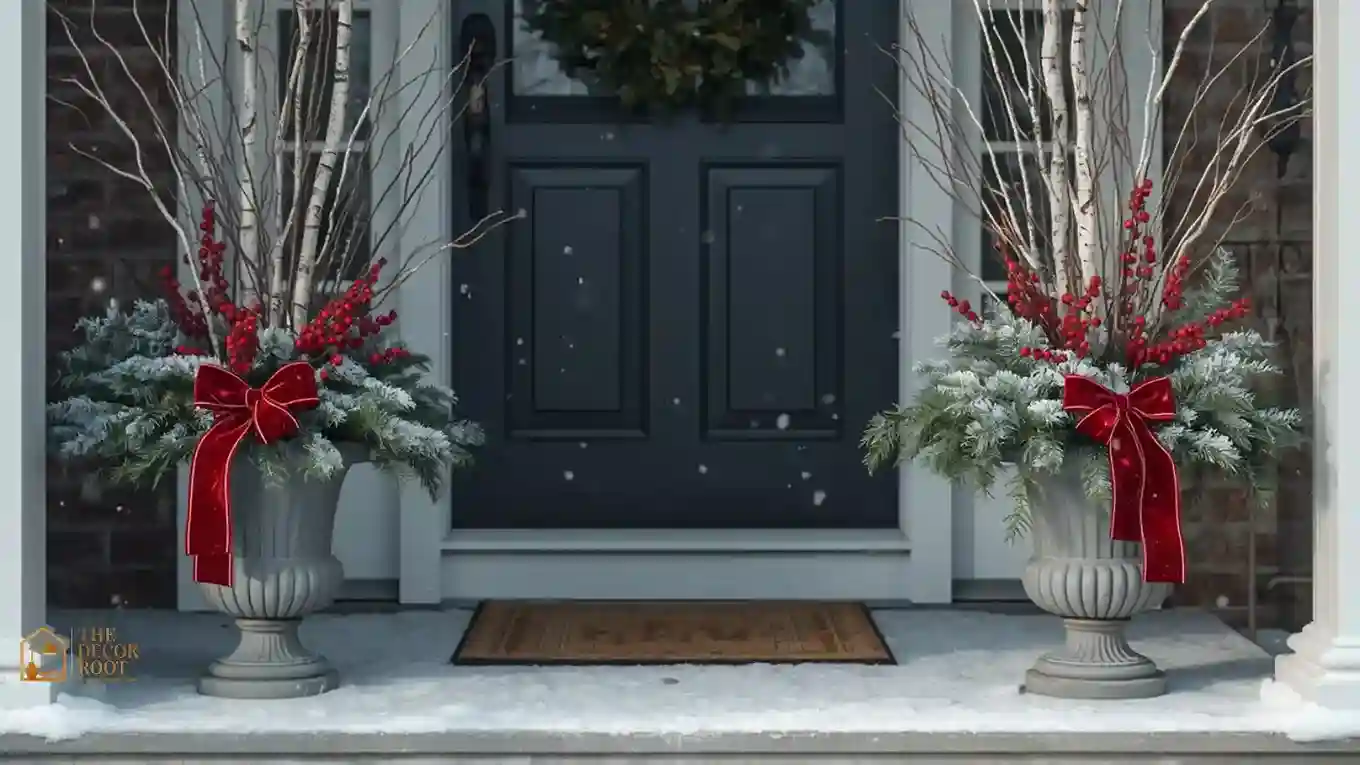
White birch branches, either real cut stems or realistic faux versions, add striking vertical lines and a pale, contrasting color against dark evergreen. They read as sophisticated and slightly Scandinavian, and because birch bark itself is naturally weather-resistant, real cut branches hold their appearance through an entire winter without any special treatment or protection needed.
5. Add Lighted Branch Picks for Evening Glow
Battery-operated picks pushed into the arrangement alongside real branches extend your planter’s impact into the evening hours, when most porch traffic and holiday-lit walks actually happen. Look specifically for picks rated for outdoor, cold-weather use, since indoor-only versions will fail quickly once temperatures drop below freezing consistently.
EDITOR’S PICK
🛒 LED Lighted Branch Picks, Outdoor-Rated, Battery-Operated
Battery picks add evening glow to planters; choose outdoor‑rated versions to avoid failure in freezing temperatures.
(paid link)
6. Cluster Pinecones for Natural Texture
Pinecones, whether collected for free or purchased in bulk from a craft store, add dense, natural texture and hold up indefinitely in cold weather since they’re essentially already a dried, weatherproof material. Wiring them onto floral picks makes them easy to nestle into the arrangement at varying heights and depths rather than leaving them sitting loosely on top, where wind can scatter them.
7. Add Faux Winterberry Picks for Color
Faux winterberry: small, saturated red berries on thin branches mimic the look of real winterberry holly without any risk of the berries drying out, dropping, or fading over a multi-month display. This is one of the most efficient ways to add concentrated color to an otherwise green-and-brown arrangement, and unlike fresh berries, faux versions look identical in week one and week twelve.
8. Wrap the Planter Base in Burlap for an Insulated Look
Wrapping the exterior of the planter in burlap, secured with twine or a hot glue gun, adds a rustic textural layer while visually suggesting insulation, whether or not the planter actually needs it. This is a particularly good trick for older or mismatched planters, since the burlap unifies their appearance while adding a farmhouse-appropriate texture that fits the cold-climate winter aesthetic well.
9. Anchor Everything in Floral Foam for Stability
Cold-climate porches are frequently windy, and loosely arranged branches without a secure anchor point will shift, lean, or blow over entirely over a multi-month display. A block of floral foam (or wet sand in a pinch) at the base of the planter gives every stem a secure, stable hold point, which matters considerably more for winter arrangements left outdoors for months than it does for a one-day event arrangement.
10. Add a Lantern as the Centerpiece
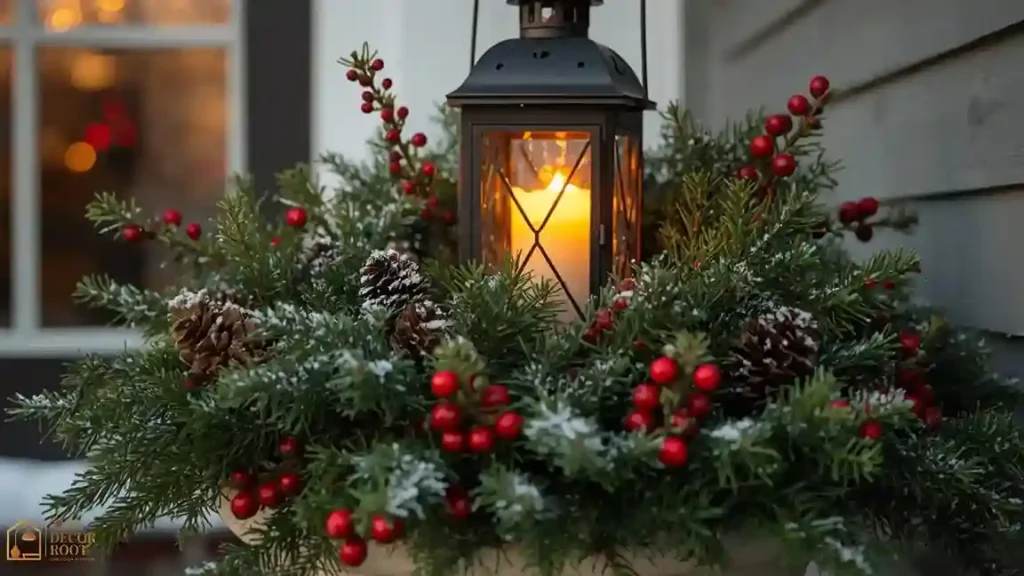
Nestling a into the center of a planter, surrounded by shorter branches and greenery, creates an elevated focal point that reads as more designed than an arrangement built purely from stems. Choose a lantern explicitly rated for outdoor and cold-weather use, since battery compartments and seals on indoor-only lanterns often fail once real winter conditions set in.
EDITOR’S PICK
🛒 Battery-Operated Outdoor Lantern, Flicker-Effect, Weatherproof
A weatherproof lantern at the planter’s center, framed by greenery, creates a designed focal point choose outdoor‑rated to avoid winter seal failure.
(paid link)
11. Try an All-White-and-Silver Winter Theme
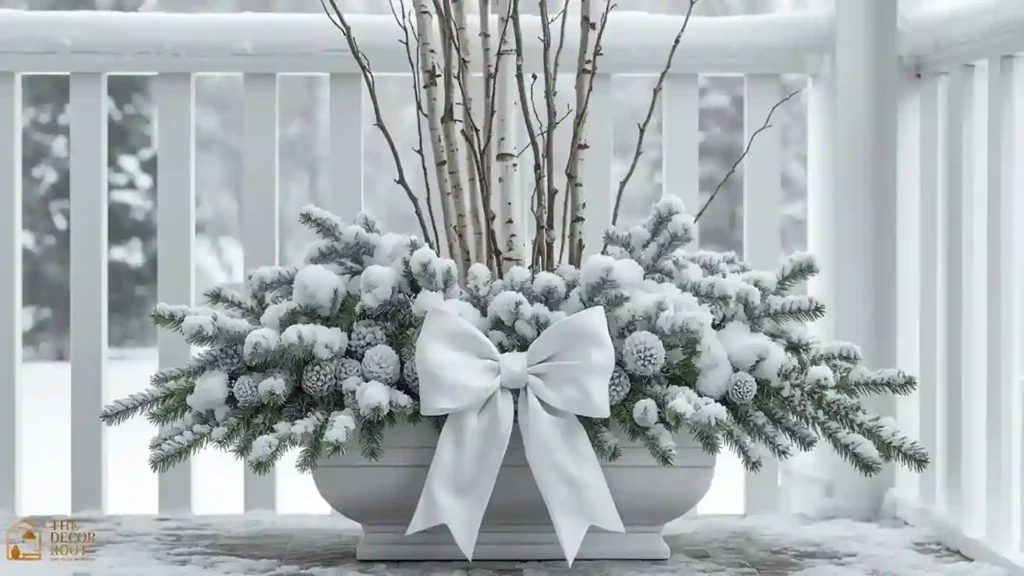
Skipping traditional red-and-green entirely in favor of white birch, silver-dusted pinecones, and white berry picks creates a striking, almost frost-covered look that fits especially well in genuinely snowy climates, where the arrangement visually echoes the landscape around it rather than contrasting against it. This palette also tends to transition gracefully past Christmas into a general winter look through January and February.
12. Add an Oversized Weatherproof Bow
A large bow made from outdoor-rated ribbon (vinyl-backed or specifically labeled weatherproof) tied prominently at the front of the planter adds a strong focal point and ties the planter visually to a matching front door wreath or bow. Standard fabric ribbon left outdoors for a full season will fade and fray considerably faster than weatherproof versions, so this is worth spending slightly more on for a cold-climate display meant to last months.
13. Insulate Real Root Balls With Mulch if Using Live Elements
If you’re incorporating any live, cold-hardy elements alongside cut branches, certain dwarf conifers, for instance, a thick layer of mulch or bark over the soil surface helps insulate roots against the deepest freeze cycles, which is often what actually kills marginally hardy plants rather than the cold air itself. This step is optional for purely cut-branch arrangements but essential if you’re mixing in anything with living roots.
14. Structure With Thriller-Filler-Spiller Heights
Borrowing the classic container-gardening structure, a tall “thriller” element in the center or back, mid-height “filler” branches surrounding it, and a trailing “spiller” element cascading over the edge gives even a simple winter planter real dimensional structure rather than a flat, uniform mound of greenery. Curly willow or trailing eucalyptus works well as the spiller element in a cold-climate arrangement since both hold up well outdoors.
15. Add Faux Poinsettia Picks for Classic Color
Deliver the single most recognizable Christmas color and shape without any of the fragility of real poinsettias, which wilt and die almost immediately in freezing outdoor temperatures. Tucking a few throughout the arrangement, rather than clustering them all in one spot, distributes that classic red color evenly across the whole planter for a more cohesive look.
EDITOR’S PICK
🛒 Faux Poinsettia Picks, Weatherproof, Set Of 3+
Faux poinsettias give classic Christmas color and shape without outdoor wilting; scatter them evenly across the planter rather than clustering for a cohesive red look.
(paid link)
16. Add Glass Ornament Ball Sprays
Ornament ball sprays: several faux glass or shatterproof ornaments pre-wired onto a single stem add shine and reflected light throughout the greenery, catching both sunlight during the day and porch light after dark. Shatterproof plastic versions specifically designed for outdoor use hold up far better than glass ornaments repurposed from tree decorating, which can crack in extreme cold.
17. Add Trailing Ribbon Streamers
Long ribbon tails allowed to trail down and slightly over the edge of the planter add movement and a sense of intentional styling, especially when the ribbon catches wind slightly on breezier days. Weatherproof ribbon in a plaid or metallic pattern works particularly well here, echoing the same ribbon choice used elsewhere on the porch for a cohesive overall look.
18. Build a Matching Symmetrical Pair
Two identical planters flanking the front door create immediate visual balance and a more polished, boutique-entrance feel than a single asymmetrical planter or two mismatched ones. This is worth the extra initial cost of a matching set, since symmetry is one of the fastest visual cues that reads as “designed” rather than “decorated” to anyone approaching the door.
19. Add Dried Hydrangea for Soft Texture
Dried hydrangea heads hold their shape and color for an entire season outdoors without any special care, adding a soft, papery texture that contrasts nicely against structured evergreen branches. Their muted, slightly faded coloring also works beautifully in a cold-climate context, echoing the softer winter light of shorter, grayer days.
20. Use an Insulated Planter Liner in Extreme Cold
In genuinely harsh climates, an placed inside your main container adds a protective barrier between the coldest air and anything inside the planter, extending the life of both the container itself and any semi-live elements you’ve included. This is a small, inexpensive addition that meaningfully reduces the risk of a planter cracking during the harshest cold snaps of the season.
EDITOR’S PICK
🛒 Insulated Planter Liner, Weather-Resistant
A planter liner or insulating insert adds a protective barrier in harsh climates, reducing the risk of container cracking and extending the life of both the planter and any semi‑live elements inside.
(paid link)
21. Mix Cedar and Magnolia Leaves for Contrast
Combining feathery cedar with the broad, glossy, dark-green leaves of magnolia (real or faux) creates strong textural contrast within the greenery itself, before you’ve even added any accent pieces. Magnolia’s leathery leaf structure also holds up exceptionally well in cold, dry winter air compared to more delicate greenery options, making it a smart cold-climate-specific choice.
22. Add Buffalo Plaid Ribbon for a Farmhouse Accent
Black-and-red buffalo plaid ribbon woven through the arrangement or tied as an accent bow brings the same farmhouse signature look used elsewhere in cold-climate holiday decor, and its bold, graphic pattern reads clearly from the street even against a busy, textured planter arrangement.
23. Add a Wooden Monogram or Sign Stake
A small weatherproof wooden stake with a house number, monogram letter, or short phrase pushed into the center or back of the arrangement adds a personalized, finished touch. Sealed or painted wood holds up well through a full winter outdoors, and this detail is what often separates a planter that looks like a generic arrangement from one that looks custom-designed for your specific home.
24. Layer On Faux Snow Flocking for a Frosted Look
Light flocking spray applied to the tips of evergreen branches mimics a fresh dusting of snow, adding visual interest even during dry cold spells when no real snow has fallen. This works especially well combined with the white-and-silver theme from earlier in this list, deepening the frosted, wintery effect across the whole arrangement.
25. Build a Reusable Faux Boxwood Spiral Base
For the most durable, multi-year option on this entire lis gives you a structured, reusable centerpiece that holds its shape and color through every winter without needing to be rebuilt from scratch each year. Simply swap the ribbon, lights, and seasonal picks around it annually, and the core investment pays for itself across several Christmas seasons rather than being a single-use purchase.
EDITOR’S PICK
🛒 Faux Boxwood Spiral Topiary, Outdoor-Rated, Reusable
A structured, reusable centerpiece holds shape for years swap ribbon and picks seasonally, and it pays for itself across many Christmases.
(paid link)
For more cold-weather-ready ways to round out your entryway, check out our guides on Christmas wreath ideas and professional Christmas light ideas.
Quick Action Plan
- If you’re building your porch planters this weekend, get the foundation right first: choose a frost-proof fiberglass or resin container, anchor everything in floral foam, and build the base from fresh-cut evergreen and birch branches rather than live plants.
- Once that structural foundation is solid, layer in two or three accent ideas from this list: lighted branch picks, a lantern centerpiece, or faux poinsettia, and your planters will hold their look through the entire cold season with essentially no upkeep.
Frequently Asked Questions
Conclusion
A Christmas porch planter that survives real winter comes down to the right container, a secure anchor, and materials that are naturally built for cold weather rather than fighting against it all season. Start with the structural basics from this list, then layer in the accents that fit your climate and style, and your porch will look just as good in February as it did the day you built it.
💾 Save this to your Christmas Porch Decor Pinterest board so it’s ready when you build yours this season.