21 Thanksgiving Hosting Ideas for Small Dining Rooms
Thanksgiving Hosting Ideas. There’s a specific kind of dread that comes with realizing you’re hosting Thanksgiving in a dining room built for six, for a guest list that’s somehow become eleven. Extra chairs won’t fit. The buffet table’s a fantasy. And Pinterest’s idea of “small space entertaining” usually still assumes a room bigger than the one you actually have. This list skips the fantasy and deals in the real logistics: seating, serving, traffic flow, and where on earth the extra pie goes for genuinely small dining rooms, not just modestly sized.
This post contains affiliate links. As an Amazon Associate, I earn from qualifying purchases. If you buy through these links, I may earn a small commission at no extra cost to you.
The Real Reason This Works 🕯️
Small-space hosting fails when people try to force a big-room plan into a small room. It works when you redesign around the room’s actual constraints, using height instead of floor space, moving serving off the table entirely, and treating seating as flexible rather than fixed. Every idea below solves one specific small-room problem: not enough table surface, not enough chairs, not enough walking room, or not enough serving space. Solve those four things and a small dining room stops feeling cramped and starts feeling intimate, which, honestly, is the version of Thanksgiving most people actually want anyway.
1. Get an Extendable Table, Even a Small One
If your current table is fixed-size and already tight for everyday use, a compact extendable table with a removable or fold-out leaf solves the single biggest small-room problem: not enough surface for the meal itself. Look specifically for models designed for small spaces, since many extendable tables are still bulky at their base size even before extending. A compact extendable dining table earns its keep well past Thanksgiving, since it flexes for everyday use and expands only when you actually need it.
EDITOR’S PICK
🛒Compact Extendable Dining Table
A compact extendable dining table with a removable leaf expands only when needed, solving small-space surface shortages without everyday bulk.
(paid link)
2. Move Serving Dishes Off the Table Entirely
The single fastest way to free up table space in a small room is to stop putting the food on the table at all; set up a buffet-style serving line on a counter, sideboard, or even a covered dresser, and let guests fill plates before sitting. This also solves a real logistical problem in small rooms: passing heavy dishes around a tightly packed table is genuinely awkward once chairs are close together, so removing that step improves the whole flow of the meal.
3. Use a Bench on One Side Instead of Individual Chairs
A bench seats more people in less linear space than the same number of individual chairs, since it removes the need for gaps between chair arms and backs. Push it against a wall on one side of the table for stability, and use individual chairs only on the side with more room to maneuver. This is one of the most effective seating tricks for small dining rooms specifically because it’s flexible: a bench can seat two adults snugly or three kids without needing to plan exact numbers.
4. Borrow or Rent Folding Chairs for the Day
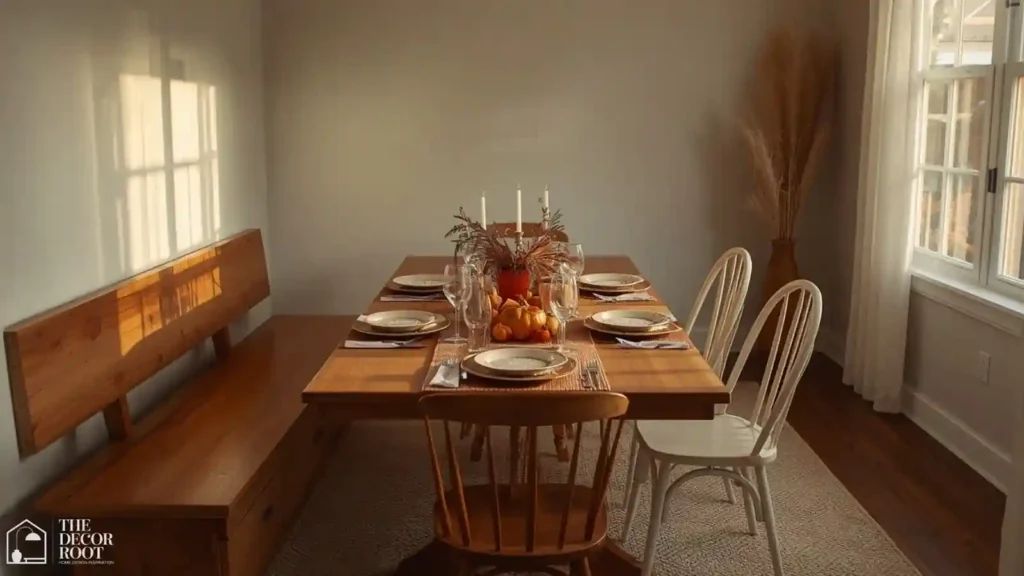
Rather than owning a full set of extra dining chairs that sit unused 364 days a year, borrow mismatched folding chairs from a neighbor, garage, or storage closet just for the hosting day, and store them away immediately after. Folding chairs also solve a small-room-specific problem: they can be pulled out only when needed and leaned against a wall the rest of the time, unlike bulky permanent extra chairs that eat floor space year-round.
5. Add a Folding Card Table as a Kids’ or Overflow Table
If your guest list exceeds what your main table can hold, even extended, a simple folding card table set up in an adjacent room or corner solves overflow seating without needing a bigger dining room at all. Dress it with the same runner and napkin style as the main table so it still feels connected to the main setup rather than like an afterthought kids’ table.
EDITOR’S PICK
🛒Folding Card Table
Folding card table with matching runner and napkins expands seating seamlessly.
(paid link)
6. Push the Table Against a Wall for a Buffet-Style Layout
If your dining room is narrow rather than small overall, pushing the table against one wall, even temporarily, just for hosting day frees up an entire side of walking space that a centered table would otherwise block. This works especially well combined with idea 2 (moving serving off the table), since it turns the dining table into essentially a long, single-sided seating bench arrangement.
7. Use Vertical Space for Serving, Not Just the Table Surface
A small bar cart, a tiered stand, or even a bookshelf cleared out for the day can hold drinks, desserts, or side dishes vertically instead of spreading everything across an already-tight table. This is one of the most underused small-space hosting tricks; most people default to spreading things wider when the room is tight, when going taller is usually the better move.
8. Skip the Formal Centerpiece Entirely
In a small dining room, every inch of table surface matters more than usual. A tall or wide centerpiece that would look fine in a spacious room can genuinely crowd a small one. Skip it, or replace it with something extremely low-profile, like a single runner with scattered fruit, so the visual warmth doesn’t come at the cost of usable table space guests actually need for their plates.
9. Use a Tiered Serving Stand to Consolidate Dishes
A tiered serving stand lets you stack two or three smaller dishes vertically in the footprint of one plate on the table, which is one of the most direct fixes for a small table that simply doesn’t have room to spread out six or seven side dishes side by side.
EDITOR’S PICK
🛒Tiered Serving Stand
A tiered serving stand stacks 2–3 dishes vertically, fitting six side dishes into the footprint of one plate.
(paid link)
10. Seat Fewer People at the Main Table, More in the Living Room
Not every guest needs to sit at the formal dining table. Set up a small side table or coffee table with plates and space in an adjacent living room for kids, teens, or anyone happy with a more casual setup. This genuinely solves the math problem of a small room better than trying to squeeze everyone around one table, and most groups actually enjoy the mixed formal-casual setup once it’s framed as intentional rather than as a downgrade.
11. Use Round Instead of Rectangular Where Possible
A round table seats people more efficiently in a small square-ish room than a long rectangular one, since it eliminates the awkward corner seats that are hard to reach and hard to sit at comfortably. If you’re shopping for a new table specifically for a small dining room, a round or oval shape with a leaf insert is usually the better long-term choice over a fixed rectangle.
12. Rearrange the Room Just for Hosting Day, Then Reset It After
Treat your dining room layout as temporary rather than fixed. Move a sideboard, a bookshelf, or a bench out of the room entirely the morning of hosting, then move it back that evening. This single mindset shift (the layout doesn’t have to work for the other 364 days of the year) opens up far more floor space than most people realize is available in a “small” room.
13. Get a Table That Expands Significantly Beyond Its Base Size
If you’re shopping specifically for small-space Thanksgiving hosting, prioritize the difference between a table’s base size and its fully extended size, not just its base footprint. A dining table with a large drop-leaf or double extension can go from a compact everyday table to a genuinely large hosting table, which matters more for a small room than the table’s unextended size.
EDITOR’S PICK
🛒Drop-Leaf Extendable Dining Table
For small-space hosting, prioritize the table’s fully extended size over its base footprint, not just its unextended dimensions.
(paid link)
14. Use Nesting or Stacking Side Tables as Overflow Surface
A set of nesting or stacking side tables, pulled apart and placed around the room, gives guests extra surface for drinks, plates, or dessert without needing a full second table. This is a particularly good small-room hosting trick because the tables store flat or nested the rest of the year, taking up almost no permanent space.
15. Keep the Lighting Warm and Low, Not Bright and Overhead
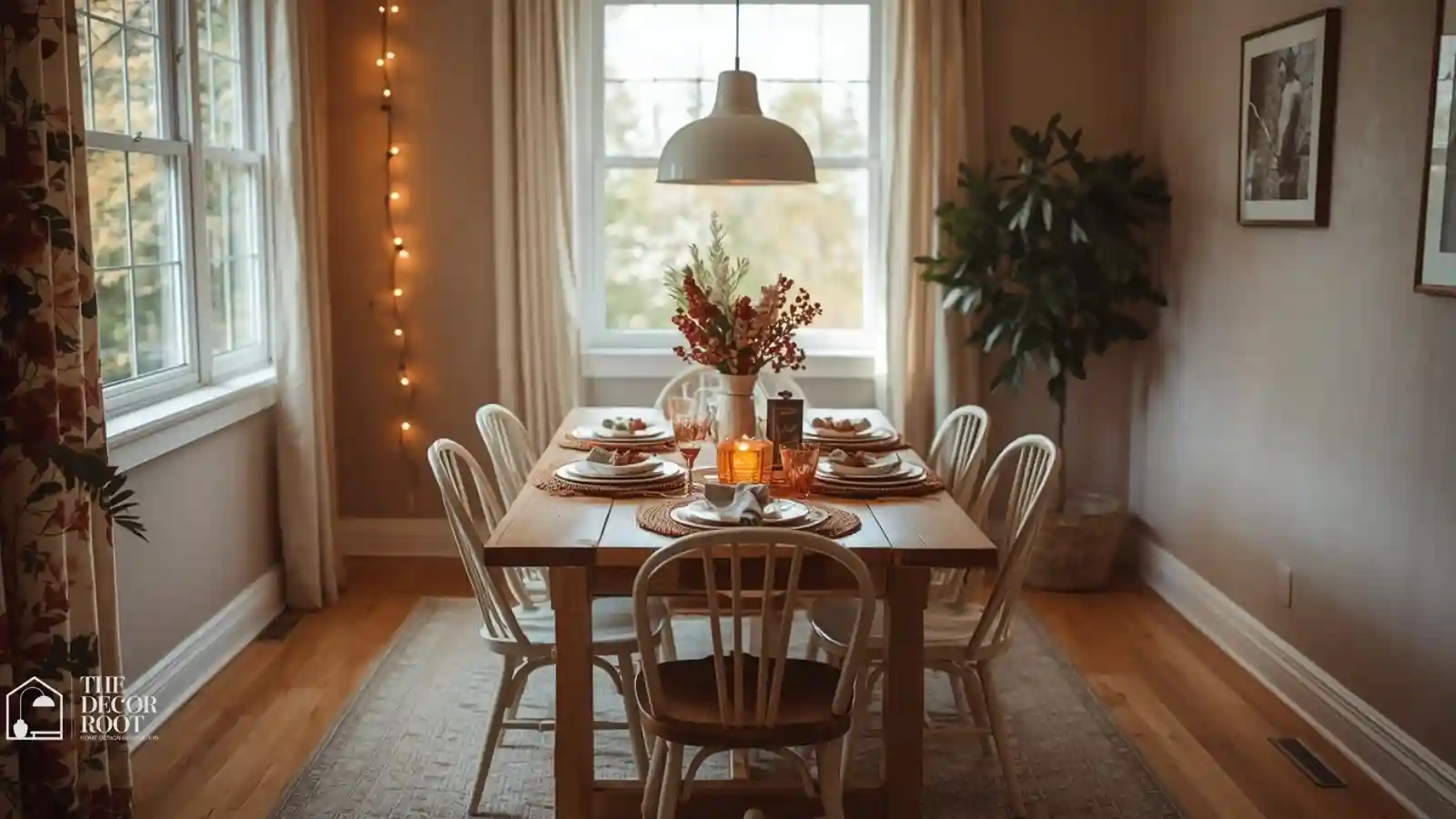
Bright overhead lighting in a small room tends to emphasize how tight the space is; warm, low lighting (candles, string lights, a dimmed overhead) does the opposite, making a small room feel cozy and intimate rather than cramped. This is one of the cheapest, fastest fixes on this entire list, and it works in tandem with almost every other idea here.
16. Serve Dessert in a Different Room Entirely
Moving dessert and coffee to the living room after the main meal gives everyone a natural stretch break, resets the energy of the gathering, and frees up the dining table for cleanup while people are still enjoying the day. This is standard practice in professional small-space event planning for exactly this reason; it solves both a comfort problem and a practical cleanup problem at once.
17. Mount a Fold-Down Table on a Wall for Extra Prep or Serving Space
If your dining room shares a wall with the kitchen or a hallway, a wall-mounted fold-down table gives you extra serving or prep surface that completely disappears when folded flat, which is one of the most space-efficient hosting solutions available for genuinely tight rooms.
EDITOR’S PICK
🛒Wall-Mounted Fold-Down Table
A wall-mounted fold-down table offers a disappearing extra serving surface, the most space-efficient solution for tight dining rooms.
(paid link)
18. Use Cushions or a Low Bench for Kids’ Floor Seating
For younger kids specifically, a small floor seating area with cushions and a low coffee table (rather than trying to fit a full extra chair at the main table) can free up real chair space for adults while still keeping kids close to the main gathering. Most kids under a certain age genuinely prefer this setup anyway, since it feels more like an event than a formal seat at the grown-up table.
19. Skip the Sideboard Display, Use It for Storage Overflow Instead
If you have a sideboard or buffet that’s usually styled with decor, clear it entirely for hosting day and use it as pure functional storage: extra plates, serving utensils, drink glasses rather than trying to keep it decorative. In a small room, function has to win over styling on the one day it actually matters most.
20. Use a Narrow Runner Instead of a Wide Tablecloth
A tablecloth that hangs well past the table’s edges can make an already-tight room feel even more closed-in, since it visually extends the table’s footprint into the walking space around it. A narrow runner down the center keeps the table’s actual edges visible, which helps the room feel more open even at the same physical size.
21. Set Up a Simple Buffet Station With Chafing Dishes
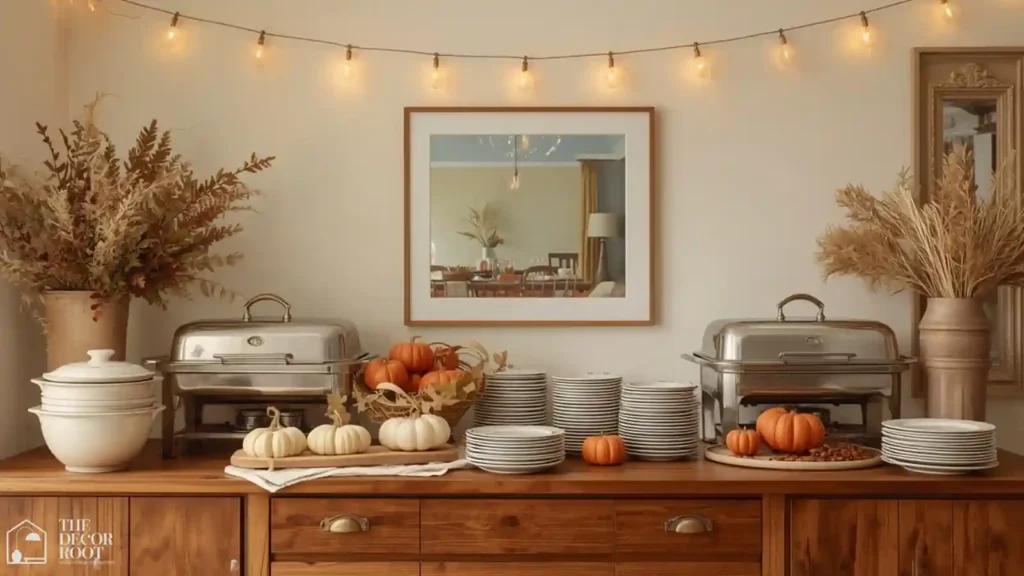
For genuinely tight dining rooms, moving the entire serving setup to a dedicated buffet station, even a folding table against a wall with a chafing dish set to keep food warm, solves the space problem completely by removing serving dishes from the equation altogether. Guests fill plates buffet-style, then the dining table only ever needs to hold plates and drinks, not the entire spread.
EDITOR’S PICK
🛒Wood Dough Bowl
A dedicated buffet station with chafing dishes keeps food warm off the table, freeing the dining table for plates and drinks in tight spaces.
(paid link)
Explore more: Pair your layout with 22 Thanksgiving Table Setting Ideas That Aren’t Fussy for the finishing touches, or browse 25 Thanksgiving Centerpiece Ideas Using What You Own for low-profile centerpiece options that won’t crowd a small table.
Quick Action Plan
- Start with the two moves that solve the most space at once: get serving dishes off the dining table entirely (idea 2), and use vertical space- a tiered stand, a sideboard, a bar cart, for everything else (idea 7).
- Then decide whether you need extra seating capacity (a bench, folding chairs, or an extendable table) based on your actual final headcount, rather than assuming you need more space than you do.
- Most small dining rooms can comfortably host more people than they seem to at first glance once serving is handled off-table.
Frequently Asked Questions
Conclusion
A small dining room isn’t a hosting limitation; it’s a design constraint, and constraints usually make for better, more intentional decisions than an unlimited amount of space would. Pick a few of these ideas, plan your layout around your real headcount, and let the room do what it does well: feel close and warm instead of empty and formal.
💾 Save this to your Thanksgiving hosting board.