
Christmas Tree Ideas: Decorate in This Order and It Looks Professional
Most Christmas trees look amateur for one reason, and it is not the tree. It is the order. These Christmas tree ideas start from that order: ornaments go on first in most homes, lights get wound around the outside at the end, ribbon is an afterthought, and the topper leans like it is about to jump. Professionals layer in the opposite direction: shape, lights, ribbon, large ornaments deep, medium ornaments, fillers, topper, then the base. This article is that order, with the fix for every step when it goes wrong.
You do not need a new tree to use these Christmas tree ideas, and you do not need all 12 products below. Find the step where your tree falls apart, fix that section first, and stop when the tree looks finished from the doorway. Every product here solves one specific decorating problem in one specific section.
How we choose: We don’t buy every product we list. We compare manufacturer specs, dimensions, materials, capacity, and patterns in verified owner reviews: what owners repeatedly praise, and what they repeatedly complain about. If we ever hands-on test a product, its box will say TESTED. Researched and updated: October 2026. Links to Amazon are paid affiliate links.
Affiliate Disclosure: This article contains affiliate links to products on Amazon. As an Amazon Associate I earn from qualifying purchases. The price you pay stays the same, and the commission helps keep The Decor Root running.
The Layering Order (And Why Your Tree Looks Sparse Even With 100 Ornaments)
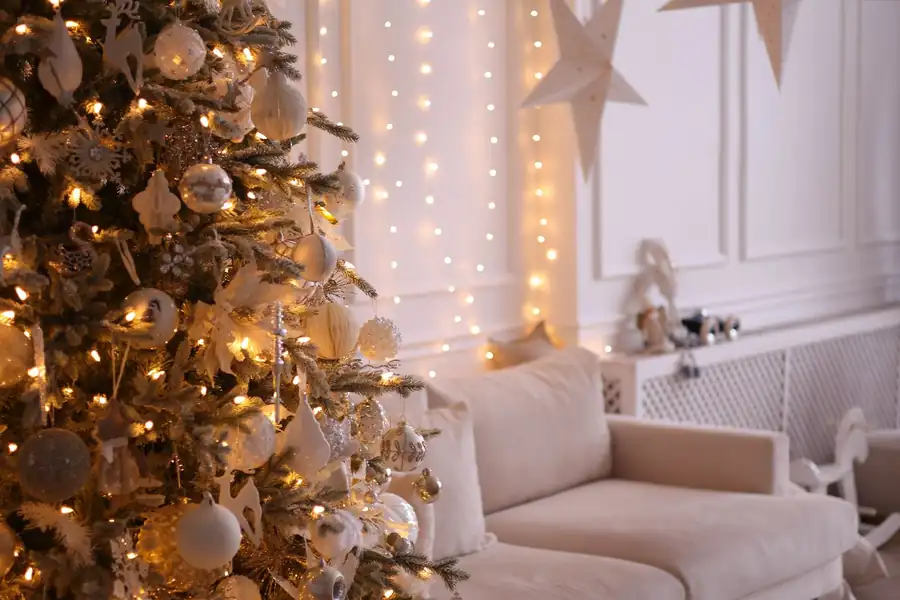
A tree looks sparse for two reasons, and neither one is the number of ornaments. The first is light: a tree lit only on the outside looks flat, because the inside stays dark and every gap reads as a hole. The second is depth: ornaments hung only on the branch tips look like a shell, because nothing fills the middle of the tree. Fix those two things and these Christmas tree ideas make a tree with 60 ornaments look fuller than a tree with 120 ornaments hung the wrong way.
Here is the order, start to finish. First, shape the tree: pull every branch out and down, fluff the tips, and stand back to check the silhouette before anything goes on it. Second, lights, worked inside-out, not wrapped around the outside. Third, ribbon, looped in deep, not draped on the surface. Fourth, large ornaments hung deep near the trunk. Fifth, medium ornaments through the middle. Sixth, small ornaments and fillers on the tips. Seventh, the topper, anchored, not balanced. Eighth, the collar or skirt at the base.
The ornament and light formula below is a working rule, not a law of nature, but it ends the annual guessing. Count lights at about 100 per foot of tree. Count ornaments at about 10 per foot for a full look. That gives a 7.5 foot tree roughly 750 lights and roughly 75 ornaments. A 6 foot tree needs roughly 600 lights and 60 ornaments. A small 4 foot tree needs roughly 400 lights and 40 ornaments. If your tree still looks thin at those counts, the problem is almost never the count: it is lights only on the outside, or no large ornaments deep inside.
One more rule before the table: decorate from the inside out and from the top down. Lights and large ornaments go in first and deepest, because you cannot reach the inside of the tree once the tips are covered. The pretty work at the front is last, not first.
Quick Decision Table: By Tree Type and By Room Size
| Your situation | First decision | Watch out for |
|---|---|---|
| Real tree, cut fresh | A stand that one person can set up, and a daily watering habit | A dry tree near heat, and a stand that is too small for the trunk |
| Pre-lit artificial tree | Check the built-in lights before decorating, and keep spare fuses | A dark section you only notice after ornaments are on |
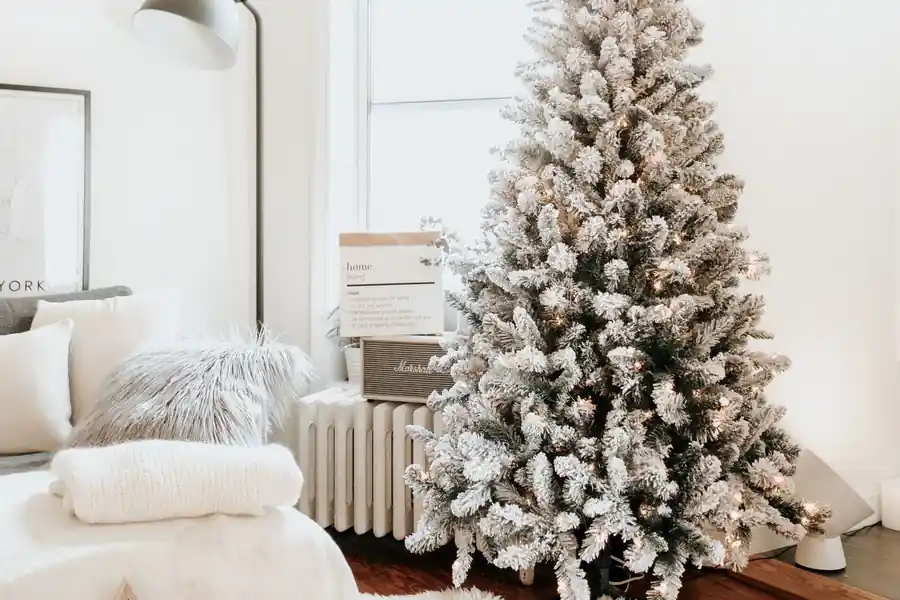
| Flocked artificial tree | Fluff outdoors or over a sheet, and vacuum after setup | Flocking shed on floors, and a top section that needs help holding a topper |
| Small tree, small room | One palette, fewer ornaments, and a collar instead of a skirt | Over-decorating: a small tree with 100 ornaments looks crowded, not festive |
| Standard living room, 7 to 8 foot tree | The full layering order in this article | The tree blocking a walkway or an exit |
| Large room or high ceiling | A taller tree plus large ornaments deep, or the tree looks lost | A topper that is too small for the tree: scale the topper up with the tree |
If your tree is a small one, our small Christmas tree ideas cover the small-space version of this same order. If you love the old-fashioned look, our vintage Christmas tree ideas keep the same layering with a different palette.
Problem 1: The Tree Itself: Gaps, Leaning, Wrong Size for the Room

Three tree problems get blamed on the ornaments, and none of them are ornament problems. Gaps come from unfluffed branches. Leaning comes from the stand. Wrong size comes from buying the tree before measuring the room. Fix the tree before you hang a single ornament, because no ornament covers a gap you can see from the doorway.
Start with size, because it is the only one you cannot fix after the tree is up. Measure the ceiling, then subtract at least a foot for the topper and breathing room: a 7.5 foot tree under an 8 foot ceiling leaves no room for a topper and looks crammed. Measure the floor space too, including the stand’s leg span, not just the tree’s width on the box. A tree that fits the corner but blocks the walkway to the kitchen will annoy you for a month.
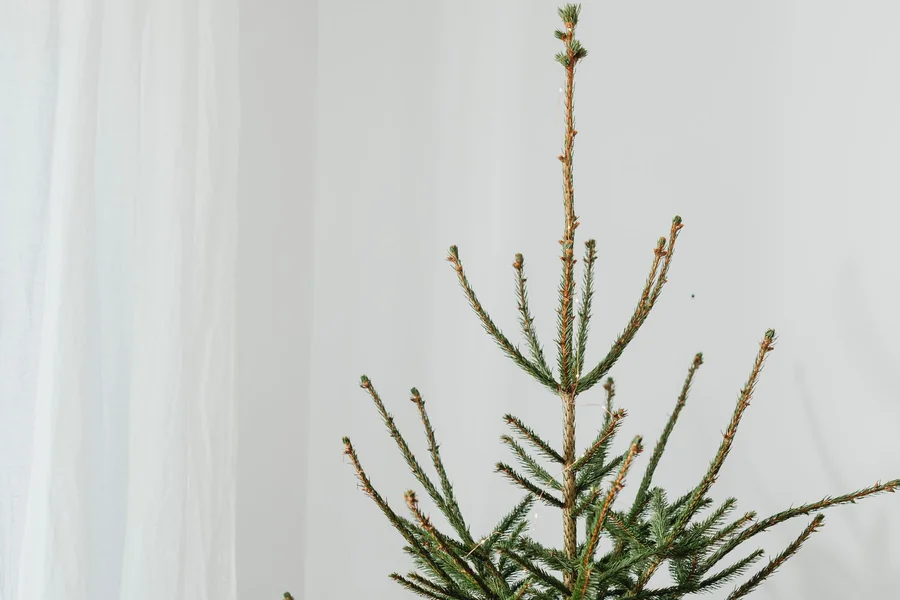
Then fluffing, which takes 30 to 45 minutes on a full artificial tree and cannot be rushed. Pull each branch out from the trunk, spread the tips in different directions, and bend the outer tips slightly downward so the branch reads as full from below. Step back every few minutes and look at the silhouette, not at individual branches. The gaps you see from the doorway are the ones that matter.
Leaning is a stand problem, and it has two different answers. Artificial trees lean when the stand is flimsy or the sections are not seated. Real trees lean when the trunk is not clamped straight, and fixing it is a two-person wrestling match with a screw stand. A foot-pedal clamping stand ends that match: one person can set the tree straight, and the water gauge tells you when to refill without crawling under the branches.
Finish the base before the ornaments go on. A collar hides the stand and the tangle of cords, and it looks cleaner than a fabric skirt that wrinkles and slides. Measure the stand’s leg span first, because collars do not stretch, and put felt pads under a metal collar on a hard floor so it does not scratch.
Also solves this: a real tree that leans and takes two people to set straight
Krinner Christmas Tree Genie M, Foot-Pedal Stand for Real Trees up to 7 ft
A foot-pedal clamping stand with a built-in water level indicator, so one person can set a real tree straight without crawling under the branches. Not for: trees over 7 ft, check trunk diameter before buying; the unit is heavy, the reservoir is tricky to empty, and it is overkill for artificial trees, which come with their own stands.
Check Price on Amazon → (paid link)
Also solves this: a wrinkled skirt and a stand that shows
BIRDROCK HOME 4-Panel Hammered Metal Christmas Tree Collar, Gold
Four hammered metal panels that hide the stand and the cords, fold flat for storage, and cannot be clawed the way fabric can. Not for: stands wider than the collar, measure the leg span first, and use felt pads under it on hard floors so the metal does not scratch.
Check Price on Amazon → (paid link)
Problem 2: Lights and Ribbon Look Tangled, Not Layered

Lights look tangled when they are wrapped around the outside of the tree like a belt. The professional method is the opposite: work each strand from the trunk outward, weaving in and out of the branches, so light comes from inside the tree. Start at the top and work down, one section at a time, and step back with the room lights low to check for dark patches before moving on. A tree with lights only on the surface will always look flat in the evening, no matter how many strands it has.
Count from the formula, not from the box. A 7.5 foot tree needs roughly 750 lights, which means two to three strands of 300 lights, not one. One 99 foot strand of 300 lights is not enough for a 7.5 foot tree on its own, and buying a second strand in January is the most common regret in tree decorating. Buy the count the formula gives you, plug the strands in as you go, and replace any strand with worn cords or loose connections before it goes on the tree.
Ribbon fails for the opposite reason: it is draped on the surface instead of looped deep. The width matters more than the pattern. A 2.5 inch wired ribbon holds its loops, because the wire edge keeps the shape; narrow unwired ribbon collapses into strings. Cut the ribbon into lengths, make loose loops, and tuck each loop deep between branches, working top to bottom, so the ribbon reads as part of the tree rather than decoration stuck on top. Ten yards dresses one tree lightly: plan on two to three rolls for a full 7.5 foot tree.
Also solves this: ribbon that collapses instead of holding loops
WIKHIA Burlap Wired Edge Ribbon, 2.5 Inch, 2 Rolls of 6 Yards, Solid Burlap-Natural
Solid natural-coloured wired ribbon in 2 rolls of 6 yards, for cutting into lengths and looping deep between branches. Not for: anyone wanting natural jute fiber, this is a polyester burlap-look ribbon, and plan on two to three rolls for a full 7.5 foot tree.
Check Price on Amazon → (paid link)
Then the small fix that makes the whole layering look professional: clips. Light runs sag between branches, and sagging runs are what make a tree look homemade. A clip every foot keeps each run straight, and the same clips tidy the cord from the tree to the outlet so nobody trips over it in the dark. The same clips tidy a mantel garland too, and our Christmas mantel styling ideas pair with this section.
Also solves this: light runs that sag between branches
MEILIDY Christmas Light Clips, 100 Pieces, White/Clear
Snap-on clips that keep each light run straight instead of sagging, one clip about every foot, and the same pack tidies the cord to the outlet. Not for: permanent outdoor mounting, plastic gets brittle after seasons in sun, and match the clip to the surface before buying.
Check Price on Amazon → (paid link)
Problem 3: Ornaments Cluster at the Front and the Topper Falls Off

Ornaments cluster at the front because the front is where the decorator stands. The fix is a rule: hang by size, from the inside out. Large ornaments go deep, near the trunk, where they create the illusion of fullness. Medium ornaments fill the middle of the branch. Small ornaments and fillers go on the tips, where they catch the light. When every size hangs at the same depth, the tree looks like a wall of ornaments. When sizes are layered by depth, the same ornaments look twice as full.
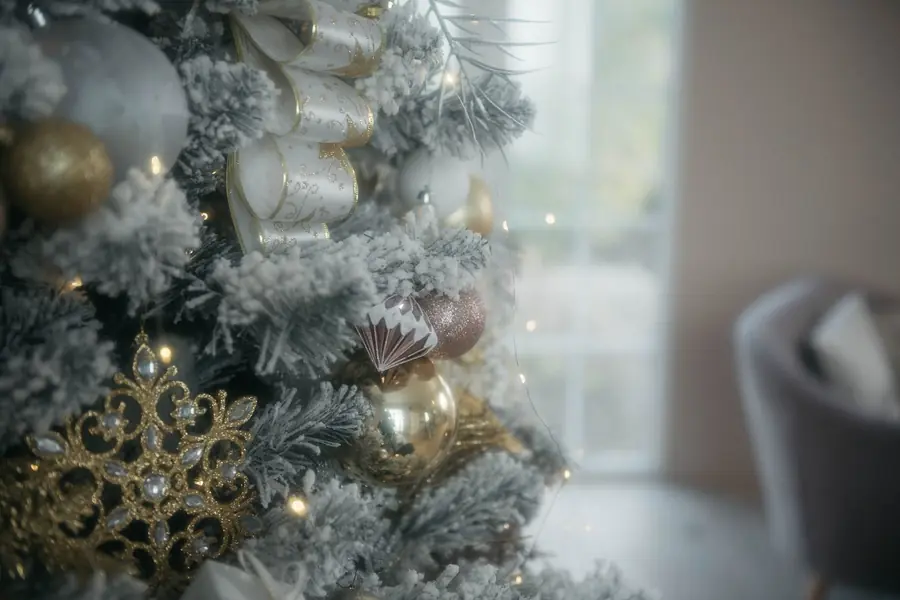
Colour discipline is the second half of the fix. Pick one palette and stay in it: champagne gold and white, for example, with every ornament in that family. A box of mixed colours from three different years is the fastest way to a tree that looks busy rather than decorated. One palette also makes the budget work: a single 50 piece set in one palette covers the bulk of the tree, and a handful of oversized ornaments in the same palette does the depth work.
The topper falls off because it is balanced, not anchored. No topper stays up by itself on a flocked or full tree. The anchor trick is floral wire: wire the topper to the top three branches, not just the single top stem, so the weight spreads and the topper stands straight. Scale the topper to the tree as well: a small topper on a 7.5 foot tree looks lost, and a 12 inch star has the presence the height needs. And if your tree’s top section is weak from flocking, wire the topper lower, into the strongest branches, rather than forcing it onto the very tip.
Also solves this: a tree that looks thin no matter how many small ornaments it has
RoseCraft 5.9 in Shatterproof Oversized Ornaments, 6-Pack, Gold
Six oversized balls hung deep near the trunk, the depth-layer trick that makes a tree look twice as full. Not for: hanging on branch tips, oversized balls belong deep, not on tips, and colour-match them to the palette set so they read as part of the tree.
Check Price on Amazon → (paid link)
Also solves this: a topper that falls off or looks too small for the tree
Elf Logic 12 in Bright White LED Moravian Star Tree Topper
A folding 3D Moravian star in bright white, 12 inches, with the presence a 7.5 foot tree needs, and a hanging mount that takes the anchor trick well. Not for: trees with a weak top branch unless it is wired to the top three branches, and it needs an outlet nearby.
Check Price on Amazon → (paid link)
Problem 4: Kids, Pets and January: Safety and Storage
December safety is mostly about three things: electricity, heat, and breakage. Electricity means no worn cords, no loose connections, and lights on a timer so they are never left on all night or while the house is empty. Heat means the tree stands at least three feet from fireplaces, radiators, candles and heat vents, and a real tree stays watered every day, because a dry tree is the fire risk, not a watered one. Breakage means
shatterproof ornaments at low height, where kids and pets actually reach, and glass kept high or not bought at all. The National Institute of Standards and Technology holiday fire safety guidance, which repeats the National Fire Protection Association Christmas tree tips, covers the same three rules: water daily, keep three feet from heat, and turn lights off before bed or leaving the house. Outdoor lights follow the same rules, and our front porch Christmas ideas and outdoor Christmas decoration ideas carry the outside version of this setup.
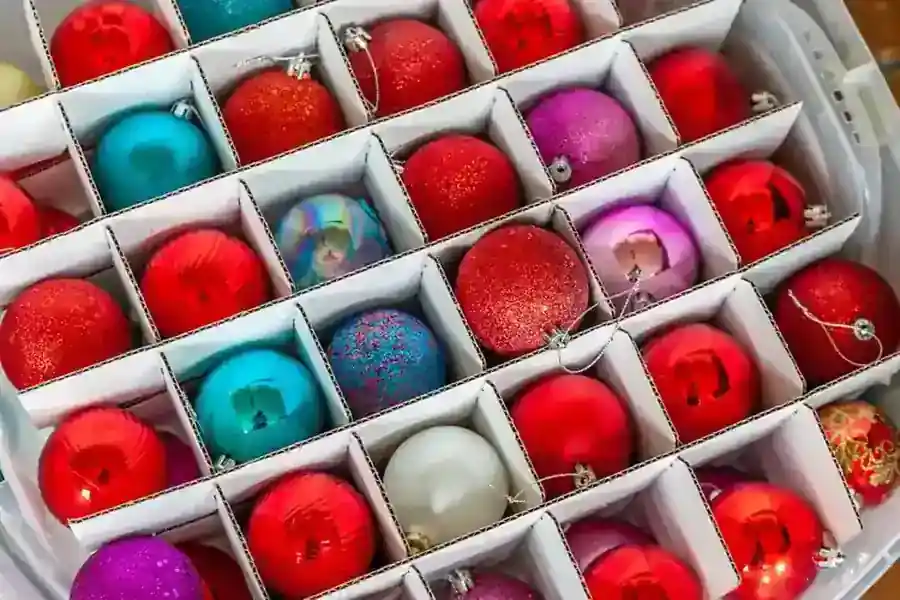
January is where most trees cost their owners twice. Ornaments tossed loose into a bag break, tangle, and take twice as long to hang next year. The fix is a box with adjustable dividers, bought in December when the ornaments are bought, not discovered missing in January. Set the dividers to your ornament sizes, wrap glitter pieces in tissue, and label the box by palette so next year’s tree starts organised. The tree itself goes in a bag, not back in the cardboard box it came in, because that box rarely survives January.
Be honest about the teardown: a duffel bag means disassembling the tree, about 20 minutes of work. Readers who refuse disassembly want an upright cover that slips over the decorated tree instead, but it needs vertical closet space, so measure before choosing.
Also solves this: the cardboard box that never survives January
BALEINE 7.5 ft Christmas Tree Storage Bag, Dual Zipper, Gray
A heavy-duty bag with dual zippers, reinforced handles and room for the sections, skirt and stand together. Not for: readers who refuse disassembly, this is a duffel that needs about 20 minutes of teardown; an upright cover suits those readers instead, if they have vertical closet space.
Check Price on Amazon → (paid link)
Also solves this: lights left on all night, and the evening look with no effort
BN-LINK 7-Day Digital Outdoor Timer, Dual Outlet
A 7-day programmable timer with dual outlets and 8 on/off programs, so the tree and the porch run from one plug and the lights are never left on all night. Not for: programming in the dark, the button labels are hard to read in low light, so program it indoors first, and mount it vertically at least 2 feet off the ground to keep the weatherproof rating.
Check Price on Amazon → (paid link)
7 Tree Mistakes
- Hanging ornaments before lights: once the tips are covered, the inside of the tree is unreachable, and the lights end up on the surface.
- One ornament size only: without large ornaments deep, the tree has no depth, and adding more small ornaments only makes the shell thicker.
- Balancing the topper instead of anchoring it: wire it to the top three branches, or it leans by Christmas morning.
- A collar or skirt too small for the stand: measure the leg span before buying, because collars do not stretch.
- A tree blocking a walkway or an exit: measure the floor space, not just the ceiling height, before the tree goes up.
- Forgetting the back: if the tree is visible from another room or a doorway, the bare back is part of the display, so light and decorate it too.
- Lights left on overnight and a dry tree near heat: use the timer, water a real tree daily, and keep three feet from every heat source.
Budget Plans: $50 Refresh, $150 Full Redecorate in One Palette, $400 New Tree Year
Every tier below uses only the products from this guide, no new picks.
$50 Refresh: WIKHIA solid natural-coloured wired ribbon, the light clips, and the timer. A tree that already exists, relit neatly, re-looped, and on a timer, looks new without a single new ornament.
$150 Full Redecorate in One Palette: the 50 piece white and gold ornament set, the oversized gold ornaments, the gold collar, and the bright white star topper. That is one palette from base to top, and the depth layer included. For the full farmhouse room beyond the tree, our farmhouse Christmas decor ideas carry the same palette through the house.
$400 New Tree Year: the flocked tree, extra fairy lights to reach the formula count, the ornament set, the storage box, and the tree bag. That is a new tree plus everything needed to decorate it and pack it away properly in January. Before guests reach the tree, they pass the entryway: our Christmas entryway ideas set that first impression.
If you already own a tree and only want the snowy look, mention the flocking kit option in your planning: a flocking kit is a small DIY purchase, not a CTA pick here, because complete flocked trees carry the review volume and the value in this guide.

FAQs: Christmas Tree Ideas, Answered
The questions below are the ones decorators ask most about Christmas tree ideas.
1. How many ornaments do I need for a 7.5 foot tree?
Ans: About 75 ornaments, from the formula of roughly 10 per foot. That breaks down as a handful of large ornaments hung deep near the trunk, medium ornaments through the middle, and small ornaments and fillers on the tips. If your tree still looks thin at 75, check the lights and the depth layer before buying more.
2. Is a real tree or an artificial tree cheaper per year?
Ans: An artificial tree costs more once and then nothing for years, while a real tree costs every single year, plus the stand, plus water and disposal. Over five years the artificial tree is usually cheaper, but the real tree wins on scent and tradition, which is a personal call, not a money call.
3. Do flocked trees shed a lot, and is the mess worth it?
Ans: Yes, flocking sheds during setup and first fluffing, and that is normal, not a defect. Fluff over a sheet, vacuum after setup, and the shedding drops sharply once the tree is decorated. Pet and kid homes should vacuum once more after the first day.
4. When is the best time to buy Christmas decorations?
Ans: January, when the season’s stock clears, for next year’s tree, and early November for this year’s tree, when the full range is still in stock. Buying in December means paying full price for a picked-over range, so the January sale is where the storage box and the ornament set get cheapest.
5. What width of ribbon holds loops on a Christmas tree?
Ans: A 2.5 inch wired ribbon, because the wire edge holds the loop shape. Narrow unwired ribbon collapses into strings. Cut it into lengths, loop it deep between branches, and plan on two to three rolls of 10 yards for a full 7.5 foot tree.
The Bottom Line on Christmas Tree Ideas
A Christmas tree does not look professional because of how much was spent on it. It looks professional because of the order: shape, lights inside, ribbon deep, large ornaments near the trunk, medium and small out to the tips, topper anchored, base finished. Follow that order, count from the formula instead of guessing, and fix the one step where your tree falls apart. Do that, and the tree looks like someone who knew what they were doing decorated it, which is the whole point of these Christmas tree ideas.
Once the tree is layered, give the fireplace the same treatment with our christmas mantel ideas.
Save these Christmas tree ideas to your Pinterest board, so your tree is layered in the right order before the first guest arrives!
Photos via Pexels.