
Laundry Room Organization Ideas: A Sort-by-Household System That Keeps Piles Off the Floor
laundry room organization ideas start with one fact, not one purchase. The pile on the floor is not a storage problem, it is a sorting problem, because clothes with no assigned path land wherever the basket tips, and the room drifts back to clutter within a week of every tidy-up. Most organization lists skip that fact and show matching baskets, then call the room done. A room earns its order from the system you sort by, and the system is household size first, zones second, and storage last, because storage bought before the system is storage that holds the wrong things in the wrong place.
This article promises a laundry room that stays sorted between wash days, not just on the day you tidy it. You get a sort-by-household system, a five-zone layout, hamper sizing by household size, folding-station depth by station type, shelf spacing that fits bottles and baskets, six problems solved in order, and 12 researched picks mapped to the jobs where they work. Nothing here asks you to buy everything at once, and nothing here asks one basket to carry the whole room.
This article is research based curation, not hands on testing. Where a detail could not be verified, it is left out rather than guessed, and you should check size, capacity, and contents on the live listing before ordering. The numbers quoted from other sites, the 54 to 56 inch pair width, the 24 to 28 inch folding depth, and the 12 to 14 inch shelf spacing, are their figures, not tested claims.
How these picks were chosen: each pick was researched from listing and source pages and checked at the publish date. No star rating is claimed for any pick. Check size, color, and contents on the listing before ordering, because listings and variants change. Where a detail cannot be verified, it is left out rather than guessed.
Affiliate disclosure: This article contains affiliate links to products on Amazon. As an Amazon Associate I earn from qualifying purchases. The price you pay stays the same, and the commission helps keep The Decor Root running.

Pick Your Sorting System First, Then Buy Storage to Fit It
Pick the sorting system before you buy a single basket, because the system decides how many sections you need, how big each one must be, and where each one lives. A household of two sorts into two sections, lights and darks, with delicates in a mesh bag inside a load, and a household of four needs three sections at 135L to 190L total, or one basket per person plus shared category hampers. Buy the baskets first and you own three bins for a two-section household, or two bins for a four-person household, and the system fails before the first load.
Run the audit in order, because the order is the method. Count the people, count the loads per week, and watch which category fills first, because the category that fills first sets the wash schedule and the basket size. Then give each job its own zone, sort, wash, fold, dry, put away, with storage on the walls and the things used every load within arm’s reach of the washer. The room that sorts by household size and zones by job is the room that stays sorted, and the room that starts with matching baskets is the room that drifts back to the floor pile.
The wallpaper version of the same room, with wall coverings that handle humidity and steam, is shown in laundry room wallpaper ideas.
| Sort or measure | Size or system |
|---|---|
| Sort by category | Darks, lights, towels, bedding, special-care items combined into efficient loads (The Dutchman’s Laundry) |
| Sort by person | Each person has a hamper or basket, washed together where care labels permit (The Dutchman’s Laundry) |
| Hybrid system | Bedroom hamper per person, sorted into shared categories before washing (The Dutchman’s Laundry) |
| Household of 1 to 2 people | 2 sections, lights and darks, delicates in a mesh bag inside a load (Homestaire; The Dutchman’s Laundry) |
| Household of 3 people | 145L 3-section hamper, stated by its maker to hold a week of clothes, 23 in L x 14.6 in W x 27.1 in H (Bathola) |
| Household of 4 or more | 3 sections at 135L to 190L total, or one basket per person plus shared category hampers; 135L hamper 27.56 in x 15.75 in x 25.98 in, 44 lb maximum load (SONGMICS manual via manuals.plus; Spacetronik) |
| Side-by-side pair wall | About 54 to 56 inches of wall, each machine about 27 inches wide (HeySunday) |
| Folding counter height | 36 inches; HomeRoomFix gives 36 to 40 inches; MyComfyHouse gives 36 to 38 inches (HeySunday; HomeRoomFix; MyComfyHouse) |
| Folding counter depth over front loaders | 24 to 28 inches; minimum 24 inches deep by 36 inches wide, 48 to 60 inches wide for larger households (CascadeFlare; MyComfyHouse) |
| Wall-only folding shelf | 12 to 16 inches deep, for clothing only (HomeRoomFix) |
| Folded shirt footprint | About 12 by 14 inches; folded queen sheet about 30 by 20 inches at the intermediate fold stage (Quiet Minimal) |
| Lowest shelf above the machines | 18 to 20 inches above the machine tops for front loaders; 18 inches above a worktop so a bottle still stands under it; top loaders: open the lid fully, measure to the top of it, add a couple of inches; second source gives 20 to 24 inches of vertical clearance above a top loader (HomeRoomFix; NameChuckle; HeySunday; CascadeFlare) |
| Spacing between shelves | 12 to 14 inches for detergent bottles and bins; 16 inches of clear height lets a tall bottle lift straight out, 12 inches for folded cloths and tins (HomeRoomFix; NameChuckle) |
| Shelf depth | 12 inches takes a detergent bottle, a spray cleaner, a folded cloth, and a jar of pegs in one row; 16 inches only for baskets or bulk packs (NameChuckle) |
| Slim gap beside a machine | Slim rolling cart, often around 5 inches wide; carts as slim as 4 inches wide (Homestaire; OxiClean) |
| Retractable line | Roughly 10 feet of air-drying space for delicates and activewear (Homestaire) |
| Walkway in front of machines | 48 inches minimum for full door opening and standing room while loading (MyComfyHouse; CascadeFlare) |
The table figures come from named guides, and where the guides disagree, the range is shown and the conflict is named, not settled. The sort-by-household framework comes from The Dutchman’s Laundry, the pair width and the top-loader lid rule come from HeySunday, the folding depths and the shelf figures come from HomeRoomFix, CascadeFlare, MyComfyHouse, and NameChuckle, and the slim gap and the retractable line come from Homestaire and OxiClean.
The two between-shelf figures, 12 to 14 inches and 16 inches, disagree, so the article presents them as a range tied to what sits on the shelf: tall bottles need 16 inches, folded cloths and tins need 12 inches. The folding depths, 12 to 16 inches for a wall shelf and 24 to 28 inches for a counter over the machines, are different jobs, not a conflict: the wall shelf is for clothing only, the counter must also handle bedding folds.
Quick check: when one sorting bag is full, it is one load, so a full bag means wash now, not sort later
Laundry Room Organization Ideas: Sort by Household Size: 2 Sections, 3 Sections, or 1 Basket per Person
Sort by household size, because the household decides the system and the system decides the baskets. A household of one or two people sorts into two sections, lights and darks, with delicates in a mesh bag inside a load, and two sections are enough because the loads are few and the categories fill slowly.
A household of three moves to three sections, darks, lights, and delicates, and a 145L three-section hamper is stated by its maker to hold a week of clothes for a family of three. A household of four or more needs three sections at 135L to 190L total, or one basket per person plus shared category hampers, because the loads are many and the mix-ups are the problem.
Choose between three systems, not three basket colours. Sort by category gives shared hampers for darks, lights, towels, bedding, and special-care items, combined into efficient loads, and it suits a household that washes by category and wants the fewest baskets. Sort by person gives each person a hamper or basket, washed together where care labels permit, and it suits a household where mix-ups are the problem and easy return matters most. The hybrid system gives each person a bedroom hamper, then sorts into shared categories before washing, and it suits a household that needs both easy collection and careful separation.

Size the hamper by how fast each section fills, not by the room, because a hamper that fills in three days sets a three-day wash rhythm and a hamper that fills in seven days sets a weekly rhythm. The 135L three-section hamper measures 27.56 by 15.75 by 25.98 inches with a 44 lb maximum load, and the 190L three-compartment hamper measures 64 by 40 by 75 cm with a 25 kg maximum load, so the larger household takes the larger total and the two-person household takes the two-section size. When one sorting bag is full, it is one load, so a full bag means wash now, not sort later, and that rule is the whole system in one sentence.
The sorter below is the first purchase, because it turns the system into furniture. Three removable bags for darks, lights, and delicates sit on locking wheels, with a folding table on top, so sorting and folding happen at one station and the bags carry the load to the machine without a second basket.
Where Each Zone Goes: Sort, Wash, Fold, Dry, Put Away
Give each job its own zone, because a room with five zones never asks one surface to do five jobs. Sort sits where the dirty clothes arrive, wash sits at the machines, fold sits at the counter or the wall shelf, dry sits at the rack or the line, and put away sits at the destination baskets beside the folding station. The path runs in order, hamper, sorting area, washer, dryer or drying rack, folding station, designated storage space, with a clear place and owner at every stage, and the order is the system that The Dutchman’s Laundry builds its whole guide around.
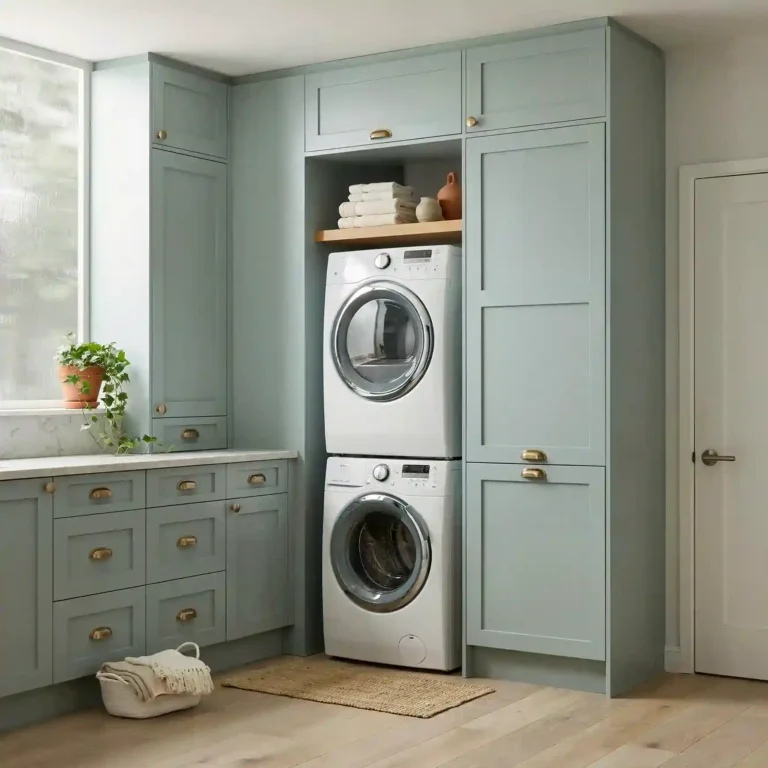
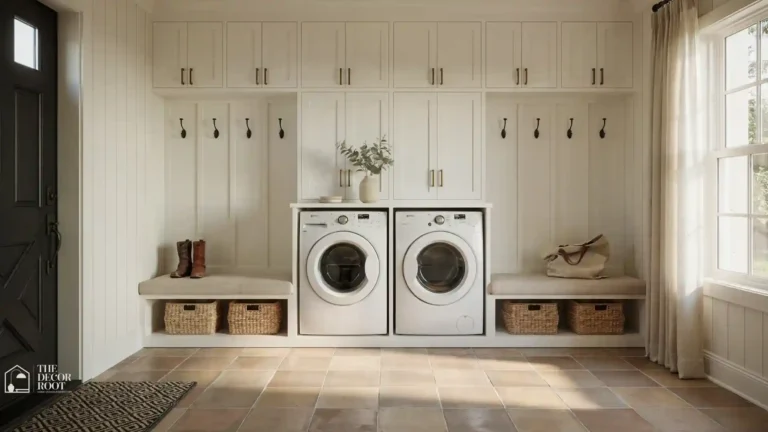
Keep the zones tight, because a zone that sprawls is a zone that collects clutter. Sorting needs the hamper and the sorter within one step of the door, washing needs detergent within arm’s reach of the washer, folding needs the counter clear and the destination baskets beside it, drying needs the rack or the line clear of the dryer vent, and put away needs one finished load at a time, not five half-finished piles. A side-by-side washer and dryer pair takes about 54 to 56 inches of wall, each machine about 27 inches wide, so the zones stack vertically above the pair and the walkway in front stays 48 inches clear for full door opening and standing room while loading.

The zone that fails first is always the fold zone, because clean clothes with nowhere to fold land in baskets and live there. Fix the fold zone before you buy more baskets, because a basket is storage and a folding station is a job done, and the room that folds at the counter is the room that puts clothes away. The folding-station depth that decides it, 24 to 28 inches over front loaders and 12 to 16 inches for a wall-only shelf, is covered in the section below, and the wall coverings that survive the steam in this room are shown in laundry room wallpaper ideas.
Hamper and Basket Sizing by Household Size
Size the hamper by the household, not by the aisle, because the hamper is the wash schedule in furniture form. A 150L three-section hamper with a lid suits a bedroom or a laundry room where the pile must stay out of sight, and its three sections sort lights, darks, and colors at the point of undressing, so the sorting happens when clothes come off, not at wash time on your knees.
The 135L three-section hamper suits a family routine with a 44 lb maximum load, the 145L three-section hamper is stated by its maker to hold a week for a family of three, and the 190L three-compartment hamper suits a larger household, so the size follows the speed each section fills.
Match the basket to the job, because one basket shape cannot do every job. The lidded hamper hides the pile and suits the bedroom, the open basket suits the shelf where supplies must be seen and grabbed, and the mesh bag suits delicates that must wash inside a load without snagging. A basket that is too large for its section invites overfilling past the load limit, and a basket that is too large for its floor space blocks the walkway, so measure the floor first and the basket second, and keep the 48 inch walkway in front of the machines clear.
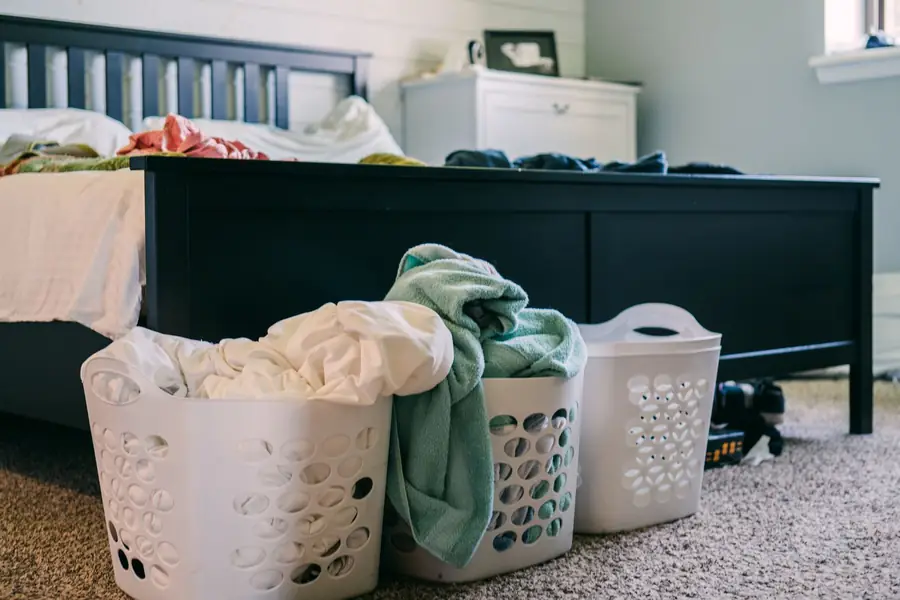
The bedroom version of the same sizing rule, with layers that keep a cold room warm, is shown in winter bedroom ideas.
Also solves this: the bedroom pile that must stay out of sight, not the room that wants a rolling sorter
SONGMICS Laundry Hamper, 39.6 Gal (150L), 3-Section Laundry Basket with Lid, Bamboo, Foldable, Removable and Machine Washable Liner, Natural, ULCB091N01
Capacity 150L; 3 sections; product dimensions 23.6 in L x 15.7 in W; bamboo frame; foldable; removable and machine washable liner; lid included; model ULCB091N01, as printed. The lidded hamper for a bedroom or a laundry room where the pile must stay out of sight. Three sections sort lights, darks, and colors at the point of undressing. Not for: A household that needs wheels, since this is a fixed hamper to carry by its handles, or a room where a 150L hamper is too large for the floor space.
(paid link)
Folding-Station Depth: Over the Machines, on the Wall, or Beside Them
Depth decides whether folding happens or whether clean clothes live in baskets, because a surface too shallow for a shirt is a surface that never gets used. A folding counter over front loaders needs 24 to 28 inches of depth, with a minimum of 24 inches deep by 36 inches wide, and 48 to 60 inches wide for larger households, because a folded shirt takes about 12 by 14 inches and a folded queen sheet needs about 30 by 20 inches at the intermediate fold stage.
A wall-only folding shelf at 12 to 16 inches deep still works for sorting and folding clothing, because clothing folds flat in that depth and bedding does not, so the wall shelf is for clothing only and the counter must also handle bedding folds.
Set the height at 36 inches, the kitchen counter height, so most people fold without bending, with HomeRoomFix giving 36 to 40 inches and MyComfyHouse giving 36 to 38 inches for the counter. The height and the depth work together: a counter at the right height and the wrong depth still fails, because the sheet hangs over the front edge, catches, and pulls out of square. Measure the machines first, then pick the counter, because the machines decide the height and the folding job decides the depth, and the catalog decides neither.

The wrinkle fix sits at the folding station, not in a separate ironing corner, because a shirt steamed straight off the drying rack never reaches the ironing board. A handheld steamer smooths the shirt where it folds, so ironing stays a touch-up job, and the steamer below is the pick for that job, with its 120V limit stated plainly so no reader orders it for a 220V outlet.
The desk version of the same folding-station math, with a surface sized to the work and not to the room, is shown in home office design ideas.
Shelf Spacing Above the Machines That Fits Bottles and Baskets
Shelf spacing is decided by what sits on the shelf, not by a single number, because the guides disagree and the disagreement is the answer. HomeRoomFix gives 12 to 14 inches between shelves for detergent bottles and bins, and NameChuckle gives 16 inches of clear height so a tall bottle lifts straight out, dropping to 12 inches for folded cloths and tins. Use 16 inches where tall bottles live and 12 inches where folded cloths and tins live, and do not merge the two figures into one settled number, because the shelf contents decide the spacing and the spacing decides whether the bottle comes out cleanly.
Set the lowest shelf by the machine type, because front loaders and top loaders need different clearances. For front loaders, the lowest shelf sits 18 to 20 inches above the machine tops, and 18 inches above a worktop still lets a bottle stand under it. For top loaders, open the lid all the way, measure to the top of it, and add a couple of inches before fixing the lowest shelf, with a second source giving 20 to 24 inches of vertical clearance above a top loader. A shelf fixed before the lid is measured is a shelf that blocks the lid, and a blocked lid is a room that cannot wash.

Keep the shelf depth to 12 inches for a single row of supplies, because 12 inches takes a detergent bottle, a spray cleaner, a folded cloth, and a jar of pegs in one row, and 16 inches is only for baskets or bulk packs. A shelf deeper than its contents invites a second row behind the first, and the second row is where bottles go to be forgotten. The shelf layer below carries the two picks for this section: the over-machine shelf frame and the matching shelf basket, sized to the same 12 inch depth.
Also solves this: the shelf that needs matching bins that pull down as a unit, not the shelf that needs a lidded bin
mDesign Farmhouse Decor Metal Wire Food Storage Organizer Bin Basket with Handles, 12 in x 9 in x 6 in
Size 12 in x 9 in x 6 in; metal wire; built-in handles; open front; brand mDesign, as printed. The shelf basket. One size repeated across the shelf keeps detergent, stain pens, dryer balls, and cloths in matching bins that pull down as a unit. Not for: Wet items, since this is an open wire basket for dry supplies, or a reader who wants a lidded bin, since this basket has an open top and open front.
(paid link)
The Slim Gap Beside the Machines: What Fits in 5 Inches
The gap beside the machines is the most wasted space in the laundry room, because it looks too narrow to use and it is exactly wide enough for a cart. A slim rolling cart, often around 5 inches wide, holds bleach, stain sticks, and sponges, and OxiClean notes carts as slim as 4 inches wide, so measure the gap before you buy and buy the cart that fits the gap, not the cart that looks right in the listing photo. The cart rolls out when a bottle is needed and rolls back when the load starts, so the supplies live beside the machine instead of on top of it.
Use the gap for the bottles you reach every load, because the gap cart is for reach, not for bulk. Bleach, stain sticks, sprays, and dryer sheets belong in the cart, and bulk detergent belongs on the shelf above the machines, because a slim cart loaded with bulk jugs is a cart that tips and a cart that never rolls. The six side hooks on the cart below hold the lint roller, the mesh bags, and the stain pen, so the hand tools hang where the hand reaches them.

Measure the gap at the floor and at the machine top, because a machine that leans or a wall that bows can make the gap narrower at one end than the other. A cart that fits at the top and sticks at the floor is a cart that never rolls, so the narrowest measurement is the one that decides. The bathroom version of the same gap thinking, with storage fitted to the room instead of the floor, is shown in modern farmhouse bathroom ideas.
Also solves this: the gap beside the machine that holds bottles within reach, not the bulk store that needs a shelf
Simple Houseware 3-Tier Slim Rolling Storage Cart with Handle, 5.5 in Wide x 26.5 in Height, Black, CB-15A-K
3 tiers; width 5.5 inches; height 26.5 inches; 6 side hooks; rolling organizer; model CB-15A-K; UPC 811244039448, as printed. The gap cart. At 5.5 inches wide it slides into the gap beside a machine that Homestaire and OxiClean both describe, holding bleach, stain sticks, and sprays where they are reached every load. Not for: A gap narrower than 5.5 inches, since the cart will not fit, or heavy bulk detergent, since this is a slim cart for bottles and tins, not a bulk store.
(paid link)
Drying Without a Floor Rack: Wall Racks and a Retractable Line
Delicates and air-dry items need a drying zone that does not take the floor, because a floor rack in a laundry room is a trip hazard that stays up all week. The wall rack folds flat when not in use, and the retractable line pulls out across the room while laundry dries and retracts into its housing when done, so no rack stays up between loads. A retractable line gives roughly 10 feet of air-drying space for delicates and activewear, mounted into studs and kept clear of the dryer vent, and the wall rack below folds to 2.25 inches deep when not in use.
Keep one freestanding rack for the full load, because wall drying suits delicates and lighter items, not a full load of wet towels. The freestanding rack below carries up to 50 lb, including towels and bulky items, and folds flat to slide behind a door when laundry is done. Use the wall rack for the delicates, the line for the activewear, and the freestanding rack for the towels, and no single drying method carries a load it cannot hold.

Mount the wall rack and the line into studs, because a drying rack loaded with wet clothes pulls hard on its anchors, and the sources used give no stud spacing or anchor type for the wall rack below, so confirm the mounting hardware on the live listing before ordering. A rack that pulls out of drywall is a rack that drops wet clothes on the floor, and the anchor figure is one the article does not invent. The lighting version of the same wall thinking, with fixtures placed where the work happens, is shown in winter lighting ideas.
Also solves this: the delicates that need wall drying with no floor space, not the full load of wet towels
Honey-Can-Do Wall-Mounted Wooden Clothes Drying Rack, White, DRY-04445
Wall mount; folds to 2.25 inches deep; holds 30 lb; model DRY-04445; UPC 847539044453; material MDF wood, as printed. The wall drying fix for delicates. It folds to 2.25 inches deep when not in use, so air drying needs no floor space at all. Not for: A full load of wet towels, since the rating is 30 lb, or a wall with no stud to anchor into, since mounting must be confirmed before ordering.
(paid link)
The Door and the Dryer Side: Storage That Uses No Floor
The door and the dryer side sit empty while the floor fills up, because both look like dead space and both are storage. An over-door organizer with 24 mesh pockets holds dryer sheets, lint rollers, clothespins, stain sticks, and mesh bags, all visible and off the machines, and a magnetic lint bin sticks to the dryer side where lint is cleared every load, so lint goes straight in instead of onto the floor or into a bucket that takes floor space. Both use no floor at all, and both keep the things used every load within arm’s reach of the washer.
Check the door before you buy the organizer, because an over-door hook needs a door thickness it can fit, and mesh pockets suit light items, not heavy bottles. Check the dryer side before you buy the lint bin, because the magnet needs a metal surface, and a dryer with a non-magnetic side panel needs the wall-mount option with its two hooks instead. The 1.2 gallon lint bin below is a lint bin only, not a trash bin, and the 24-pocket organizer below is for light extras, not for detergent jugs.

Hang the iron, the board, and the bags on wall hooks on the dryer side, because the dryer side is the wall that never gets used and the iron is the tool that always needs a hook. The seasonal version of the same door thinking, with a workspace that uses the wall instead of the floor, is shown in fall home office ideas.
Also solves this: the laundry extras that need 24 visible pockets on the door, not the heavy bottles that need a shelf
Amazon Basics 24 Medium Mesh Pocket Over-the-Door Hanging Shoe Organizer, Light Grey, AQ-NON008
24 medium mesh pockets; door mount; model AQ-NON008; UPC 819154020150; pockets hold one shoe or a pair of slippers each, and the listing states pockets can also store cleaning supplies or household items, as printed. The door organizer for laundry extras. Each pocket holds dryer sheets, lint rollers, clothespins, stain sticks, or mesh bags, all visible and off the machines. Not for: Heavy bottles, since mesh pockets suit light items, or a door where an over-door hook will not fit, since door thickness must be checked before ordering.
(paid link)
Also solves this: the lint that must go straight into a bin on the dryer side, not onto the floor
SUBEKYU Magnetic Lint Bin for Laundry Room, Wall Mounted Metal Lint Box Holder with Lid, White
Capacity 1.2 gallons; magnetic back sticks to the side of a dryer; wall mount with 2 hooks as a second option; lid included; brand SUBEKYU; UPC 778107549035, as printed. The lint fix. It sticks to the dryer side where lint is cleared every load, so lint goes straight in instead of onto the floor or into a bucket that takes floor space. Not for: A dryer with a non-magnetic side panel, since the magnet needs a metal surface, or a household that wants a large trash bin, since this is a 1.2 gallon lint bin only.
(paid link)
Detergent, Lint, and Delicates: The Three Bins That Stop Clutter
Detergent, lint, and delicates are the three clutter sources in the room, and each needs its own bin, because one shared bin is a bin that mixes them. Detergent lives in the shelf basket above the machines, in matching bins that pull down as a unit, with the bulk jugs on the shelf and the daily bottles in the gap cart. Lint lives in the magnetic bin on the dryer side, cleared every load, and delicates live in mesh bags, one bag per delicate load, so bras, lingerie, and fine tops never snag in the machine.
The mesh bag system is two sizes, one large at 40 by 50 cm and one medium at 30 by 40 cm, in 125gsm honeycomb mesh with an auto-lock zipper, and the two sizes cover a large load and a medium load. Keep one bag for the large delicate load and one for the medium, and wash the bags with the load they protect, because a bag that never washes is a bag that holds old detergent. The bags below are fine mesh for delicates only, not for shoes or heavy items, and the pack carries one large and one medium bag, not a single size.

Label every basket and bin, because a label is what stops the room drifting back to clutter within a week. The label tells the next person where the detergent lives, where the lint goes, and which bag holds the delicates, and the room that labels its bins is the room that stays sorted after the tidy-up. The dark version of the same labelling discipline, with every item given one home, is shown in dark moody living room ideas.
Also solves this: the delicates that need a mesh bag per load, not the shoes or heavy items
Kimmama Mesh Laundry Bags for Washing Machine, L plus M, Honeycomb Mesh, 2 Pack
2 pack, 1 large 40 x 50 cm plus 1 medium 30 x 40 cm; 125gsm honeycomb mesh; auto-lock zipper; model Meah Laundry Bag 003; brand Kimmama, as printed. The delicates system. One bag per delicate load keeps bras, lingerie, and fine tops from snagging, and the two sizes cover a large load and a medium load. Not for: Shoes or heavy items, since these are fine mesh bags for delicates, or a reader who wants a single size only, since this pack carries one large and one medium bag.
(paid link)
12 Verified Laundry Organization Picks in Buy Order
Buy in the order the problems appear, because the order is the method and the method is what keeps the room sorted. First the sorter, because sorting happens before anything else, and the Seville three-bag sorter with its folding table turns the system into furniture. Then the lidded hamper, because the pile must stay out of sight between loads, and the SONGMICS 150L three-section hamper sorts at the point of undressing. Then the shelf layer, because detergent with no home lands on the machines, and the ULIFHOME six-tier shelf with its matching mDesign baskets holds the supplies above the pair.
Then the gap cart, because the gap beside the machine is the most wasted space in the room, and the Simple Houseware 5.5 inch cart holds the bottles reached every load. Then the drying pair, because delicates with nowhere to go drape over chairs, and the Honey-Can-Do freestanding rack plus the wall rack plus the Riveda retractable line cover the full load, the delicates, and the activewear. Then the door and the dryer side, because the door and the dryer side sit empty while the floor fills up, and the Amazon Basics over-door organizer plus the SUBEKYU magnetic lint bin use no floor at all.
Then the delicates system, because fine tops snag without it, and the Kimmama two-pack mesh bags cover the large and the medium delicate loads. Last the retractable line, because it pulls out across the room while laundry dries and retracts into its housing when done, so no rack stays up all week. The line is 40 feet by the product information, not 45 feet as the listing title states, so confirm the live length before ordering. Label every basket and bin as you buy, and the room stays sorted after the tidy-up, because the label tells the next person where everything belongs.
Also solves this: the delicates and activewear that need a line that retracts when done, not a rack that stays up all week
Riveda Retractable Clothesline, Portable Heavy Duty Indoor and Outdoor Washing Line, Grey
Item length 40 feet; PVC retracting line; wall mount; model 8542015556; UPC 748528269454; brand Riveda, as printed. The retractable line for delicates and activewear. It pulls out across the room while laundry dries and retracts into its housing when done, so no rack stays up all week. Not for: Heavy wet bedding, since a single retractable line suits delicates and lighter items, or a room with no two walls or anchor points within its 40 foot reach.
(paid link)
FAQs
1. How many laundry sorting sections do I need?
Ans: 2 sections suit 1 to 2 people, 3 sections suit a household of 3 or more, with darks, lights, and delicates as the usual split, and a hybrid system with one basket per person plus shared category hampers suits a larger household where mix-ups are the problem.
2. How big should a laundry hamper be?
Ans: A 135L 3-section hamper suits a family routine with a 44 lb maximum load, a 145L 3-section hamper is stated by its maker to hold a week for a family of three, and a 190L 3-compartment hamper suits a larger household, so size it by how fast each section fills, not by the room.
3. How deep should a folding station be?
Ans: 24 to 28 inches deep over front loaders, 36 inches high, and 12 to 16 inches deep for a wall-only folding shelf used for clothing.
4. How high should shelves sit above the washer and dryer?
Ans: 18 to 20 inches above the machine tops for front loaders, with top loaders needing the lid opened fully plus a couple of inches, and 20 to 24 inches of clearance in a second source.
5. How do I air dry delicates without a floor rack?
Ans: A wall-mounted accordion rack that folds flat, or a retractable line giving roughly 10 feet of drying space, mounted into studs and kept clear of the dryer vent.
Bottom Line: A laundry room stays sorted when the system comes first and the storage follows it. Sort by household size, give each job its own zone, size the hamper by how fast each section fills, set the folding depth by the job, space the shelves by what sits on them, and use the gap, the door, and the dryer side before you buy more floor storage. One sorter, one lidded hamper, one shelf layer, one drying pair, and labels on every bin are enough, and the rest is support. Start with the household count, check every measurement before you order, and the room stays sorted between wash days, not just on the day you tidy it.
Pin this laundry room organization plan before your next wash day so you can sort by household size instead of sorting on your knees.
Photos via Pexels. All photos are free to use and sourced from Pexels.