
Master Bedroom Ideas – One Room, Three Jobs, Two People
Master bedroom ideas fail when they decorate one room for one imaginary sleeper. A real master bedroom is asked to be a sleep cave, a dressing room, and the quietest retreat in the house, for two people who rarely want the same light, the same temperature, or the same hour. One partner reads until midnight while the other needs darkness at ten. One runs hot while the other reaches for a second blanket. One dresses at 5am while the other is still asleep. Zone the room first, then decorate inside the zones, and most of those conflicts solve themselves before you spend anything.
If you buy one thing from this article, buy the thing that serves the conflict your room actually has. A new bedding set will not fix a dressing zone that lives on the bed. A prettier chair will not fix a reading light that floods the whole room. Start with the zone audit, find your homeless zone, then spend in this order: light control, temperature split, dress zone, decompress.
This article is research based curation, not a hands on test report. Every product below was chosen by comparing review sources, roundups, and listing specifications, then verified to a real product page on Amazon before it was included. Where a claim could not be verified, it is not in this article. Where a product’s marketing language overstates what it can do, the honest version is stated next to it. Prices change, so check the listing before you buy, and buy only the exact variant named in each box.
Affiliate Disclosure: This article contains affiliate links to products on Amazon. As an Amazon Associate I earn from qualifying purchases. The price you pay stays the same, and the commission helps keep The Decor Root running.
The Zone Audit
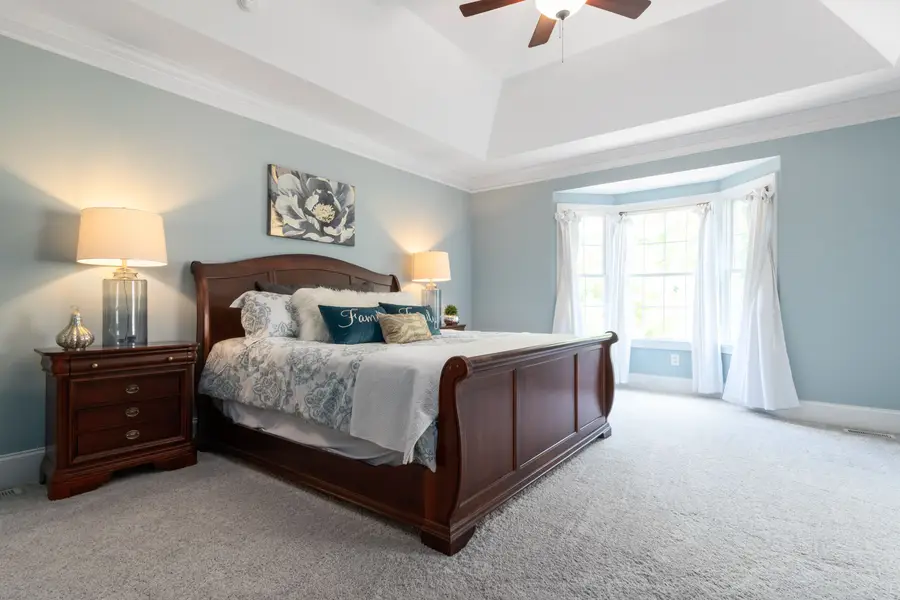
A master bedroom has three jobs, and every failed layout can be traced to one of them having nowhere to live. The sleep zone is the bed and the two nightstands. The dress zone is where clothes are chosen, checked, and put away. The decompress zone is one seat, one light, and one surface for the last half hour of the day. Map your room against those three zones before you buy anything, and be honest about which one is homeless. It is usually dressing, and a homeless dress zone colonises the bed: clothes pile on the duvet, shoes gather by the nightstand, and the sleep zone stops feeling like sleep.
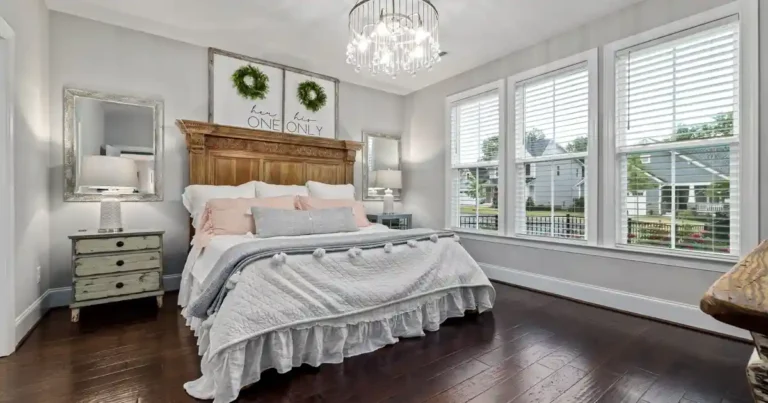
Balance is the second half of the audit. The bed anchors the room, ideally centered on the main wall with a nightstand on each side, so neither partner climbs over the other and neither side feels like an afterthought. Keep at least 24 inches of clearance on both sides of the bed, and 30 to 36 inches where the room allows it, because a partner who cannot walk their side of the bed without shuffling sideways will resent the room no matter how it looks. The classic competitor advice holds here too: you should be able to see the door from the bed without lying directly in line with it, which keeps the room feeling settled rather than exposed.
The audit also settles the symmetry question. Matching nightstands and matching lamps look calm because they give each partner equal standing in the room, and that matters more in a shared room than in any other room in the house. Symmetry does not mean identical everything. It means neither side of the bed is the good side and neither side is the leftover side. Once the zones are mapped and the sides are balanced, the conflicts below each get a named fix instead of a vague hope.
Layout Decision Table: By Room Size
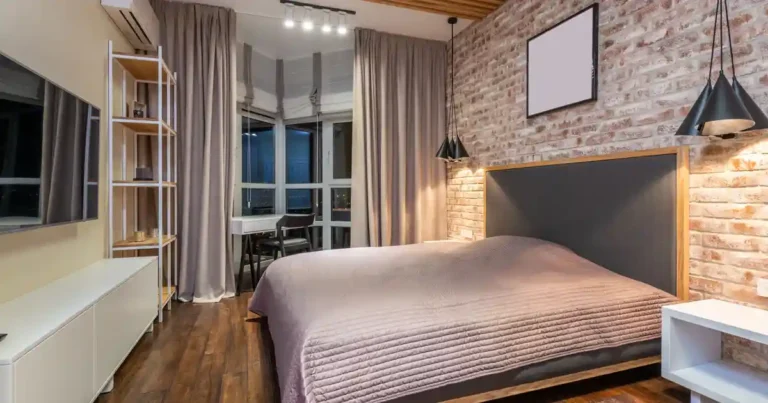
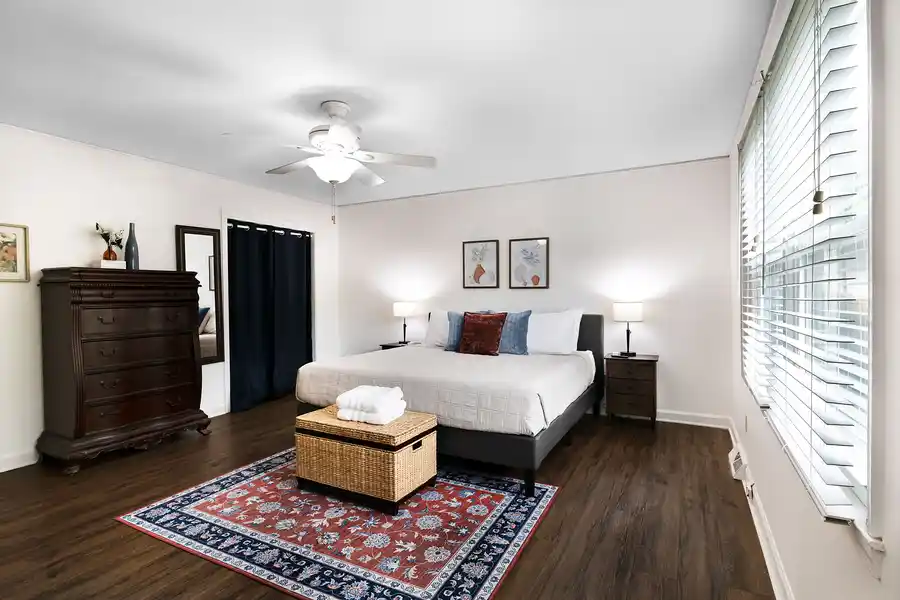
If your room is under 12×12 feet, the sleep zone takes priority and the decompress zone is the sacrifice. Keep a queen bed, not a king, because a king in a small room eats the clearance on both sides and leaves no walking room at all. The dress zone becomes one valet stand and the closet, and the decompress zone becomes the bed itself for now, with a firm rule that work stays out of it. Skip the accent chair until the room grows; a chair crammed against a wall helps nobody.
If your room is the classic 12×14 to 14×18 feet, all three zones fit, and this is the layout most readers should aim for. Bed centered on the main wall, nightstands on both sides, dress zone on the wall opposite the bed or beside the closet, and the decompress chair by the window or in the short arm of the room. Skip the second dresser; one dresser plus under bed storage beats two dressers that turn the room into a furniture showroom.
If your room is L-shaped or irregular, let the short arm of the L carry the decompress zone. The bed takes the long wall, the dress zone takes the wall nearest the closet, and the chair, light, and surface tuck into the nook where a bed would never fit well. Skip the urge to square the room off with furniture; the irregular corner is a gift, because it gives the decompress zone walls on two sides and a feeling of enclosure for free.
If your room is 18×20 feet or larger, the risk flips: the room is big enough for a sitting area, but a sitting area without a boundary becomes a second living room that never lets you wind down. Zone it deliberately with a rug under the chair and ottoman, a floor lamp that lights only that corner, and nothing that invites work into the room. Skip the television as the default focal wall, a point the mistakes section returns to, because a big room with a screen at its center is a lounge, not a retreat.
Problem 1: The Sleep Zone Is Compromised
The sleep zone is compromised by light first, and the compromise is almost always one partner’s light, not the sun. One partner reads while the other sleeps, and a ceiling light or a bright bedside lamp floods the whole room, so both partners lose. The fix is directional light: a beam that aims at one book and nowhere else, with dimming that lets the reader turn it down as the sleeper drifts off. The second compromise is morning light, which should arrive softly rather than all at once, and the third is the alarm, which should wake one partner without waking both.
Noise is the quieter compromise. It is rarely a loud noise; it is the small ones, a phone buzz, a drawer closing, a partner getting up for water. The honest fix is not soundproofing, which this article does not pretend a Saturday project can deliver. It is routine: the early riser stages clothes the night before, the late sleeper gets darkness and quiet in return, and the room’s zones keep the morning’s movement away from the bed. The products below handle the light half of this problem, which is the half you can actually buy your way out of.

Also solves this: morning light that arrives softly
TOWN & COUNTRY LUXE Talia Double Layer Curtains, 52×84, Winter White
Two panels, each 52W x 84L, with a sheer layer plus a room darkening layer in one panel, grommet top, and thermal insulation. The sheer layer softens daylight for the partner who wakes first, and the room darkening layer gives the late sleeper darkness without a separate darkening panel to wrestle with. Not for: State the honesty plainly: this is ROOM DARKENING only, and this article never claims more than that.
Check Price on Amazon → (paid link)
Also solves this: a gentle wake for the early partner
Dekala Sunrise Alarm Clock with Sunrise/Sunset Simulation, Dual Alarms, FM Radio
Gradual brightness increase from 10 percent to 100 percent, dual alarms so each partner keeps their own time, natural sounds, snooze, FM radio, and a 7 color night light. The gradual light is the gentle wake for the early partner. Not for: Honest limit, stated plainly: it does not replace a loud alarm for a very heavy sleeper, so do not buy it expecting it to.
Check Price on Amazon → (paid link)
Problem 2: The Temperature Split
One partner runs hot and the other runs cold, and a single blanket cannot serve both. The usual advice is two separate duvets, and the full two-duvet method, with its Scandinavian split explained in detail, lives in our cooling bedroom ideas guide, which this hub links to rather than repeating. But not every couple wants two duvets on one bed, and this section solves the split inside a single shared comforter. One comforter, two zones: a cooler side and a warmer side, each labeled so nobody has to guess in the dark which side is theirs.
The fan and the sheets complete the split. A small fan aimed at one side only gives the hot sleeper airflow without chilling the cold sleeper, and it must sit on one nightstand, not at the foot of the bed where it blows on both. The shared base layer matters just as much: a breathable cotton sheet set both partners accept, so the temperature argument is fought on the comforter, not on every layer at once. Get the base layer right and the split above it stays simple.

Also solves this: airflow for one side only
DREO Fan for Bedroom, 12 Inches, 70ft Powerful Airflow, 25db Quiet Table Air Circulator
Twelve inch table air circulator, 3 speeds, 120 degree adjustable tilt, 800 CFM stated, tabletop and wall mount. Aim it from the hot sleeper’s nightstand across their side only, and keep it off the foot of the bed where it would blow on both partners. Not for: The 25 decibel figure is the listing’s low-noise rating, not every speed, and this article says so rather than implying whisper quiet at full power.
Check Price on Amazon → (paid link)
Also solves this: the shared base layer
California Design Den Soft 100% Cotton Queen Sheet Set, 400 Thread Count, Silky Smooth Sateen Weave, White
Four piece Queen set: 1 flat sheet 90W x 102L, 1 fitted sheet 60W x 80L with all-around elastic fitting mattresses 8 to 16 inches, and 2 standard and queen pillowcases 21W x 32L. One hundred percent cotton sateen, naturally breathable, so the base layer never becomes part of the temperature argument. The split lives in the comforter above it, and the sheets stay neutral ground.
Check Price on Amazon → (paid link)
Problem 3: Dressing Has No Home
Dressing at 5am in the dark is where a master bedroom most visibly fails. The early riser needs light to choose clothes and a mirror to check them, and the sleeper needs darkness and quiet, and a room with no dress zone forces both to lose. The fix is the valet principle: tomorrow’s clothes are staged the night before, out of the sleep sightline, so the morning needs no drawer rummaging and no overhead light. The dress zone gets its own light and its own mirror, placed at the dress zone, not at the bed, so the sleeper’s side of the room stays dark.
Storage beyond the closet is the second half of this problem. A closet alone rarely holds two people’s clothes plus the overflow, and the overflow is what ends up on the bed. Under bed drawers take the overflow that does not need daily access: out of season clothes, spare bedding, the things that only need reaching once a month. For the deeper closet system itself, our small bedroom closet ideas guide covers the measured audit, and this hub routes there rather than repeating it.

Also solves this: dress-zone light that does not flood the bed
Coomily 58×18 Full Length Mirror with LED Lights, Dimmable Lighted Floor Mirror with 3 Color Lighting and Touch Control, Standing Wall Mounted Full Body Mirror, Tempered Glass for Bedroom, White
Fifty eight by 18 inches, tempered glass, dimmable, 3 color lighting modes, touch control, standing, leaning or wall mounted. The warm setting is one of the three color modes, and it is the setting to use at 5am, because it lights the outfit without throwing daylight across the room. Not for: No Kelvin figure was verified for this variant, so this article says warm setting, never a number.
Check Price on Amazon → (paid link)
Also solves this: the overflow
IRIS USA 22 Qt Under Bed Storage, Stackable Organizer Bin Plastic Container with Sliding Drawer, 2 Pack, White
Two pack, each bin 23.69L x 17.81W x 6H inches, 22 quart capacity, sliding drawer opening, stackable. Measure first, then order, and keep daily clothes in the closet and the valet, not in these bins. Not for: The 6 inch height is the clearance number the reader must measure against their bed frame before ordering, because a drawer that does not slide under the frame is a box in the hallway, not storage.
Check Price on Amazon → (paid link)
Problem 4: No Decompress Zone
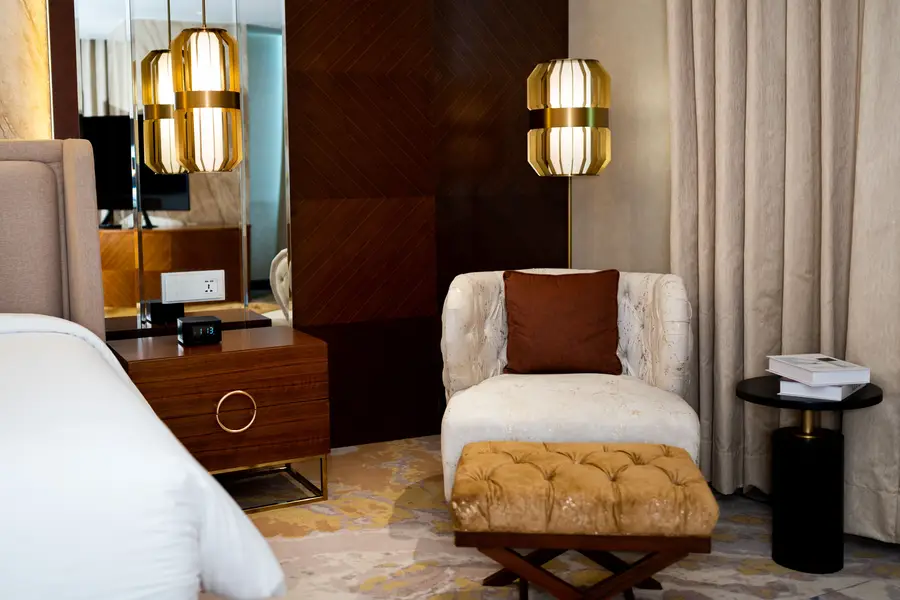
When the bed is the only seat in the room, the bed becomes the office, the reading chair, the television lounge, and the place where the day’s worries get processed, and then it wonders why sleep will not come. A decompress zone breaks that pattern with one chair, one light, and one surface, placed by the window or in the short arm of the room, far enough from the bed that sitting there feels different from lying down. The chair is for the last half hour of the day: a book, a glass of water, a conversation, and nothing that needs a screen.
The no-work-in-bed boundary is the rule that protects this zone. A desk stays out of the bedroom, or screened behind something that makes it invisible from the bed, because a visible desk is a visible to-do list at midnight. The morning side of the same ritual is the in-suite coffee station, and our coffee bar ideas guide covers the compact countertop setup, which this hub links to rather than repeating. The style direction for the whole room, warm and layered rather than stark, follows our earthy boho bedroom ideas guide, and the guest room version of the same hospitality thinking lives in our guest bedroom ideas guide.
Also solves this: the decompress zone light
Brightech Leaf Pharmacy LED Reading Lamp, Dimmable Floor Lamp, Adjustable Standing Lamp, Tall Lamp for Sewing and Craftwork, Jet Black
Fifty three inches tall, 19 inch adjustable swing arm, 3000K warm white LED, 1150 lumens, 3-way dimmer at 100 percent, 50 percent and 25 percent. The 25 percent setting is the wind-down setting, low enough that the room feels like evening and the chair feels like a separate place from the bed. Swing the arm over the chair for reading, then dim it down when the book closes.
Check Price on Amazon → (paid link)
Also solves this: the wind-down ritual
Bedside Water Carafe and Glass Set, Mfacoy 17 Oz Glasses Pitcher and 5 Oz Cup, Bedside Night Carafe Pitchers and Water Glass Tumbler Set, Vintage Glass Water Pitcher with Cup Set for Bedroom
Seventeen ounce lead-free glass carafe, 5 ounce glass cup that doubles as the lid, vintage glass. The ritual is the carafe set on the nightstand beside the book, which is all it needs to be, because the point is water within reach, not another object to style. Not for: No tray is included in this box, and this article never claims one: the box is carafe plus cup only.
Check Price on Amazon → (paid link)
6 Master Bedroom Mistakes
- Putting the bed under the window’s draught and noise line, so every night’s sleep competes with the street and the weather.
- Buying a matching furniture set that flattens the room, so the bedroom reads as a showroom floor instead of two people’s room.
- Making the television the focal wall by default, without asking whether the room’s job is watching or sleeping.
- Lighting the whole room with one ceiling light, so evening has exactly two settings: interrogation bright or pitch dark.
- Storing everything only in the closet, so the overflow colonises the bed, the chair, and every flat surface in sight.
- Styling a bed you cannot maintain on a weekday, so the room looks right only on the day it is photographed.
Budget Plans
The $75 zone fixes tier is where everyone should start: the directional lamp pair for the reading conflict and the carafe set for the wind-down ritual, both small, both reversible, both working the first night. Do this first and live with it for two weeks, because it tells you whether your room’s real problem is light, temperature, or storage before you spend more.
The $300 conflict fixes tier adds the temperature split and the dress zone: the dual zone comforter, the bedside fan for one side, and the valet stand for the 5am dresser, so the two-person conflicts all have a named fix. This is the tier where the room starts to feel designed for two people instead of decorated for one, and it is the tier most readers should aim for.
The $850 retreat build covers all three zones at once: light control, temperature split, dress zone, and decompress, with the chair and ottoman, the floor lamp, the mirror, and the under bed storage completing the room. The spend order stays the same at every tier: light control first, then temperature split, then dress zone, then decompress, because a room that sleeps well and dresses quietly earns its retreat touches, while a room that does neither just has expensive furniture in it.

FAQs
1. Which zone do I sacrifice in a small master bedroom?
Ans: Sacrifice the decompress zone first, and protect sleep and dressing, because those two run every single day while the chair is a luxury. Keep the queen bed, not a king, keep the valet stand and the closet system, and let the bed carry the last half hour of the day for now, with the firm rule that work stays out of it. Add the chair back the day the room allows a 28 inch wide corner with about 44 inches of depth, and not before.
2. Should I call it a master bedroom or a primary bedroom?
Ans: Both names describe the same room, and neither is wrong in ordinary use. Master bedroom is the older, more common search term, and primary bedroom is the newer term many builders and listings now prefer. This article uses master bedroom because that is the phrase readers search for, and it links the same room either way. Use whichever term your household prefers; the zones do not change with the name.
3. How does the master bedroom connect to an en-suite bathroom?
Ans: Treat the en-suite as a fourth zone, the ritual zone, that borrows the bedroom’s calm rather than fighting it. The warm palette and layered lighting should continue through the bathroom door, and the morning routine should flow from bed to bathroom to dress zone without crossing the sleep zone. Our spa bathroom ideas guide covers the en-suite ritual in full, and our boho bathroom ideas guide covers the warm palette that ties the suite together.
4. Can a work-from-home corner live in a master bedroom without wrecking sleep?
Ans: Yes, but only behind a boundary the eye respects from the bed. Put the desk in the short arm of an L-shaped room, or screen it with a room divider or a tall plant, so the work surface is invisible when you lie down. Close the laptop, cover the desk if you must, and keep the decompress chair as the room’s evening seat, because a visible desk is a visible to-do list at midnight. If the desk cannot be hidden from the bed, it belongs in another room.
5. What if the master bedroom must also hold a nursery corner?
Ans: Treat the nursery corner as a temporary zone with an expiry date, not a fourth permanent zone. Give it the corner nearest the door, keep the crib, changing surface, and night feeds inside that corner, and protect the sleep zone and dress zone around it. When the nursery years pass, the corner reverts to the decompress zone, which is why nothing in the nursery corner should be built in or bolted down. The temporary-zone protocol keeps the room a bedroom first and a nursery second.
Bottom Line
A master bedroom is a system, not a shopping list: three zones mapped before anything is bought, the two-person conflicts solved one by one in spend order, and a decompress corner that keeps the bed for sleep. Do the zone audit first, fix light before temperature, give dressing a home before buying retreat touches, and spend only on the conflict your room actually has. This hub pulls the bedroom cluster together: the cooling bedroom guide for the full temperature method, the small bedroom closet guide for the measured storage system, the earthy boho guide for the warm style direction, and the guest bedroom guide for the hospitality thinking.
The modern farmhouse living room thread continues the whole-home story, and this room sits in it as the quiet center of the house.
Save this master bedroom guide before your next bedroom buy: zones first, conflict fixes second, retreat touches last, for two real people.
Photo credits: Photos via Pexels. Full photographer credits in IMAGE-CREDITS.md.