
Christmas Dining Room Ideas: How to Seat Every Guest Without Losing the Festive Table
christmas dining room ideas start with one question, not one centerpiece. Ask how many guests the table seats, and whether each guest gets 24 inches of table edge, before you buy a single garland. Most Christmas dining room lists skip that question and show a runner, then call the room done. A dining room earns its festive feel from the order you fix it in, and the order is seats, settings, clearance, centerpiece, layers, then light.
This article promises a Christmas dining room that seats every guest and still looks festive. You get a seven check audit before you spend, a quick decision table by starting point, six problems solved in order, two named palettes, six mistakes to skip, budget tiers by guest count in spend order, and 12 researched picks mapped two per problem. Nothing here asks you to buy everything at once, and nothing here asks the table to hold more guests than it fits.
This article is research based curation, not hands on testing. Where a detail could not be verified, it is left out rather than guessed, and you should check size, color, and contents on the live listing before ordering. The numbers quoted from other sites, the 60 cm per guest figure, the 24 inch setting width, the 90 cm chair clearance, and the 70/20/10 split, are their figures, not tested claims.
How these picks were chosen: each pick was researched from listing and source pages and checked at the publish date. No star rating is claimed for any pick. Check size, color, and contents on the listing before ordering, because listings and variants change. Where a detail cannot be verified, it is left out rather than guessed.
Affiliate disclosure: This article contains affiliate links to products on Amazon. As an Amazon Associate I earn from qualifying purchases. The price you pay stays the same, and the commission helps keep The Decor Root running.

Give every guest 24 inches of table edge, keep the centerpiece under 12 inches tall, and leave 90 cm behind each chair. Count the guests first, then the chairs, because a table that seats eight cannot serve ten, and a low centerpiece keeps the whole table in one conversation.
Bel Furniture gives the same numbers in its dining table size guide, allowing about 24 inches of table edge per adult and at least 36 inches, about 90 cm, from the table edge to a wall.
The Christmas Dining Room Audit for Christmas Dining Room Ideas
First, run the seat check. Count the guests first, then count the chairs, and write both numbers down before you buy anything. Divide each long side by 60 cm and round down, then add one seat at each end if the table is at least 80 cm wide. A 6 ft table seats 3 per long side at 24 inches each, plus 2 at the ends, which is 8 in total. If the count runs 1 to 3 over the chairs, the fix is spare chairs, not a new table.
Second, run the setting check. Measure 24 inches wide and 21 inches deep for each place setting, with 30 by 27 inches as the comfortable optimum. Lay the charger down first, then the plate, then the flatware, so the charger marks the boundary before anything else lands on it. If two chargers touch, the table is overbooked, and one setting needs to move to the overflow table.
Third, run the clearance check. Leave 90 cm behind every chair to pull out and sit, and 110 to 120 cm on the side where food is carried past seated guests. Measure from the table edge to the nearest wall, not from the chair back, because the chair moves when the guest stands. If the room cannot give 90 cm on every side, give it on the serving side first, and move the sideboard to the wall.
Fourth, run the centerpiece check. Keep the centerpiece under 12 inches tall, so guests can see each other across the table. Sit in a chair and look across: if the centerpiece blocks a face, it is too tall, and it belongs on the sideboard. A low centerpiece under 12 inches keeps the table as one conversation, and tall pieces belong where they block no one.
Fifth, run the layer check. Name the four layers on the table: base, centerpiece, light at more than one level, and one personal detail at every seat. If the table has only plates on wood, it has no layers yet, and the runner is the first layer to add. The base carries the color, the centerpiece carries the shape, the light carries the mood, and the personal detail carries the welcome.
Sixth, run the light check. Turn on every light you plan to use at dinner and name the temperature. One cold white overhead beside warm candlelight splits the room, and the table reads as cold even when the decor is warm. The audit asks for warm light at more than one level, fairy lights in the garland plus tapers at the ends, with the overhead left off.
Seventh, run the cost check. Name the guest count, then name the tier that matches it, before you buy. Six guests need the runner, the garland, and the lights first. Eight guests add the chargers and the matching plates. Ten to 12 guests add the spare chairs and the folding table before any decor, because a guest with no chair costs the evening more than a bare table does.
christmas dining room ideas are about fixing the room in order, seats first and decor last. A room with enough chairs, measured settings, clear pull-out room, and one warm light temperature reads as festive, while a room with a new garland on a table that seats four reads as a shop shelf. The elegant dining room register that holds the formal end of this plan together is shown in elegant dining room ideas.
Quick Decision Table: By Starting Point
Find your starting point, then move to the next section.
| Starting point | First move |
|---|---|
| Short 1 to 3 seats | Borrow or buy folding chairs, seat children at the ends |
| Table too short for the guest list | Squeeze to 55 cm per guest, add a folding table for the overflow |
| Settings crowd each other | 24 inches wide, 21 inches deep, charger first, then plate |
| Chairs cannot pull out | Move the sideboard to the wall, 90 cm behind every chair |
| Serving side blocked | Keep 110 to 120 cm on the serving side, drinks station on the wall |
| Centerpiece blocks the view | Under 12 inches, low garland plus bud vases, tall pieces to the sideboard |
| Table reads flat | Runner, charger, napkin, one personal detail at every seat |
| Budget is tight | Cost tiers first, warm light and one runner, then the chargers |
The budget row needs the most discipline, because a tight budget buys decor first and seats last, and the table ends up pretty and short of chairs. The cost tiers, the warm light, and the one runner are the three markers, and the color thread that holds them together is shown in color psychology dining room ideas.
Problem 1: The Seats Do Not Add Up, the Table Is Short 1 to 3 Seats
The guest list lands at 10 and the dining chairs number 8. The table is not the problem, the count is, and the count was never run before the invitations went out. Most hosts discover the shortfall on the day, when a guest stands with a plate and no chair, and the fix at that point is a kitchen stool that matches nothing.
Run the seat math first. Divide each long side by 60 cm and round down, then add one seat at each end if the table is at least 80 cm wide. A 6 ft table seats 3 per long side at 24 inches each, plus 2 at the ends, which is 8 in total. If the guest list runs 1 to 3 over that number, the shortfall is a chair problem, not a table problem, and spare chairs solve it.
If the shortfall is one seat, squeeze to 55 cm per guest for the night, and seat children at the ends, where the table is narrower and the reach is shorter. Below 55 cm, guests start apologising between courses, so the squeeze has a floor. A pedestal base frees seats that corner legs take away, and a table with arms on the chairs needs 700 mm per guest, not 600 mm, so count the armchairs separately.

The shortfall of 1 to 3 seats is a chair problem, and four matching folding chairs solve it without a new table. The chairs below fold flat after dinner, stack in a closet, and sit at the table in white, so they read as spare seats, not as a mismatch.
When the shortfall is a whole table, not just chairs, the fix is a second table, not more chairs at the first one. The folding table below seats 3 per long side at 24 inches each, and it folds flat for storage after dinner, so the overflow has a table of its own.
Also solves this: the shortfall that is a whole table, not just chairs
COSCO 6ft Fold-in-Half Blow Molded Folding Table, White
6 ft, fold-in-half, HDPE blow molded top, metal frame, comfort handle, model 14678WSP1, white, 72 by 29.25 inches, as printed. Six feet seats 3 per long side at 24 inches each, and it folds flat for storage after dinner. Not for: white plastic top needs a cloth or a runner to look festive, no finish options on this listing.
(paid link)
The seats decide the evening, because a guest with no chair remembers the evening as a queue, not a dinner. Count first, buy the spare chairs second, and add the folding table only when the shortfall is a whole table. The farmhouse thanksgiving table register, which seats a full table with the same count first method, is shown in farmhouse thanksgiving table ideas.
Problem 2: Each Place Setting Crowds the Next, No Per-Guest Width or Depth
The plates go down, the glasses follow, and by the third setting the chargers touch. Each guest has a plate but no elbow room, and the flatware from one setting crosses into the next. The table reads as crowded before the food arrives, and the crowding is a width problem, not a plate problem.
Give each setting 24 inches wide and 21 inches deep, with 30 by 27 inches as the comfortable optimum. Set in order: space first, then plates, then flatware, so the charger marks the boundary before anything else lands on it. A 6 ft table seats 3 per long side at 24 inches each, and a fourth setting on the same side means the width was guessed, not measured.
A charger plate marks each setting and holds the plate stack in place, so the eye reads 12 separate settings instead of one long row of plates. A matching dinnerware set fills the chargers with the same plates, bowls, and finish at every seat, so no setting borrows from the next. Count a service for 8 as 24 pieces for 8 guests, and add one or two spare places for the guest who arrives with a plus one.

The charger is the marker that holds each 24 inch setting in place, and 12 matching chargers turn a long row of plates into 12 separate settings. The gold chargers below cover a full table of 12, and they carry the red and gold palette at the same time.
A matching dinnerware set fills the chargers with the same plates and bowls at every seat, so no setting borrows from the next. The set below serves 8 guests with dinner plate, salad plate, and bowl each, and the cappuccino glaze keeps the table warm.
Also solves this: the mixed plates across the table, not the plates that need replacing
GBHOME Stoneware Dinnerware Sets for 8, 24-Piece, Cappuccino
Service for 8, 24 pieces, 8 dinner plates 10.25 inches, 8 salad plates 8.5 inches, 8 cereal bowls 5.5 inches, stoneware, reactive glaze, dishwasher and microwave safe, model GDW159, cappuccino, as printed. Not for: plates and bowls only, no mugs in the set, and the cappuccino reactive glaze varies piece to piece.
(paid link)
The setting is the unit of the table, and the table is only as calm as its narrowest setting. Measure the width, mark it with a charger, and fill it with matching plates, and the crowding disappears without removing a single guest. The christmas tree register, which carries the same red and gold thread into the next room, is shown in christmas tree ideas.
Problem 3: Chairs Cannot Pull Out, the Room Has No Clearance
The chairs sit against the wall, and the guest at the wall end cannot pull out without the chair hitting the sideboard. The guest in the middle cannot stand without asking the whole side to shift, and the person carrying the roast cannot pass behind anyone. The room has chairs, but it has no clearance, and clearance is what makes chairs usable.
Leave 90 cm behind every chair to pull out and sit, and 110 to 120 cm on the side where food is carried past seated guests. Measure from the table edge to the nearest wall, not from the chair back, because the chair moves when the guest stands. If the room cannot give 90 cm on every side, give it on the serving side first, and move the sideboard to the wall.
Test the serving side with a tray before the night. Walk from the kitchen with a tray while someone sits at the table, and note where the tray brushes a chair or a wall. If the tray cannot pass behind a seated guest, the serving side needs the 110 to 120 cm, and the sideboard needs to move to the wall. The test takes one minute, and it finds the blocked side before the guests do.
The overflow belongs on the wall, not on the table. Plates, glasses, and the dessert spread sit on a slim console against the wall, where they are reached without crossing a seated guest. The drinks live on a rolling cart parked on the serving side, which rolls to the table for refills and away again, so the table never holds bottles beside the plates.

The overflow belongs on the wall, and a slim console holds it without stealing the 90 cm chair pull-out zone. The console below is 11.8 inches deep, so it parks plates, glasses, and the dessert overflow against the wall, where they are reached without crossing a seated guest.
The drinks live on a rolling cart, parked on the serving side where the 110 to 120 cm clearance is, and the cart below rolls to the table for refills and away again. Three tiers hold the bottles, the glasses, and the tools, so the table never holds bottles beside the plates.
Also solves this: the drinks that live on the table, not the drinks that need a sideboard
TUTOTAK Bar Cart with Wheels, Marble Gold, 3-Tier
3 tiers, 23.7 inches wide, wine rack holds 3 bottles, glass holder holds 6 glasses, 6 hooks, 4 casters with 2 brakes, model BC01BMG030, marble gold, as printed. Not for: 23.7 inches wide fits a drinks station, not a full dessert spread.
(paid link)
Clearance is the difference between a dining room and a display room, and it is measured in centimeters, not in decor. Move the sideboard to the wall, park the drinks cart on the serving side, and the chairs work. The warm christmas kitchen register, which plans the walk from the kitchen with a tray while someone sits, is shown in warm christmas kitchen decor ideas.
Problem 4: The Centerpiece Blocks the View Across the Table
The centerpiece arrives tall and proud, a vase of branches that rises above every head, and the guests across the table cannot see each other. Conversation bends around the vase, serving dishes have no room in the middle, and the table reads as two separate tables with a hedge between them.
Keep the centerpiece under 12 inches tall, so guests can see each other across the table. A low garland runs the length of the table and stays under the sightline, and bud vases at different heights give the eye movement without building a wall. Tall pieces belong on the sideboard, where they are seen from every seat and block no one.
Candle clusters of three at different heights, repeated every 60 cm, give the middle its glow without its height. Leave a gap in the center for the serving dishes, because a centerpiece that covers the whole middle leaves nowhere for the roast to sit. The garland, the bud vases, and the candle clusters are the centerpiece, and none of them needs to rise above 12 inches.
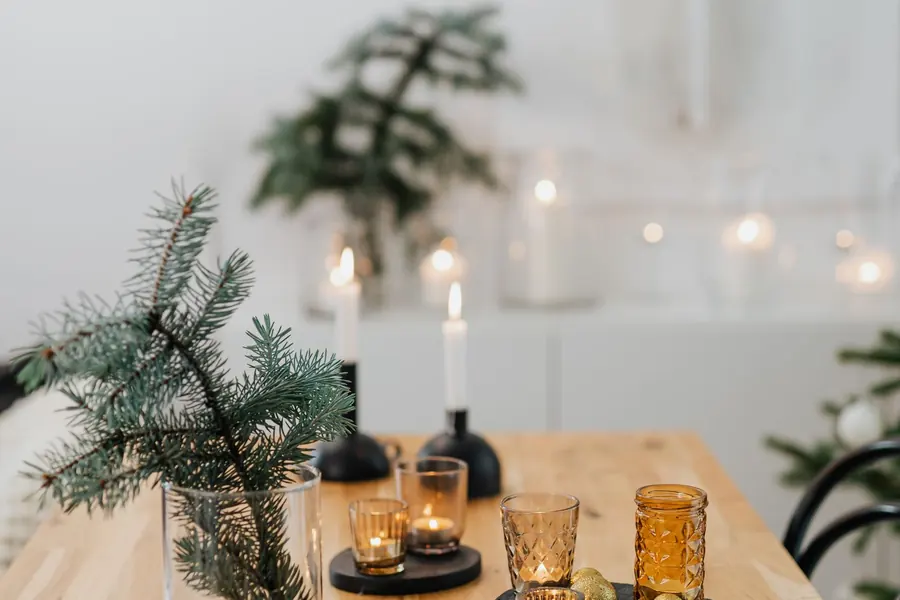
The low centerpiece starts with a garland that stays under the 12 inch sightline, and two 6 ft lengths run the table or wrap the sideboard. The cedar garland below reads fresh without shedding, and it gives the bud vases and the fairy lights a base to sit on.
Also solves this: the centerpiece that blocks the view, not the centerpiece that needs removing
Sggvecsy 6Ft Christmas Cedar Garland, 2 Pack
6 ft each, 2 pack, real touch cedar and cypress, model 20250819-15, as printed. Two 6 ft lengths run the table or wrap the sideboard, and the real touch cedar reads fresh without shedding. Not for: no lights or berries included, pair it with fairy lights for glow.
(paid link)
The height in the middle comes from bud vases at different heights, not from one tall vase, and 12 bud vases spread down the garland give the eye movement without a wall. The set below holds one stem each, so the garland carries 12 separate stems along its length.
Also solves this: the flat middle with no height, not the middle that needs a tall vase
Thenshop Glass Bud Vase Set of 12, Slanting Style
Set of 12, glass, slanting style, 9.5 by 2.4 inches, as printed. Twelve bud vases spread down the garland at different heights, each holding one stem, so the eye moves along the table without a wall in the middle. Not for: bud size only, holds one stem each, not a full bouquet.
(paid link)
A centerpiece earns its place by staying low, and the sightline test decides it: sit in a chair, look across, and if a face is blocked, the piece is too tall. Keep it under 12 inches, and the table stays one conversation. The diy christmas centerpiece register, which builds the same low centerpiece by hand, is shown in diy christmas centerpiece ideas.
Problem 5: The Table Layers Read Flat, No Layer Order
The plates sit straight on the wood, the napkins lie flat beside them, and the table reads as a surface, not a setting. Nothing separates the plate from the wood, nothing gives the eye a level to land on, and the garland, if it exists, floats on bare table. The table has decor, but it has no layers, and layers are what make a table read as finished.
Layer in order: base, centerpiece, light at more than one level, one personal detail at every seat. The runner is the base, and it runs the table end to end, so the chargers, the garland, and the napkins have a color to sit on. The centerpiece sits on the runner, the light sits above and inside the centerpiece, and the personal detail, a napkin ring, a name card, or a sprig of evergreen, sits at every seat.
A velvet table runner in burgundy gives the base its color, and a 120 inch runner runs a 6 ft table end to end, so the color carries the whole length. Twelve matching napkin rings give each setting the same finish as the chargers, so the table reads as one plan, not a mix of spare pieces. The runner and the rings are the cheapest layers on the table, and they do the most work.
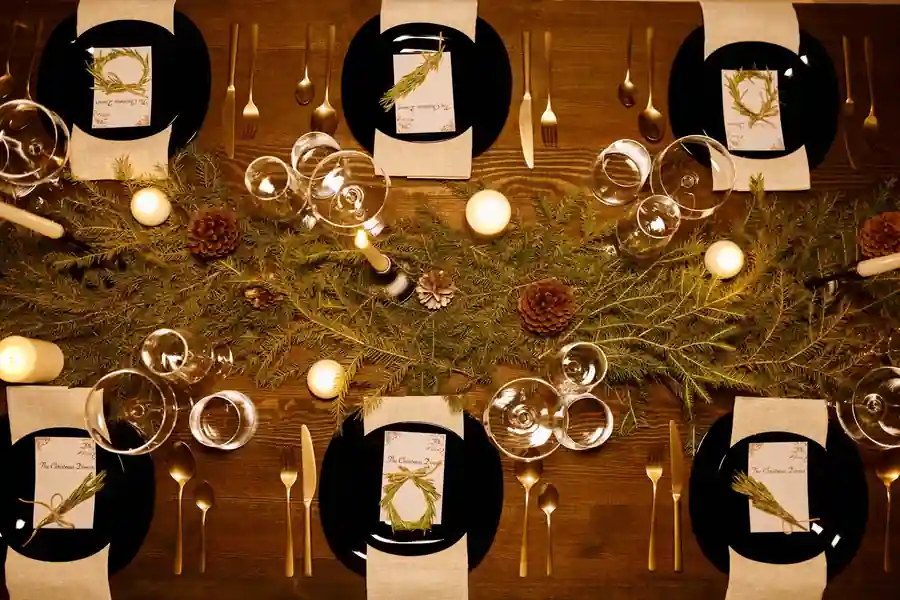
The base layer is a runner, and a velvet runner in burgundy gives the chargers, the garland, and the napkins a color to sit on. The runner below is 120 inches long, so it runs a 6 ft table end to end, and the color carries the whole length.
The personal detail at every seat is a napkin ring, and 12 matching rings give each setting the same finish as the chargers. The hammered gold rings below match the gold chargers, so the table reads as one plan, not a mix of spare pieces.
Also solves this: the setting with no personal detail, not the setting that needs new plates
ITOS365 Handmade Round Hammered Golden Napkin Rings, Set of 12
Set of 12, handmade hammered metal, gold, as printed. Twelve matching rings give each setting the same finish as the chargers, so the table reads as one plan, not a mix of spare pieces. Not for: hammered texture reads modern glam, not rustic farmhouse.
(paid link)
Layers are the difference between a set table and a dressed table, and the order matters more than the spend. Runner first, charger second, napkin third, one personal detail at every seat, and the table reads as built. The christmas bedroom register, which layers a room the same way, base first and detail last, is shown in christmas bedroom decor ideas.
Problem 6: The Room Costs Too Much, or the Light Stays Cold and Flat
The room has one overhead light, cold white, and the table reads as flat under it. The garland has no glow, the candles are unlit because the matches are in the kitchen, and the whole room looks like a photograph taken with the flash on. Or the opposite failure: the plan costs more than the budget, because the decor was bought before the audit, and the chairs were never counted.
Warm the light at more than one level. One string of warm white fairy lights weaves through the garland on the table, and flameless tapers light the table ends and the sideboard together, with one remote and a timer that turns them off after dinner. The overhead stays off, because one cold overhead beside warm candlelight splits the room, and the table reads as cold even when the decor is warm.
Turn the overhead off at the start of the evening, not halfway through, because the room reads as flat from the first minute if the cold light is on. The fairy lights and the tapers are the light, and the overhead is the backup, not the plan. A room lit at more than one level reads as warm from the doorway, and a room lit from above reads as a kitchen at noon.
Cost tiers by guest count decide the spend order, and the audit decides the tiers. Six guests need the runner, the garland, and the lights first, because those three carry the whole table. Eight guests add the chargers and the matching plates, because the settings multiply before the decor does. Ten to 12 guests add the spare chairs and the folding table before any decor, because a guest with no chair costs the evening more than a bare table does.
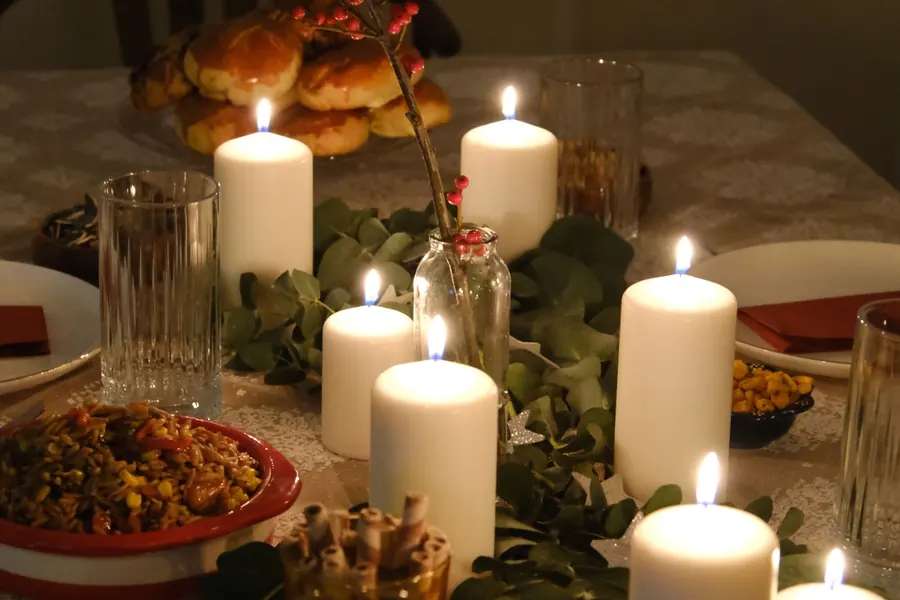
The warm light at more than one level starts with fairy lights woven through the garland, and one battery string needs no cord across the room. The lights below are warm white with 8 modes and a remote, so the glow is set once and left alone for the evening.
Also solves this: the room with one cold overhead light, not the room that needs new fixtures
WERTIOO Battery Operated String Lights Fairy Lighting, 33FT 100 LEDs, Warm White
33 ft, 100 LEDs, warm white, battery powered, 8 modes, waterproof, remote control, model Sr-510IRSW, as printed. One string weaves through the garland on the table, and battery power means no cord across the room. Not for: batteries not included, and one string covers a garland, not a whole room.
(paid link)
The candlelight layer needs no open flame near the garland, and flameless tapers with one remote light the table ends and the sideboard together. The tapers below are 11 inches tall, so they belong at the ends of the table or on the sideboard, outside the sightline, and the timer turns them off after dinner.
Also solves this: the candlelight that needs a flame near the garland, not the candlelight that needs watching
Homemory 12 Pcs Flameless Taper Candles with Remote Timer Dimmer, 11 Inches Ivory
12 pieces, 11 inches, ivory, plastic, LED, remote, 2/4/6/8 hr timer, flickering or steady light, dimmer, model H11INGLYKSL-LST12, as printed. Twelve tapers with one remote light the table and the sideboard together, and the timer turns them off after dinner. Not for: plastic, not wax, and at 11 inches tall these belong at the ends of the table or on the sideboard, outside the sightline, not in the middle under the 12 inch centerpiece rule.
(paid link)
Light and budget are the same problem, because both are spent before the room is seen. Warm the light at more than one level, spend in tier order, and the room reads as festive on any budget. The christmas living room register, which carries the same warm light into the room next door, is shown in christmas living room decor ideas.
Steal This Look: Two Christmas Dining Room Palettes, Named
Palette A, Classic Red and Gold, runs on Benjamin Moore White Dove OC-17 on the walls, a warm white that keeps the red from shouting, with 70 percent of the room in that warm white. The 20 percent is deep red, on the velvet runner, the napkins, and the ribbon bows on the chair backs. The 10 percent is gold, on the charger plates, the napkin rings, and the candle holders, and gold is the one metal, so no silver or brass joins it.
Palette B, Pine and Ivory, runs on Sherwin-Williams Alabaster SW 7008 on the walls, a soft white that keeps the green from going cold, with 70 percent of the room in that soft white. The 20 percent is pine green, on the cedar garland, the napkins, and the sideboard display. The 10 percent is brass, on the candle holders, the flatware, and the bud vases, and brass is the one metal, so no gold or silver joins it.
The split rule is 70/20/10, and the metal rule is one lead color plus one metal. Pick the palette before you buy, because a table that mixes red, green, gold, and brass reads as four palettes, not one. The runner, the napkins, and the chargers carry the palette, and everything else follows them.

A palette is a decision, not a purchase, and it is made once, before the first order. Choose red and gold or pine and ivory, keep the 70/20/10 split honest, and hold the one metal rule, and the table reads as planned from every seat.
6 Christmas Dining Room Mistakes
- Buying the centerpiece before counting the seats, so the table is beautiful and short of chairs.
- Setting places at less than 24 inches wide, so the chargers touch and the flatware crosses.
- Pushing chairs against the wall with no pull-out room, so the guest at the wall end cannot stand.
- Building the centerpiece above 12 inches, so the guests across the table cannot see each other.
- Lighting the room with one cold overhead, so the garland has no glow and the table reads as flat.
- Buying decor before the audit, so the budget goes to the table and the seats are never counted.
Budget Plans
The cost tiers by guest count run in spend order, and each tier adds to the one before it, so a 6 guest table buys Tier 1, an 8 guest table buys Tier 1 plus Tier 2, and a 10 to 12 guest table buys all three.
Tier 1, 6 guests, buys the runner, the garland, the fairy lights, and the napkin rings first. One velvet runner for the base, one garland for the low centerpiece, one string of warm white fairy lights for the glow, and one set of 12 napkin rings for the personal detail at every seat. The runner and the garland carry the table, the lights carry the room, and the rings carry the settings.
Tier 2, 8 guests, adds the charger plates, the matching dinnerware set, and the flameless tapers. Twelve gold chargers mark each 24 inch setting, one dinnerware set for 8 fills the chargers with matching plates and bowls, and 12 tapers light the table ends and the sideboard together. The chargers and the plates fill the settings, and the tapers fill the light at more than one level.
Tier 3, 10 to 12 guests, adds the folding chairs, the folding table, the slim console, and the rolling bar cart. Four matching folding chairs cover the shortfall of 1 to 3 seats, one 6 ft folding table seats the overflow, one slim console holds the plates and the dessert overflow against the wall, and one bar cart parks the drinks station on the serving side. The chairs and the table seat the guests, and the console and the cart clear the room.

Spend in tier order, and the table is finished at every tier, not only at the last one. A 6 guest table that buys Tier 1 is done, and an 8 guest table that buys Tier 1 plus Tier 2 is done, and the 10 to 12 guest table that buys all three is done, with no tier wasted and no guest left standing.
Frequently Asked Questions
1. How much space does each guest need at a Christmas table?
Ans: Allow 60 cm of table edge per guest, which is 24 inches per person, and 700 mm if the chairs have arms. One place setting needs 24 inches wide and 21 inches deep, with 30 by 27 inches as the comfortable optimum. If the table is short, squeeze to 55 cm per guest for the night, and below that guests start apologising between courses, so the squeeze has a floor.
2. How many chairs fit around my table?
Ans: Divide each long side by 60 cm and round down, then add one seat at each end if the table is at least 80 cm wide. A 6 ft table seats 3 per long side at 24 inches each, plus 2 at the ends, which is 8 in total. A pedestal base frees seats that corner legs take away, and round tables divide the circumference by 60 cm instead.
3. How do I seat extra guests when the table is short?
Ans: If the shortfall is 1 to 3 seats, borrow or buy matching folding chairs, and seat children at the ends, where the table is narrower. If the shortfall is a whole table, add a folding table for the overflow, and dress it with a cloth or a runner so it reads as part of the room. Squeeze to 55 cm per guest for one extra seat, and never below that.
4. How tall can a centerpiece be before guests cannot see each other?
Ans: Keep the centerpiece under 12 inches tall, so guests can see each other across the table. A low garland runs the length of the table and stays under the sightline, and bud vases at different heights give the eye movement without building a wall. Sit in a chair and look across: if a face is blocked, the piece is too tall, and it belongs on the sideboard.
5. How do I layer a Christmas table setting?
Ans: Layer in order: base, centerpiece, light at more than one level, one personal detail at every seat. The runner is the base, the charger marks each 24 inch setting, the plate stack sits on the charger, and the napkin with its ring is the personal detail. Set in order: space first, then plates, then flatware, so the charger marks the boundary before anything else lands on it.
Bottom Line
Christmas dining room ideas come down to this: count the seats, measure each setting at 24 inches wide, leave 90 cm behind every chair, keep the centerpiece under 12 inches, layer the table in order, and warm the light at more than one level. One runner, one garland, one string of lights, 12 chargers, and 12 napkin rings are the whole table, and the rest is a matter of keeping the order honest.
Save these Christmas dining room ideas to your Pinterest board, so your festive table plan is ready before the guests arrive!
Photos via Pexels. All photos are free to use and sourced from Pexels.