Dark Hallway Ideas: How to Brighten a Hallway With No Windows
dark hallway ideas start with one fact, not one paint colour. A hallway with no windows is lit only by the fittings you point at it, because there is no daylight to bounce, and a single ceiling bulb leaves bright pools on the floor with gloomy shadows in the corners. Most hallway lists skip that fact and show a pretty paint shade, then call the hall done. A hallway earns its brightness from three numbers first, width, ceiling height, and door count, because the numbers decide whether light paint or a deep colour-drench wins, and the fittings are only the way you deliver them.
This article promises a hallway that feels bright without a window, not a renovation. You get a decision tree that settles light paint against colour-drench, a ceiling light sized by lumens per square metre, sconce spacing at 6 to 8 feet, 2700K warm white repeated in every fitting, mirrors that double the light you already have, a runner that pulls the eye down the hall, a console and hooks that keep the floor clear, borrowed light from glazed doors and sun tunnels, a night light layer for 3 AM trips, six problems solved in order, and 12 researched picks mapped to the jobs where they work.
Nothing here asks you to buy everything at once, and nothing here asks one fitting to carry the whole hall.
This article is research based curation, not hands on testing. Where a detail could not be verified, it is left out rather than guessed, and you should check size, spacing, load, and contents on the live listing before ordering. The numbers quoted from other sites, the 6 to 8 foot sconce spacing, the 2700K warm white, and the 100 to 150 lumens per square metre, are their figures, not tested claims.
How these picks were chosen: each pick was researched from listing and source pages and checked at the publish date. No star rating is claimed for any pick. Check size, color, and contents on the listing before ordering, because listings and variants change. Where a detail cannot be verified, it is left out rather than guessed.
Affiliate disclosure: This article contains affiliate links to products on Amazon. As an Amazon Associate I earn from qualifying purchases. The price you pay stays the same, and the commission helps keep The Decor Root running.
Measure the Hall First, Then Pick the Light and the Paint
Measure the hall first, because the hall decides the paint plan, the ceiling fitting, and the sconce spacing, and the catalog decides none of them. A hall under 1.2 metres wide with a ceiling under 2.4 metres and three or more doors behaves nothing like a hall wider than 1.2 metres with a ceiling above 2.4 metres and one door, so a paint shade bought before the hall is measured is a shade that fights the room. Width, ceiling height, and door count are the three numbers this article runs on, and the decision tree below turns them into a paint plan.
Run the audit in order, because the order is the method. Measure the width wall to wall, the ceiling height floor to ceiling, and count the doors on both sides, then check the table for the fitting and paint rules that match those three numbers. A hall with a glazed door at one end has borrowed light to work with, and a hall with no borrowed light at all needs a second light height, because one ceiling light in the middle leaves both ends dim whatever the paint shade.
The dark version of the same measure-first rule, with deep colour used on purpose instead of by accident, is shown in dark moody living room ideas.
| Hall measure | Figure and source |
|---|---|
| Sconce spacing, main rule | 6 to 8 feet apart, at the same height, for an even wash of light (Banerge; Mirodemi; Organizertone; Popolight) |
| Sconce spacing, second figure | 8 to 10 feet apart (Korewo; TheCozyCarts; Re-design; Sparklelight) |
| Sconce height | Centre of the fitting 60 to 66 inches from the floor (Mirodemi; Organizertone; Re-design; TheCozyCarts; Popolight) |
| Sconce height, higher variant | Centre about 1.7 to 1.8 metres from the floor, about 67 to 71 inches (Zigzag); Decorly gives 1.6 to 1.7 metres, about 63 to 67 inches |
| Sconce projection | Under 15 cm in a hall under 1.2 metres wide, so shoulders and bags clear it (Zigzag); 4 to 5 inches from the wall (Mirodemi; Sparklelight) |
| Kelvin, hall rule | 2700K warm white (Decorly; Organizertone 2200K to 2700K; Banerge 2700K to 3000K; Zigzag 2700K to 3000K) |
| Kelvin, brighter variant | 3000K to 3500K warm white (RoomThrift) |
| Lumens, per square metre | 100 to 150 lumens per square metre as a starting baseline (Zigzag) |
| Lumens, whole hall | A hall 3 metres by 1.2 metres is about 3.6 square metres, so 400 to 600 lumens minimum from the main fitting, then add layers (Zigzag) |
| Lumens, per sconce | 400 to 800 lumens per sconce for ambient and decorative use (Mirodemi); a softer 400 lumen bulb for a warm low glow (Organizertone); a console lamp at about 400 lumens and 2700K (Zigzag) |
| Ceiling height rule | Under about 2.4 metres high, or narrower than 1.2 metres, use a flush or semi-flush fitting (Zigzag) |
| Pendant clearance | A pendant needs roughly 2.1 metres of clearance from floor to the bottom of the shade (Zigzag) |
| Downlights | Three or four in a line down the centre, spaced roughly 1 to 1.2 metres apart, wide 60 to 90 degree beam, 50 to 60 cm from the walls (Zigzag) |
| Paint, light side | Warm white or soft cream, Benjamin Moore White Dove or Sherwin-Williams Alabaster; cool whites make a dark hallway feel colder (RoomThrift) |
| Paint, light side, second view | Cool whites reflect more light than warm whites, which can look yellow and dingy in low light (MarshallBuilders) |
| Paint, drench side | One deep colour on walls, skirting, door frames, and ceiling; the edges disappear, so the hall feels snug and deliberate (RemyHomeAI); deep green, warm charcoal, or rich clay on everything including the woodwork (Decorly) |
| Drench warning | Needs good lamps; a dark hall with one weak light looks gloomy (RemyHomeAI) |
| White warning | Plain white in a windowless corridor makes the shadows look greyer and the space feel unfinished (CreativelyLivingBlog); white has nothing to reflect, so the hall reads flat and grey (Decorly) |
| Mirror placement | Hang a mirror where it catches a wall light or ceiling fitting; a mirror directly opposite a glowing wall light doubles the visible glow (Zigzag); put a mirror at the far end or on the long wall (Decorly) |
| Mirror warning | Avoid a mirror facing a dark doorway, or facing a glazed front door that turns into a black rectangle after dark (Zigzag) |
| Runner rule | Leave a strip of bare floor on each side so the shape reads clearly (RemyHomeAI) |
| Furniture depth | A console under 300 mm deep; anything on the floor under 400 mm deep (Decorly) |
| Borrowed light | A glazed transom above a door borrows daylight from an adjoining room (CreativelyLivingBlog); an interior window does the same (CreativelyLivingBlog); a sun tunnel is the fastest way to brighten a windowless hallway (MarshallBuilders); skylights offer up to three times more light than vertical windows (MarshallBuilders) |
| Motion sensor range | Detects movement within 10 ft in the dark, off after 20 seconds of no motion (WOBANE listing); detecting distance 3 metres, 9.84 ft (AMIR listing) |
The table figures come from named guides, and where the guides disagree, the range is shown and the conflict is named, not settled. The two sconce spacing ranges, 6 to 8 feet and 8 to 10 feet, describe two different guides, not one number, so the article recommends 6 to 8 feet per the year-plan edge and names the 8 to 10 foot range as the second figure.
The two Kelvin ranges, 2700K to 3000K and 3000K to 3500K, also disagree, so the article presents 2700K as the hall rule and names the brighter range as the variant. The paint advice disagrees outright, warm white only against cool whites reflect more, so the article presents both sides with their sources and settles the choice by the decision tree, not by picking one side. Per-sconce lumens and the whole-hall baseline are different bases, so the article does not merge them into one figure either.
Quick check: stand at one end at night with only the sconces on; if you cannot see the far door clearly, add one more sconce or move the spacing closer
Dark Hallway Ideas: Colour-Drench or Light Paint: The Decision Tree That Settles It
The advice conflicts, and both sides are right about different halls. The light-paint side says warm white bounces the little light there is, and names Benjamin Moore White Dove and Sherwin-Williams Alabaster as the shades to look for. The drench side says plain white in a windowless corridor only makes the shadows look greyer, and a deep colour on everything, including the woodwork, turns the corridor into a deliberate, enveloping space. The mistake is treating either side as a blanket answer, because the hall that suits white is not the hall that suits drench.
Run the decision tree on the three audit numbers. A hall under 1.2 metres wide with a ceiling under 2.4 metres and three or more doors takes colour-drench, because white shows every door frame and every shadow, while one deep colour across walls, doors, trim, and ceiling blurs the doorways into one continuous background. A hall wider than 1.2 metres with a ceiling above 2.4 metres and one or two doors takes light and bright, because there is wall to bounce light and few frames to chop it up. A hall with a glazed door, transom, or sun tunnel at one end takes light paint, because borrowed daylight has something to bounce off.
A hall with no borrowed light at all takes drench if the ceiling is low and light if the ceiling is high, and in both cases it needs a second light height, because one ceiling light leaves both ends dim.
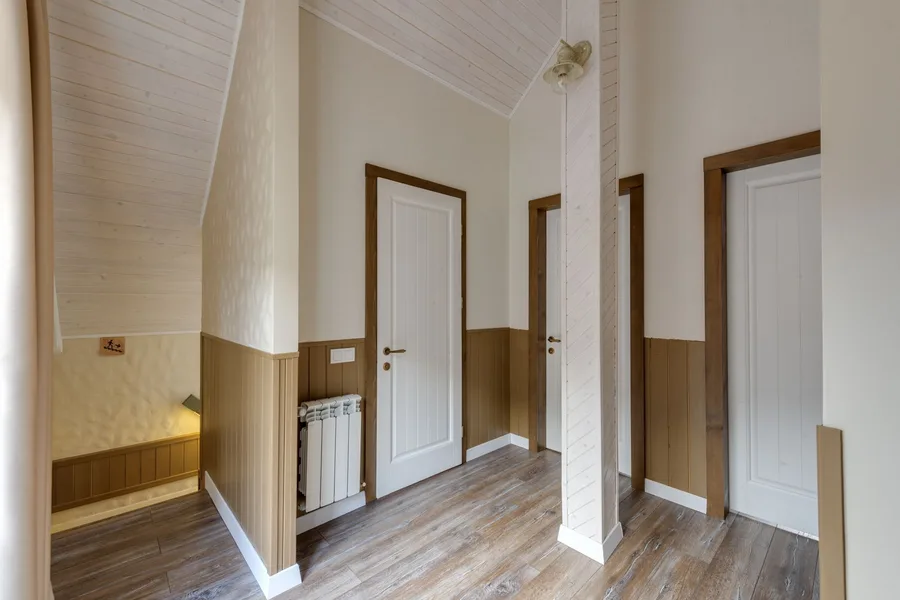
Drench only with lamps to carry it, because a dark hall with one weak light looks gloomy, and the drench side is honest about that. The sconces in the next sections, spaced 6 to 8 feet apart at 2700K, are what make a drenched hall feel rich instead of closed in, and a drenched hall with one ceiling bulb is the gloomy hall the light-paint side warns about. The wallpaper version of the same wall plan, with coverings that handle a hallway that never sees daylight, is shown in laundry room wallpaper ideas.
The Ceiling Light First: Flush Mount, Lumens, and the 2.4 Metre Rule
Start with the ceiling fitting, because it carries the ambient wash and every other layer builds on it. Size it by area at 100 to 150 lumens per square metre, so a hall 3 metres by 1.2 metres needs 400 to 600 lumens minimum from the main fitting, then add layers rather than pushing one fixture harder. If the hall is under about 2.4 metres high, or narrower than 1.2 metres, use a flush or semi-flush fitting, because a pendant needs roughly 2.1 metres of clearance from floor to the bottom of the shade, and a low-hanging shade in a tight corridor only makes the space feel narrower.
The Govee below is the ceiling pick, a 12 inch flush mount at 2400 lumens with a 2200K to 6500K range, model H60A1, dimmable to 1 percent and working with Alexa. At 2400 lumens it covers the 400 to 600 lumen minimum several times over, and the range lets the reader set 2700K once and leave it. The Philips bulbs below are the cheapest fix in the set, four 2700K bulbs at 800 lumens each, 10W for a 60W equivalent, model 565457, that set the whole hall to one warm temperature for the price of one fitting.

Also solves this: the hall that needs one warm temperature in every fitting for the price of one fixture, not the reader who wants dimming
Philips LED 60W A19 4-Pack Basic Soft White (2700K) 800 Lumen (10W = 60W) Frosted Flicker-Free Light Bulbs
A19; E26 medium base; 10W, 60W equivalent; 800 lumens; 2700K soft white; frosted; flicker-free; 4-pack; model 565457; model name 10A19/LED/927/FR/P/E26/ND 4/4CT, as printed. The cheapest fix in the set. Four 2700K bulbs set the whole hall to one warm temperature for the price of one fitting. Not for: A buyer who wants dimming, since this Basic listing does not state dimming in the sources used, or a buyer who wants a cooler temperature, since this pack is fixed at 2700K soft white.
(paid link)
Do not push one fixture harder when the hall still reads dim, because the answer is layering, not brightness. A gentle ambient wash from above, warmer vertical light on the walls, and a low-level glow for late-night trips work together, and one switch for everything means full brightness or darkness with nothing between. The lighting version of the same layering rule, with the ceiling fixture sized to the room before the task light, is shown in winter lighting ideas.
Sconce Spacing: 6 to 8 Feet Apart at 60 to 66 Inches High
Wall lights do the heavy lifting in a windowless hall, because they put light where the ceiling cannot, at eye level and along the walls, which visually pushes the walls outwards and makes a narrow space read as wider. Space them 6 to 8 feet apart at the same height for an even wash of light, per Banerge, Mirodemi, Organizertone, and Popolight, and name the second figure too, because Korewo, TheCozyCarts, Re-design, and Sparklelight give 8 to 10 feet apart.
The two ranges disagree, so the article recommends 6 to 8 feet per the year-plan edge and does not merge them into one number. One ceiling light in the middle makes a dark hall look dim at both ends, and a row of sconces at even spacing is what turns the tunnel into a sequence of spaces.
Mount the centre of the fitting 60 to 66 inches from the floor, high enough to keep the bulb out of your eyeline and low enough that the light still spills up and down the wall. Zigzag gives a higher variant, about 1.7 to 1.8 metres, about 67 to 71 inches, and Decorly gives 1.6 to 1.7 metres, about 63 to 67 inches, so the article presents 60 to 66 inches as the main rule and names the higher figures as variants.
Keep the projection under 15 cm in a hall under 1.2 metres wide, or 4 to 5 inches from the wall, so shoulders and bags clear it, and choose a fitting with a shade, diffuser, or frosted glass, because a bare bulb at head height is glare, not lighting.

Also solves this: the hall with no outlet on the wall that needs a sconce with no wiring, not the reader who wants a fixed 2700K only
Hensam Battery Operated Wall Sconces, Wireless LED Wall Sconce Set of Two, Rechargeable Wall Lights, 5 Modes Dimmable
Set of 2; rechargeable 5000mAh battery; 5 color modes; adjustable head; dimmable; model CL-K38, as printed. The no-wiring sconce for a hall with no outlet on the wall. Five colour modes cover warm white for the hall and cooler light for reading by the door. Not for: A buyer who wants a fixed 2700K only, since this fixture cycles modes, or a hall where a sconce must stay lit all evening, since battery sconces need recharging.
(paid link)
Also solves this: the hall where recharging is a chore and the battery must last longest, not the reader who wants warm white only
Nekhung Battery Operated Wall Sconces Set of Two, Wireless Battery Wall Light with 10000mAh RGB Dimmable Magnetic Bulb and Remote, Rechargeable Sconce Wall Decor
Set of 2; 10000mAh rechargeable battery; 3CCT and 7 RGB colors; dimmable; remote control; magnetic bulb; timer; lighting time 20-60 hours per charge as stated, as printed. The longest-running battery sconce in the set. The 10000mAh battery is the pick for a hall where recharging is a chore. Not for: A buyer who wants warm white only, since this fixture also carries RGB colours, or a hall where a magnetic bulb could be knocked off by passing bags.
(paid link)
Also solves this: the hall that needs one sconce to wash the wall, the art, or the floor, not the reader who wants a fixed fixture
Lightess 2PC LED Wall Sconces, 19 Colors Dimmable Wall Mounted Lamp with 5000mAh Rechargeable Battery, 360 Degree Rotate Magnetic Ball, Touch and Remote Control, Cordless Wall Light
2 pack; 5000mAh rechargeable battery; 19 colors; 3 color temperatures; 3 brightness levels; dimmable; 360 degree magnetic rotation; touch and remote control; model 10272911, as printed. The aimable battery sconce. The magnetic ball rotates 360 degrees, so one sconce washes the wall, the art, or the floor as the hall needs it. Not for: A buyer who wants a fixed fixture, since this is a magnetic ball on a mount, or a hall where the sconce must stay put under daily knocks.
(paid link)
Wire the sconces as a pair on their own switch where the wiring allows, and ask an electrician about two-way switching so the row turns on at one end of the hall and off at the other. Where there is no wiring at all, the battery sconces above are the fix, because a cordless sconce is the easiest win in a dark hallway, and a plug-in sconce covers the hall that has an outlet but no wall wiring.
2700K Warm White: The Kelvin That Makes a Hall Feel Like Home
Colour temperature is the detail that decides whether a bright hall feels welcoming or feels like a hospital corridor. Keep every fitting at 2700K warm white, and set every adjustable fixture to 2700K once, because one warm temperature across the ceiling fitting, the sconces, the console lamp, and the night lights is what makes the hall read as one room, while a mix of warm and cool lamps in one hall reads as a mistake.
The 2700K rule is the hall rule, and it holds even when the brighter range tempts. RoomThrift gives 3000K to 3500K warm white as the brighter variant, and the article names it as the variant, not the rule. Warm white light does not just flatter paint, it flatters people, because a warm glow at eye level is the light that makes a hall feel like home.
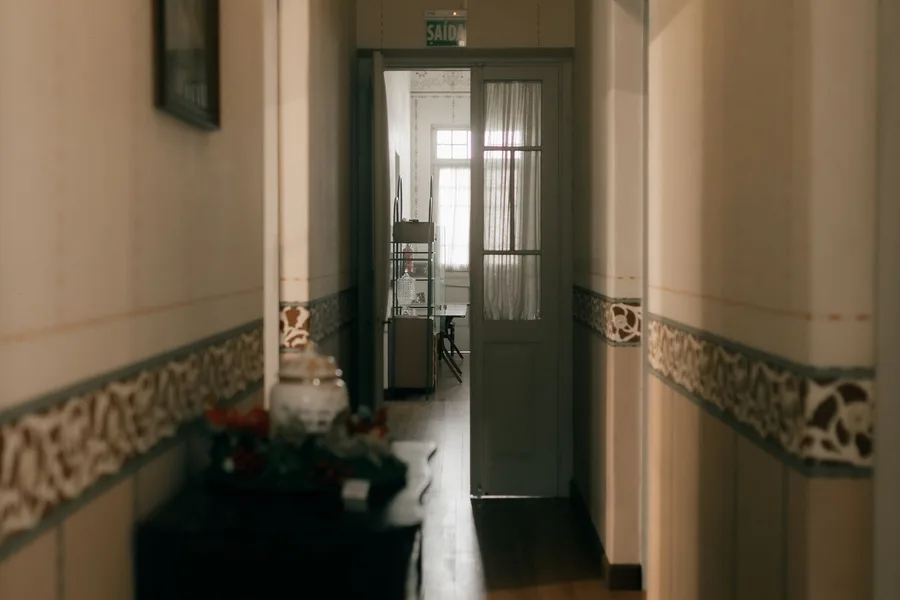
Check the colour temperature printed on the fitting before ordering, because a fitting that says 3000K or 4000K cannot be set to 2700K, and a fitting that says adjustable only helps if the adjustment actually reaches 2700K. A single dimmer for the whole hall helps too, because the hall is brightest at midday and softest at night, and the dimmer is the cheapest way to make one set of fittings do both jobs. The room that needs the same Kelvin discipline most, with the ceiling fixture set before the desk lamp, is shown in home office lighting ideas.
Mirrors That Double the Light You Already Have
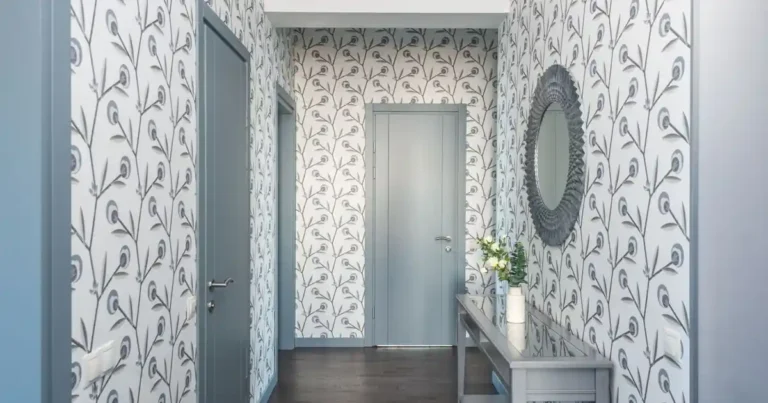
A mirror is the cheapest light in the hall, because it doubles the light you already have instead of adding a fitting. Hang a mirror where it catches a wall light or ceiling fitting, because a mirror directly opposite a glowing wall light doubles the visible glow, and put one at the far end or on the long wall, where it pulls the eye down the hall.
The frame matters as much as the glass, because a mirror in a dark hall needs a frame that reads as furniture, not a bathroom fixture. A warm wood or brass frame suits a drenched hall, and a thin black frame suits a light hall. The BEAUTYPEAK below is the mirror pick, a 36 inch round with a black frame that holds 99.99 dollars as the only priced slot in the set, model AMIR-1, measured at 24 inch diameter in the listing detail, so confirm the diameter before ordering.
Avoid a mirror facing a dark doorway, or facing a glazed front door that turns into a black rectangle after dark, because a mirror that reflects darkness only makes the hall darker.
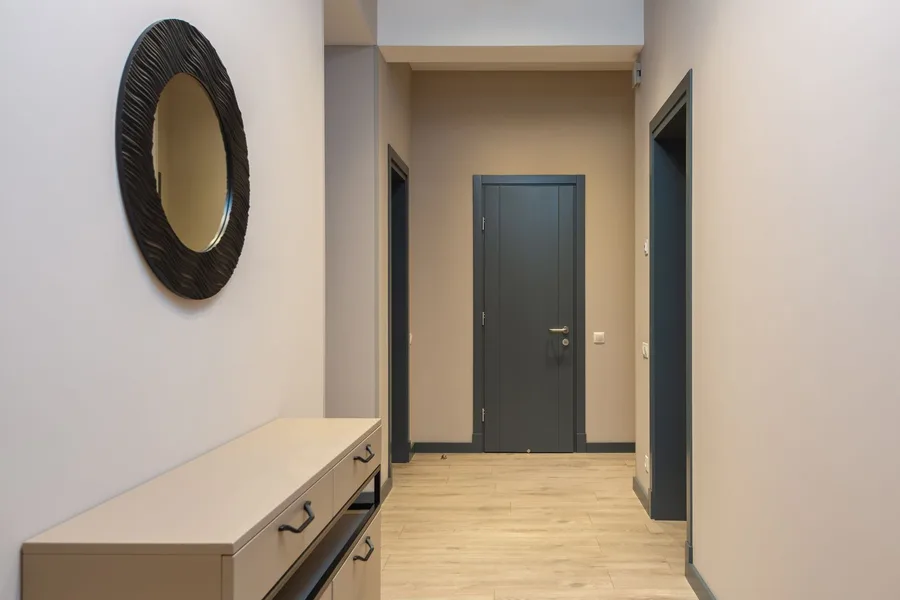
A mirror also borrows light from the one source a windowless hall does have, the glazed door at the far end, because a mirror placed to catch that borrowed daylight throws it back down the hall, and a hall with a sun tunnel gets the same gain twice over. The bedroom version of the same mirror rule, with the mirror placed to catch the lamp instead of the window, is shown in winter bedroom ideas.
The Runner That Pulls the Eye Down the Hall
A runner pulls the eye down the hall, and a hall with no runner reads as a corridor while a hall with a runner reads as a room. Leave a strip of bare floor on each side so the shape reads clearly, and choose a pattern that runs the length of the hall, because a pattern that cuts across the width only chops the hall into pieces.
The Yamaziot below is the runner pick, a 2 foot by 8 foot runner in antique brown and white at 0.27 inches thick, non-slip and machine washable, model YMZ-VR-001-BRW. A runner that needs washing is the right runner for a hall, because the hall is the most walked room in the house, and a runner that cannot be washed is a runner that stays dirty.
Also solves this: the hall that needs a runner the eye can follow to the far door, not the hall with a wide open floor that needs no runner
Yamaziot 2×8 ft Vintage Runner Rugs for Hallway, Non-Slip Carpet Runner, Machine Washable, Antique Brown/White
2 ft by 8 ft; 0.27 inch thick; non-slip; machine washable; antique brown/white; model YMZ-VR-001-BRW, as printed. The runner that pulls the eye to the far door. A low pile runner in a vintage pattern reads as a room, not a corridor, and machine washable matters in the most walked room in the house. Not for: A hall with a wide open floor that needs no runner, since this is sized for a corridor, or a buyer who wants a thick plush pile, since this is a 0.27 inch low pile.
(paid link)
Measure the runner against the hall, not the catalog, because a runner that runs past the last door looks like a mistake, and a runner that stops short of the first door looks unfinished. The bathroom version of the same floor rule, with the rug sized to the room before the pattern, is shown in modern farmhouse bathroom ideas.
A Console and Hooks That Keep the Floor Clear
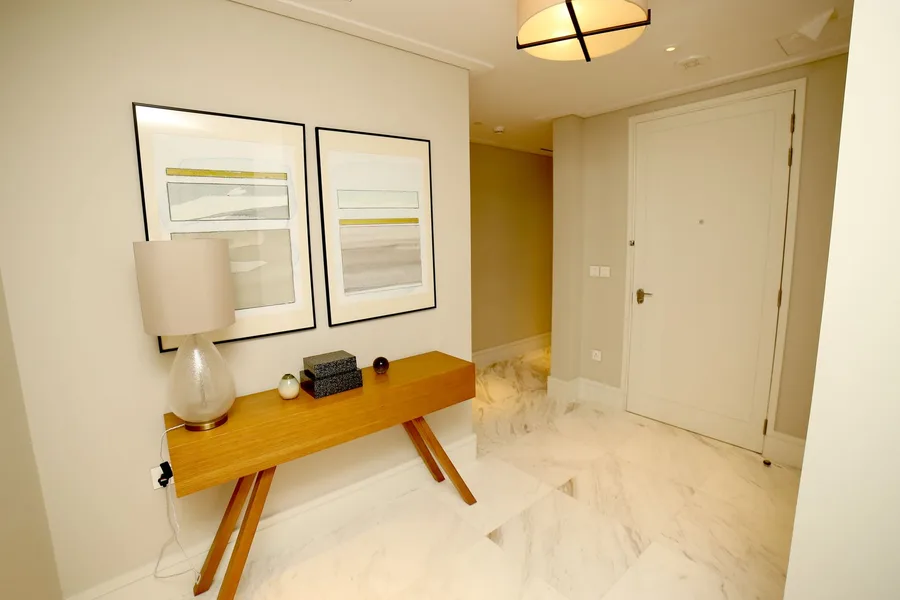
A hall that stays clear is a hall that reads as bright, because shoes, bags, and coats on the floor read as clutter, and clutter reads as dark. A console under 300 mm deep holds the keys and the lamp without narrowing the walkway, and hooks on the wall hold the coats without a floor rack taking up the floor.
The MAHANCRIS below is the console pick, a 47.2 inch console at 11.8 inches deep with two drawers and two tiers of open shelves, model ST-M-47.2, in rustic brown. At 11.8 inches deep it sits just under the 300 mm rule, and the drawers hide the clutter that would otherwise sit on the floor.
Also solves this: the hall that needs hooks that hold coats without a floor rack, not the reader who wants a full coat tree
Alaterre Furniture Pomona Metal and Wood 4 Hook Wall Mount Coat Rack, Antique White
4 hooks; antique white; metal and wood; wall mount; model AWHP2348, as printed. The hooks that keep the floor clear. Four hooks on the wall hold the coats without a floor rack taking up the floor. Not for: A buyer who wants a full coat tree, since this is a wall mount with 4 hooks, or a hall with no wall space for a mounted rack.
(paid link)
Mount the hooks at a height everyone in the house can reach, and keep the console lamp at 2700K so the entry glow matches the hall. A hall that starts clear stays clear, because the console and the hooks give every thing a place, and a thing with a place never ends up on the floor. The office version of the same keep-the-floor-clear rule, with the desk and the storage sized to the room before the decor, is shown in home office design ideas.

Borrowed Light: Glazed Doors, Transoms, and a Destination at the Far End
Borrowed light is the cheapest light in the hall, because it costs nothing once it is there. A glazed transom above a door borrows daylight from an adjoining room, and an interior window does the same. A sun tunnel is the fastest way to brighten a windowless hallway, and skylights offer up to three times more light than vertical windows.
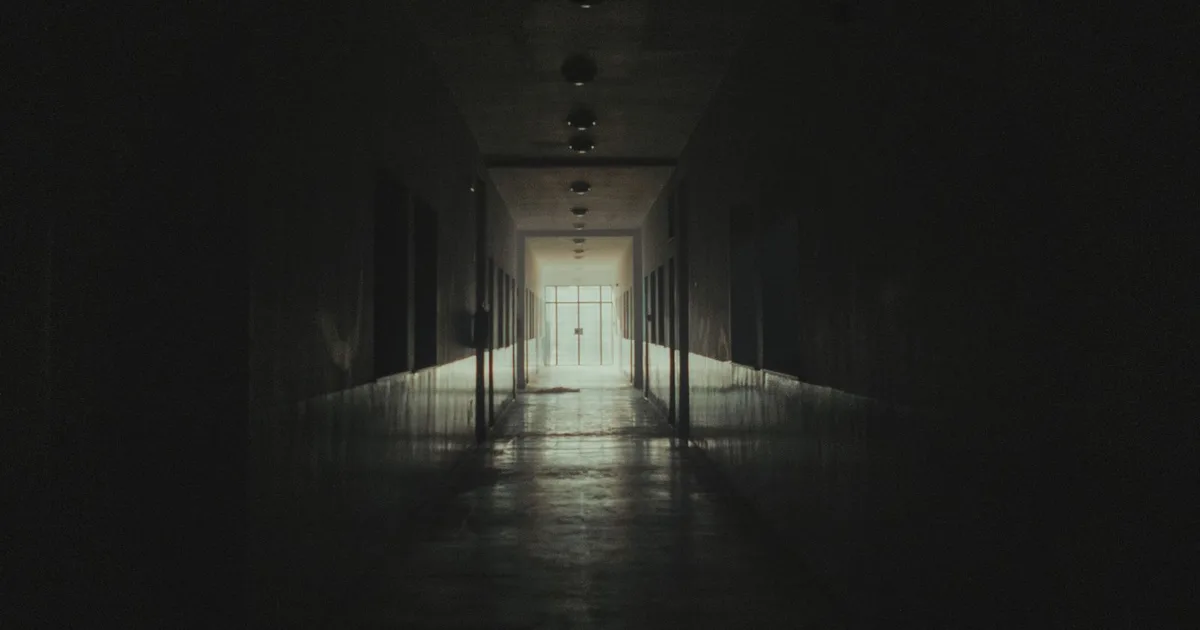
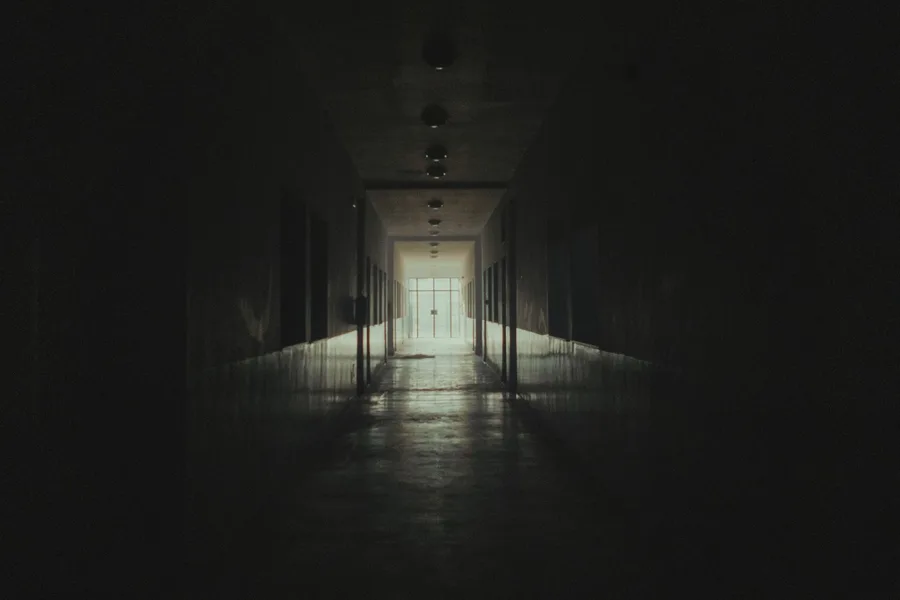
Give the hall a destination at the far end, because a hall that ends in a lit doorway reads as a room, and a hall that ends in a dark wall reads as a tunnel. The hero photo shows it: a dark corridor leads to a lighted doorway at the far end, and every fix in this article works toward that doorway.
A glazed door at the far end is the destination, and a mirror opposite it doubles the borrowed light. A hall with no glazed door at all still has the sun tunnel option, and a hall that cannot take a sun tunnel still has the sconce row, the mirror, and the runner.
Frame the borrowed light like art, because a transom that reads as a window is a feature, and a transom that reads as a hole is a repair. A dark frame around a glazed transom makes the borrowed daylight read as a picture, and the same frame trick works on the mirror, the art, and the console. The bathroom version of the same borrowed-light rule, with the towel warmer sized to the room before the mirror, is shown in heated towel rack ideas.
Night Light Layer: Motion Sensors and Strips for 3 AM Trips
The night layer is the layer most hallway lists skip, because it only matters at 3 AM, and at 3 AM it matters most. A hall that is dark at night is a hall that gets walked through in the dark, and a hall walked through in the dark is a hall that ends in a stubbed toe. The fix is a low-level glow that turns on by itself, so the hall is never fully dark and never fully bright.
Motion sensors are the switch, because a sensor that turns the light on when you step into the hall and off after 20 seconds of no motion means the hall is lit only when it is walked. The WOBANE below is the strip pick, a 65.6 foot strip that detects movement within 10 ft in the dark and turns off after 20 seconds of no motion. The AMIR below is the puck pick, a set of 6 pucks that detect movement within 3 metres and turn off after 20 seconds.
Also solves this: the hall that needs a low glow along the floor that turns itself on at night, not the reader who wants a ceiling light for the night layer
WOBANE Motion Sensor LED Strip Lights, 65.6ft LED Light Strip with Motion Sensor, Cuttable LED Light Strip for Stairs, Bed, Cabinet, Closet, Kitchen, Warm White, 3000K
65.6 ft; warm white 3000K; motion sensor; detects movement within 10 ft in the dark; off after 20 seconds of no motion; cuttable; as printed. The night strip. A low glow along the floor that turns itself on at night and off after 20 seconds. Not for: A buyer who wants a ceiling light for the night layer, since this is a strip, or a hall that needs 2700K at night, since this strip is 3000K warm white.
(paid link)
Also solves this: the hall that needs a puck of light where the strip cannot reach, not the reader who wants a hardwired night light
AMIR Motion Sensor Light, Cordless Battery-Powered LED Night Light, Stick-Anywhere Puck Light, Soft Warm Light, 6-Pack, White
6 pack; cordless; battery powered; motion sensor; detecting distance 3 metres, 9.84 ft; soft warm light; stick-anywhere; as printed. The night puck. A puck of light where the strip cannot reach, stuck to the wall at ankle height. Not for: A buyer who wants a hardwired night light, since this is battery powered, or a hall where a puck could be knocked off by passing bags.
(paid link)
Put the strip along the skirting or under the console, and the pucks at ankle height on the wall, because a low glow shows the floor without waking the house. A night light that shines in your eyes is worse than no night light at all, and a night light that shows the floor is the whole job.
12 Verified Dark Hallway Picks in Buy Order
Buy in the order the hall needs it, not the order the catalog shows it. Start with the ceiling fitting, because it carries the ambient wash, then the sconces, because they carry the wall light, then the mirror, the runner, the console, and the hooks, because they finish the room. The night layer goes last, because it only matters once the hall is lit.
The order below is the buy order, and the links go to the listings as printed. Check size, colour, and contents on the live listing before ordering, because listings and variants change, and where a detail cannot be verified, it is left out rather than guessed. The only price in the set is the BEAUTYPEAK mirror at 99.99 dollars, and every other pick carries no price in the box, because the price on the listing is the price that matters.
Start with the Govee ceiling light and the Philips bulbs, because one warm temperature across the hall is the first fix, and the cheapest fix in the set. Add the TRLIFE sconce and the battery sconces where the wiring allows, then the BEAUTYPEAK mirror over the console, the Yamaziot runner underfoot, the MAHANCRIS console against the wall, the Alaterre hooks above it, and the WOBANE strip and AMIR pucks for the night layer.
Frequently Asked Questions
Q1: Can a dark hallway be brightened without windows?
Ans: Yes. A dark hallway brightens through layers, not one fitting. A ceiling fitting sized by lumens per square metre, sconces at 6 to 8 feet, 2700K warm white in every fitting, a mirror that doubles the light, a runner that pulls the eye down the hall, and a night layer for 3 AM trips together make a windowless hall read as bright.
Q2: How far apart should hallway sconces be?
Ans: Space them 6 to 8 feet apart at the same height, per Banerge, Mirodemi, Organizertone, and Popolight. Korewo, TheCozyCarts, Re-design, and Sparklelight give 8 to 10 feet apart as the second figure, so the article recommends 6 to 8 feet and names the 8 to 10 foot range as the variant.
Q3: What colour temperature is best for a hallway?
Ans: 2700K warm white is the hall rule, because one warm temperature across the ceiling fitting, the sconces, the console lamp, and the night lights makes the hall read as one room. RoomThrift gives 3000K to 3500K warm white as the brighter variant, and the article names it as the variant, not the rule.
Q4: Should a dark hallway be painted white or drenched in a deep colour?
Ans: It depends on the three audit numbers. A hall under 1.2 metres wide with a ceiling under 2.4 metres and three or more doors takes colour-drench, because white shows every door frame and every shadow. A hall wider than 1.2 metres with a ceiling above 2.4 metres and one or two doors takes light paint, because there is wall to bounce light and few frames to chop it up.
Q5: How many lumens does a hallway need?
Ans: Size the main fitting at 100 to 150 lumens per square metre, so a hall 3 metres by 1.2 metres needs 400 to 600 lumens minimum from the main fitting, then add layers. A sconce adds 400 to 800 lumens each, and a console lamp adds about 400 lumens at 2700K.
Bottom Line: A dark hallway with no windows brightens when the hall is measured first and the fixes follow the numbers, not the other way round. Run the decision tree on width, ceiling height, and door count, set the ceiling light by lumens per square metre, space the sconces 6 to 8 feet apart at 2700K, double the light with a mirror, draw the eye with a runner, keep the floor clear, borrow daylight where you can, and add a warm night layer for the 3 AM trip. The hall reads as bright, not lit.
Save this dark hallway plan for the next room you brighten, and share it with a friend who keeps leaving the hall light on all night.
Photos via Pexels. All photos are free to use and sourced from Pexels.