
21 Budget Deck Skirting Ideas That Look Anything But Cheap
Budget Deck Skirting Ideas: The Gap Under the Deck Is the Whole Project
The space under a raised deck is the part of the house everyone sees and nobody finishes. It collects leaves, it shelters animals, and it makes an otherwise tidy home read as a job left half done. These budget deck skirting ideas treat that gap as the project itself, not as an afterthought, and they rebuild the live post’s 21 ideas as a system with measurements and a buy order. The live post named the right materials and gave each one a line or two, and this rewrite keeps all 21 and says which one to buy first, what size to buy, and how much air to leave behind it.
The competitor guides list lattice, slats, metal, and stone and stop there. DecorPlume sets the airflow rules, wood at least 6 inches above ground and quarter-inch hardware cloth buried at least 6 inches deep, Cactus Decking sets the vent math at about 1 square foot per 150 square feet with a 2 to 4 inch ground gap, and The Daily Heaven sets the access rule, one removable panel or a hinged door, plus an L-shaped cloth trench 12 inches deep and 12 inches out.
None of them names a single product, and none of them puts the fixes in buy order. These budget deck skirting ideas add the gap closer they lack: a three-rule system with exact measurements for the air, the access, and the frame, plus 12 verified picks in buy order.
The picks are 12 researched products, 4 full boxes and 8 compact ones, each tied to the problem it solves and placed where that problem is discussed. This article is research based curation, not hands on testing. Where a detail could not be verified, it is left out rather than guessed, and you should check size, color, and contents on the live listing before ordering. The numbers quoted from other sites are their figures, not tested claims, and the buy order below is the order that keeps a deck finished at every step.
How these picks were chosen: each pick was researched from listing and source pages and checked at the publish date. No star rating is claimed for any pick. Check size, color, and contents on the listing before ordering, because listings and variants change. Where a detail cannot be verified, it is left out rather than guessed.
Affiliate disclosure: This article contains affiliate links to products on Amazon. As an Amazon Associate I earn from qualifying purchases. The price you pay stays the same, and the commission helps keep The Decor Root running.

Budget Deck Skirting Ideas Start With Three Rules: Air, Access, and a Frame
A deck skirt fails on planning before it fails on taste. A skirt with panels, vents, and planting meeting at random widths reads as a cover-up, no matter how neat the boards are, and a skirt with three clear rules reads as a designed base even before a single plant arrives. The rules below decide every purchase that follows, and they take one walk around the deck and one tape measure, not a single new buy.
- Let the air move: Hold openings continuous around the perimeter, keep wood at least 6 inches above the ground, and give solid skirting about 1 square foot of vent per 150 square feet of underside, so moisture never sits against the joists.
- Leave a way in: Build at least one removable panel or a hinged door, fixed with screws rather than nails, so shutoffs, cleanouts, and stored things stay reachable.
- Frame every panel: Set each panel inside a clean, painted 2 by 4 frame in one consistent color, so the cheapest lattice reads as custom millwork.
- Keep animals out, then plant the base: Bury quarter-inch hardware cloth at least 6 inches deep, then plant the base, so the skirt is protected before the garden grows against it.
If the rules hold, these budget deck skirting ideas can be as varied as you like, because the air, the access, and the frame each have their own place. If the rules break, no single buy can fix it, because the deck has no air to breathe and no door to reach through.
Lattice First: The Cheapest Panel That Reads Custom
Lattice is the classic for a reason: a pre-made panel drops into a simple frame in an afternoon, it ventilates by default, and it costs less than almost any other cover for the gap. The live post’s first idea, classic white lattice in a painted 2 by 4 frame with climbing plants against it, is still the fastest route to a finished deck perimeter on a tight budget. The shadow box pattern from live idea 11 uses the same logic, alternating boards on the front and back of a rail so air passes while the view stays blocked, and it reads as expensive custom millwork for the cost of repetitive, simple carpentry.
The panel below is the first buy, because it costs little and changes the whole base at once. The panel is a Freestyle 4 by 8 ft white garden vinyl lattice, 0.2 inches thick and 12.04 pounds, model 73004026, so it covers a full 8 ft run per panel and gives the deck its framed edge in one move. Vinyl never rots and never needs paint, so frame it in the trim color and let the diamonds do the venting, and check the panel size on the live listing before ordering.
| Measure | Figure | Source |
|---|---|---|
| Wood above ground | At least 6 in | Univ. of Kentucky extension via DecorPlume |
| Hardware cloth burial | At least 6 in deep, 1/4 in mesh | UC IPM via DecorPlume |
| L-shaped cloth trench | 12 in deep, 12 in out | The Daily Heaven |
| Vent area | About 1 sq ft per 150 sq ft | Cactus Decking |
| Ground gap under skirt | 2 to 4 in | Cactus Decking |
| Slat spacing | 3/8 to 1/2 in | Cactus Decking |
| Vent panel spacing | Every 6 to 8 ft | Live post idea 3 |
| Board gaps, Trex guidance | 3/8 in | Trex via DecorPlume |
| Lattice panel | 4 x 8 ft, 0.2 in thick, 12.04 lb, model 73004026 | Barrette listing |
| Faux stone panel | 42 x 12 in, 3.21 sq ft, model G2SSDSHP | GenStone listing |
| Bamboo roll | 6 ft H x 8 ft L, 3/4 in poles, 56 lb | Backyard X-Scapes listing |
| Boxwood panels | 20 x 20 in each, 12 pieces, 10.33 sq ft | DearHouse listing |
| Hardware cloth | 48 in x 50 ft, 23 gauge, 1/4 in mesh | SEBOSS listing |
| Wood stain | 1 gal, Pecan, 125 sq ft coverage, model 115 | Ready Seal listing |
| Masonry waterproofer | 1 gal, 75 to 100 sq ft per gal, 15 psi, model 28613 | DRYLOK listing |
| Solar deck lights | 12 pack, 13 LEDs, 3.15 x 2.17 x 3.15 in | NIORSUN listing |
| Deck screws | #9 x 3 in, 350 count, model 10903 | GRK listing |
| Weed barrier | 3 x 50 ft, 3.0 oz PP woven | Agfabric listing |
| Wood sealer | 1 gal, Chestnut Brown, 150 to 400 sq ft per gal | Thompson’s listing |
| Vent covers | 16 x 8.7 in, fits 16 x 8 in opening, 3 pack | Jianbenkj listing |
| Cheapest three, live post figure | Often under $50 total for a standard deck | Live post FAQ 1 |
| DIY tools, live post figure | Circular saw, drill, tape measure | Live post FAQ 3 |

The low deck thinking behind this section, how a deck close to the ground stays easy to reach, lives in ground level deck ideas.
Boards, Battens, and Slats: The Wood That Matches the House
Wood is the family that matches the house, because the same boards that clad the walls can close the gap below the deck. Diagonal boards cut at 45 degrees read as custom millwork, horizontal lap siding makes the deck look like a built-out addition to the home, vertical boards with battens over the seams give the classic farmhouse texture, and horizontal slats with a 1 inch gap between them give the clean modern line. Reclaimed pallets, cedar shingles, PVC trim boards, and aged barn wood all belong to the same family, and each one takes paint or stain the way the house trim does.
The stain below is the buy that ties the family together, because one tone across the boards, the battens, and the frame makes the skirt read as part of the deck instead of an add-on. The stain is a Ready Seal 1 gallon can in Pecan, model 115, an oil-based semi-transparent stain and sealer in one that covers 125 square feet and needs no back brushing, so it soaks into bare wood and leaves the grain visible in one move. One consistent color is the whole trick, so stain the frame the same tone as the boards, and check the color on the live listing before ordering.

Also solves this: the boards that do not match the house, not the deck that needs new boards
Ready Seal Exterior Wood Stain, Pecan, 1 Gallon
Exterior wood stain and sealer, Pecan, 1 gallon, 128 fluid ounces, 125 square feet coverage, oil-based semi-transparent, no back brushing, model 115, as printed. Not for: a reader who wants a solid paint color, since this is a semi-transparent stain that lets grain show, or a reader who wants to stain over paint, since the maker says not to apply over painted or newly stained surfaces.
Check Price on Amazon → (paid link)
The screws below are the fastener that keeps the boards removable. The screws are GRK Deck Elite #9 by 3 inch screws in a 350 count box, model 10903, with a corrosion resistant coating, a Fast Bite tip, and a T-25 bit in the box, so they hold every board and frame joint and come out again when a panel needs to move. Screws rather than nails are what make an access panel a real door, so drive them where a panel meets its frame, and check the screw size on the live listing before ordering.
Also solves this: the panels nailed shut, not the deck that needs a new frame
GRK Fasteners Deck Elite #9 x 3 Inch Decking Screws, 350 PCS, Tan
Deck Elite decking screws, #9 x 3 inch, 350 count, corrosion resistant coating, Fast Bite tip, star drive recess, T-25 bit included, tan, model 10903, as printed. Not for: a reader who wants nails, since these are star-drive screws, or a reader who wants a bulk box, since this listing is 350 screws.
Check Price on Amazon → (paid link)
The deck design thinking behind this section, how the boards, the rails, and the base read as one build, lives in deck design ideas.
Metal That Reads Modern: Corrugated Panels and Wire Mesh
Metal is the modern edge, and it works when it is framed and painted rather than left raw. Welded wire panels stretched between metal T-posts and painted matte black read as high-end industrial screening, and the live post puts a 20 foot section under $50, with plants growing through the wire to soften it. Corrugated steel roofing panels cut to height and framed with painted lumber give the modern farmhouse edge, raw silver for the industrial look or deep navy, black, or sage green for the intentional one. Wire mesh inside a black timber frame reads as a sophisticated open panel from a distance, and it costs almost nothing.
The mesh below is the layer behind the look, because no metal skirt keeps animals out on its own. The mesh is a SEBOSS roll of quarter-inch hardware cloth, 48 inches wide by 50 feet long in 23 gauge, hot-dip galvanized after welding, so it buries 6 inches deep behind any panel and gives the skirt its animal-proofing in one move. Galvanized after welding means the coating covers the welds too, so cut it with gloves on and bury the bottom edge, and check the roll size on the live listing before ordering.

Also solves this: the animals digging under the skirt, not the deck that needs a solid wall
SEBOSS 1/4 inch Hardware Cloth 48 inch x 50 Foot 23 Gauge, Hot-dip Galvanized After Welding
Hardware cloth, 1/4 inch square openings, 48 inch x 50 foot roll, 23 gauge, hot-dip galvanized after welding, as printed. Not for: a reader who wants a finished face on its own, since mesh reads as unfinished without a frame, or a reader who wants wide openings, since this mesh is quarter-inch.
Check Price on Amazon → (paid link)
The deck privacy thinking behind this section, how a screen keeps the yard private without closing it in, lives in deck privacy ideas.
Stone, Block, and Painted Concrete: The Heavy Look Without the Weight
Stone and block are the heavy look, and they anchor a deck to the house the way no board can. A single course of decorative cinder block with a flat bluestone cap makes a permanent, pest-resistant base, painted concrete block in a dark matte tone is the lowest-cost finish on the whole list, and adhesive-backed faux stone veneer over a plywood backer gives the stacked stone look for under $5 per square foot, per the live post. Breeze blocks with geometric cut-outs give the mid-century look that is having a design moment, and river pebbles pressed into a concrete panel face give a genuinely custom artisan skirt for the cost of a bag of concrete and a bucket of stones.
The panel below is the stone buy, because it gives the masonry look without the masonry weight. The panel is a GenStone faux stacked stone panel, 42 by 12 inches in Desert Sunrise, model G2SSDSHP, cast from real stone in 4 unique forms with a 1 inch shiplap edge, so each panel covers 3.21 square feet and locks into the next one without a visible seam. Polyurethane means one person can carry and cut it, so screw it to a plywood backer and let the stone face do the work, and check the panel size on the live listing before ordering.

The paint below is the cheapest finish in the whole article, and it belongs on block that is already there. The paint is a DRYLOK Extreme latex masonry waterproofer in white, model 28613, a 1 gallon can that stops water, withstands 15 pounds per square inch of hydrostatic pressure, and covers about 75 to 100 square feet per gallon on rough masonry, so it turns a plain block base into a bright painted plinth in two coats. Two coats are the warranty rule, so roll the first, let it dry 1.5 hours, and roll the second, and check the coverage on the live listing before ordering.
Also solves this: the bare concrete block, not the block that needs rebuilding
DRYLOK Extreme Latex Masonry Waterproofer, White, 1 Gallon, Model 28613
Extreme latex masonry waterproofer, white, 1 gallon, 128 fluid ounces, smooth finish, model 28613, stops water, withstands 15 psi, 75 to 100 sq ft per gallon, as printed. Not for: a reader who wants to paint over an existing coating, since the maker says it cannot be used over latex or oil paint, or a reader who wants one coat only, since the warranty calls for two coats.
Check Price on Amazon → (paid link)
The river rock thinking behind this section, how stone at the base ties a deck to the garden, lives in river rock landscaping ideas.
Bamboo Rolls and Woven Screening: The Warm Look in an Afternoon
Bamboo is the warm look, and it is the fastest natural screen on the list. A bamboo fence roll fastens to a simple frame in an afternoon, and the live post puts a 6 foot section under $30, with warm tones that suit tropical, Zen, and boho yards alike. Seal it with a UV-protectant spray to slow weathering, and plan to replace panels every few years as they age. Outdoor fabric panels belong to the same soft family, stretched across a timber frame and fastened with stainless staples and trim, in a bold stripe, natural linen, or solid navy, and they work best under low decks or in sheltered spots where the fabric stays dry.
The roll below is the bamboo buy, because one roll covers a full run with no cutting and no painting. The roll is a Backyard X-Scapes natural bamboo fencing panel, 6 feet high by 8 feet long with 3/4 inch Tonkin bamboo poles, 56 pounds for the whole roll, so it unrolls against the frame and gives the deck its warm screen in one move. Natural bamboo ages and can split, so seal it after install and let it weather evenly, and check the roll size on the live listing before ordering.

The planter box thinking behind this section, how planting at the base finishes a deck the way trim finishes a room, lives in outdoor planter box styling ideas.
Airflow and Access: The Vents and the Door You Will Need
Airflow is the rule that decides whether skirting helps or hurts, and it comes before any material choice. The space under a deck is damp by nature, rain gets through the boards and ground moisture rises, and moving air carries that moisture away. Wrap the perimeter in solid panels with no gaps and the air stops moving, so the moisture stays and sits against the joists, the beams, and the ledger, and rot starts where nobody looks. Lattice, spaced slats, and wire mesh ventilate on their own, and solid skirting needs designed vents, louvered panels, vent grilles, or gaps between boards, with a vent panel every 6 to 8 feet, per the live post.
The vent covers below are the designed airflow for solid skirting, because they give the under-deck space its measured vent area without leaving an open hole. The covers are a Jianbenkj 3 pack of foundation vent covers, 16 by 8.7 inches to fit a standard 16 by 8 inch rough opening, in heavy duty galvanized steel with a damper and a screen, so they slide open in spring for airflow and shut in winter to hold heat. The screen keeps animals out while the damper controls the air, so measure the opening first and screw them into the pre-drilled holes, and check the opening size on the live listing before ordering.
Also solves this: the solid skirt with no air, not the deck that needs an open lattice
Jianbenkj Foundation Vent Cover, 16 in. x 8.7 in., Fits 16 in. x 8 in. Rough Opening, Black, 3 Pack
Foundation vent cover, 16 x 8.7 inches, fits 16 x 8 inch rough opening, 3 pack, black, heavy duty galvanized steel, damper and screen, screws included, as printed. Not for: a reader who wants an open lattice, since this is a dampered vent for solid skirting, or a reader whose rough opening is not 16 by 8 inches, since this cover is sized for that opening.
Check Price on Amazon → (paid link)
The ground cover below goes down before the skirt goes up, and it is the cheapest insurance in the whole article. The cover is an Agfabric landscape ground cover, 3 by 50 feet of 3.0 ounce heavy PP woven fabric in black, UV stabilized, model GC2903050B0, so it blocks weeds, lets water through, and keeps the soil under the deck clean and dry. Lay it flat, pin the edges, and run the skirt over it, so nothing grows through the panels and the base stays tidy, and check the roll size on the live listing before ordering.
Also solves this: the weeds growing through the skirt, not the yard that needs new soil
Agfabric Landscape Ground Cover 3x50ft Heavy PP Woven Weed Barrier
Landscape ground cover, 3 x 50 feet, 3.0 ounce heavy PP woven fabric, UV stabilized, black, model GC2903050B0, as printed. Not for: a reader who wants a solid waterproof sheet, since this is a woven barrier that lets water through, or a reader who wants a narrow strip, since this roll is 3 feet wide.
Check Price on Amazon → (paid link)
The fence thinking behind this section, how one material choice sets the whole boundary of a yard, lives in fence wood ideas.
Paint, Stain, and Seal: The Finish That Makes Budget Read Custom
The finish is the layer that makes cheap materials read as custom, and the live post says it plainly: clean paint or stain, a neat 2 by 4 frame, and some landscaping at the base. One consistent color is the trick, white, black, or charcoal, and every panel takes the same tone. Paint the piers a dark matte charcoal, navy, or forest green, leave the deck and the stairs warm, and the base reads as a designed plinth instead of an afterthought. The most successful budget projects in the live post use the same logic, cheap material, clean paint, and a frame that ties it together.
The sealer below is the finish that protects the stain, because stained boards need a sealed surface to hold their color through the seasons. The sealer is a Thompson’s WaterSeal solid color waterproofing wood stain and sealer in Chestnut Brown, model TH.093301-16, a 1 gallon can that covers 150 to 400 square feet per gallon, so it seals stained boards and holds their tone through the weather. Solid color means it covers more of the grain than a transparent stain, so brush it on the same tone as the boards and let it cure before the deck gets wet, and check the color on the live listing before ordering.

Also solves this: the stained boards left bare, not the boards that need a new color
Thompson’s WaterSeal Solid Color Waterproofing Wood Stain and Sealer, Chestnut Brown, 1 Gallon
Waterproofing wood stain and sealer, solid color, Chestnut Brown, 1 gallon, 128 fluid ounces, model TH.093301-16, covers 150 to 400 square feet per gallon, as printed. Not for: a reader who wants a clear finish, since this is a solid color that covers the grain, or a reader who wants a transparent stain, since this can is a solid color stain and sealer.
Check Price on Amazon → (paid link)
The deck stain color thinking behind this section, how one color choice sets the whole mood of a deck, lives in deck stain color ideas.
Light the Base After Dark: Grazing Light on the Skirt
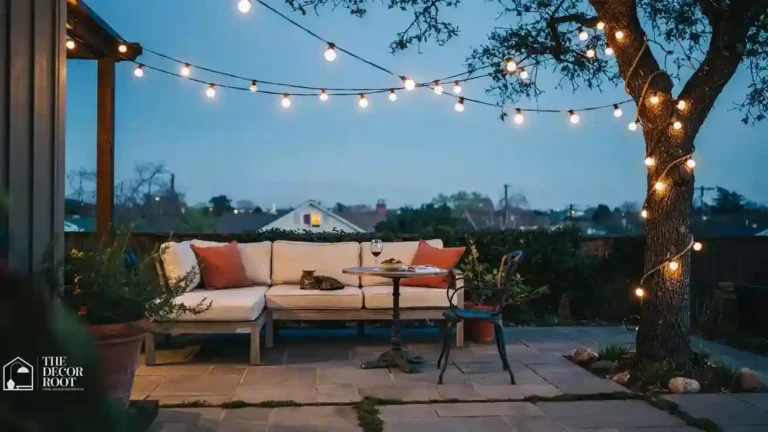
The base is the part of the deck that disappears first at dusk, and a little light is what keeps it finished after dark. Grazing light across slats turns flat skirting into a feature, and a low warm light along the base makes the whole deck read as a designed outdoor room. The trick is to light the skirt itself, not the whole yard, so the light washes the panels, the stone, or the lattice from below and leaves the garden in shadow. One row of fixtures along the base is enough, and warm light suits wood and stone better than cool light ever will.
The lights below are the evening finish, because they screw along the base and charge themselves by day. The lights are a NIORSUN 12 pack of solar step lights in warm white, 13 LEDs each, 3.15 by 2.17 by 3.15 inches in ABS, with auto dusk to dawn switching and IP67 waterproofing, so they turn on at dusk and light the skirt without a single wire. Four to five hours of sun charges them for 8 to 10 hours of light. Screw them along the base at even spacing, let them charge in daylight, and check the pack size on the live listing before ordering.

Also solves this: the base that goes dark at dusk, not the yard that needs floodlights
NIORSUN Solar Step Lights – 12 Pack Warm White Auto On/Off, Waterproof IP67
Solar step lights, 12 pack, warm white 3000K, 13 LEDs, 3.15 x 2.17 x 3.15 inches, ABS, IP67 waterproof, automatic dusk to dawn, model ABE110-A, as printed. Not for: a reader who wants bright floodlights, since these are compact step markers, or a reader who wants wired lights, since these charge by solar panel.
Check Price on Amazon → (paid link)
The outdoor string light thinking behind this section, how one warm glow turns a deck into an evening room, lives in outdoor string light ideas.
Plant the Base: The Living Skirt That Grows In
The living skirt is the one idea that improves every year, because the plants grow into the deck instead of against it. A hedge of boxwood, yew, or holly planted along the base softens the whole perimeter, and low decks under two feet can skip building entirely and let landscaping carry the base, per the Diffsense guide. The live post’s last idea, a boxwood hedge as living skirting, is the slow version of the same fix, and it only asks for the cost of plants and mulch, plus a season of patience. Keep the plants low enough that the deck stays visible, and let the green do the work the boards cannot.
The panels below are the instant version of the living skirt, because they give the hedge look the day they go up. The panels are a DearHouse 12 piece set of 20 by 20 inch artificial boxwood panels, 10.33 square feet in total, in HDPE with UV protection and interlocking connectors, so they cut with scissors and lock together into a green wall that reads as planted. The real hedge can grow behind them while the panels carry the look, so fasten them to the frame and let the green meet the deck, and check the panel count on the live listing before ordering.
Buy in Order: Frame, Panels, Finish, Then Light
The buy order is the part the competitor guides never give, and it is the part that keeps a deck finished at every step. First the four faces, lattice, faux stone, bamboo, and boxwood, because the face is what the street sees and each one covers a different side of the deck. Then the protection layer, hardware cloth, stain, and masonry waterproofer, because the cloth keeps animals out and the stain and waterproofer keep the wood and block dry.
Then the finish layer, solar lights, screws, weed barrier, sealer, and vent covers, because the screws hold the frame, the barrier keeps the ground clean, the sealer holds the color, the vents keep the air moving, and the lights keep the base finished after dark.
The live post’s Quick Action Plan is still the schedule: Day 1, measure the linear footage and the height and set the budget; Day 2, choose the material and order it; Weekend 1, build the 2 by 4 perimeter frame; Weekend 2, install the panels, paint or stain them, and add the landscaping at the base. One order, one frame, and one weekend of building are the whole skirt, and the rest is a matter of keeping the air moving and the color consistent.
Frequently Asked Questions
Q: What is the cheapest deck skirting option?
Ans: Painted concrete, pallets, or wire mesh panels are the cheapest, often under $50 total for a standard deck, per the live post. White lattice panels are the most popular budget option because they combine low cost with a consistently attractive look, and they ventilate without added vents.
Q: Does deck skirting need ventilation?
Ans: Yes, airflow under a deck prevents moisture buildup, mold, and wood rot. Allow about 1 square foot of vent per 150 square feet of underside area. Lattice, slatted, and wire mesh styles ventilate on their own, while solid panels need vent covers set at intervals.
Q: Can I install deck skirting myself?
Ans: Yes, most ideas on this list need only basic tools: a circular saw, a drill, and a tape measure. Lattice panels, horizontal slats, and faux stone veneer panels are beginner-friendly projects that fit a single weekend with no specialized skills.
Q: How do I make budget deck skirting look expensive?
Ans: Frame every panel with clean, painted lumber, since even the cheapest lattice looks custom inside a neat 2 by 4 frame. Use one consistent color throughout, white, black, or charcoal, and add landscaping at the base.
Q: How do I keep animals out from under the deck?
Ans: Bury quarter-inch hardware cloth at least 6 inches deep along the skirt, or dig an L-shaped trench 12 inches deep and run the mesh 12 inches outward underground. Check that nothing is living under the deck first, and fit an access door so you can look again later.
Quick Check Before You Order: Measure the Run, the Height, and the Vent Gap
Budget deck skirting ideas come down to this: hold the three rules, frame a 4 by 8 ft lattice panel first, face the heavy side with faux stone, warm the sunny side with a bamboo roll, plant the base with boxwood panels, bury quarter-inch cloth 6 inches deep, stain and seal the boards in one tone, vent about 1 square foot per 150 square feet, and graze the base with solar lights after dark. One tape measure, one painted frame, and one buy order are the whole skirt, and the rest is a matter of keeping the air moving.
Save these budget deck skirting ideas to your Pinterest board, so your deck keeps its finished base and its curb appeal!
Photos via Pexels. All photos are free to use and sourced from Pexels.